Agentic Commerce: What Happens Behind the Mask of an Agent-Based Sales Channel
Deep technical analysis of autonomous AI agents in e-commerce: from four-plane architecture to A2A protocols and token cost optimization.
The Agent Revolution: From Browsing to Autonomous Transactions
Traditional e-commerce is built on the assumption that there is a human with a mouse on the other side of the screen. Agentic commerce shatters this foundation – here, transactions are executed by autonomous AI agents that negotiate terms, compare offers, and finalize purchases without human intervention. This is not interface evolution; it is a fundamental reconfiguration of the entire technology stack.

Three Interaction Models Define the New Landscape
The agentic commerce ecosystem is crystallizing around three architectures:
- Agent-to-site is a scenario where an autonomous user agent communicates directly with a traditional store – for example, a personal AI assistant buying books on Amazon without opening a browser.
- Agent-to-agent eliminates visual interfaces entirely – the buyer's agent negotiates with the seller's agent through standardized protocols.
- Brokered agent-to-site introduces an intermediary (marketplace, payment platform) that orchestrates the transaction and enforces policy.
The key difference: in each of these models, the product ceases to be a page to view and becomes a resource addressable via API. Product catalogs must exist as machine-readable structures—such as JSON schemas, GraphQL endpoints, and MCP servers—rather than visual grids.
Dual-Surface Architecture: Serving Two Worlds Simultaneously
Stores must now maintain two parallel surfaces. The first is a classic frontend for humans with CSS, animations, and storytelling. The second is a structural layer for agents with clean data: specifications, pricing logic, inventory status, and promotional rules. This is fundamentally different from mobile-first system design logic.
The edge layer is the efficient place to do this. Dodo Payments describes a setup in which a Cloudflare Worker checks the User-Agent header against a list of known AI crawlers (GPTBot, ClaudeBot, PerplexityBot and others) and serves them a Markdown version of each page, pre-built at compile time, instead of HTML[3]. Cloudflare now offers a similar mechanism as a service: an agent sends an Accept: text/markdown header and gets Markdown converted at the edge – on Cloudflare's own example page that cut token usage by about 80%[2]. This is not just optimization; rendering the full visual interface for every agent query makes little economic sense.
Identity and Loyalty: From Humans to Machines
The biggest challenge lies in identity systems. The traditional model assumes: one human = one account = one purchase history. Agentic commerce breaks this assumption. One user can have multiple agents (personal shopper, budget optimizer, sustainability checker, deal hunter, subscription manager). Each agent operates autonomously, but all must share context and loyalty benefits.
This requires redesigning the entire identity layer: hierarchical permission structures, delegated authorization (where the agent acts on behalf of a user under strict limits), and session management across agents to persist context. Current OAuth2 flows are often insufficient, necessitating agent-aware authorization protocols that distinguish between a logged-in user and an agent acting with delegated permissions.
Loyalty programs are another complex area. How are points assigned when a purchase is made by an agent? To the agent's owner? To the agent itself (which may serve multiple users)? What about offer personalization – does one target the human or their shopping agent? CRM systems and recommendation engines designed over the last 20 years assume direct human interaction. All of this needs to be rebuilt from the ground up.
Five Pillars of Agent Architecture: Technical Foundation
A functioning agent system in e-commerce is more than a chatbot with API access. It is a complex architecture that must operate 24/7, handle thousands of concurrent sessions, and avoid hallucinations on high-value transactions.
Durable memory is the foundation without which an agent is no different from a stateless API. It is about maintaining full context between sessions - not just chat history, but shopping preferences, previous decisions, and abandoned carts. In practice, this is often a Redis Cluster with replication or managed services like AWS ElastiCache, where each session has its own namespace. The key difference: it is about state management – the agent must remember why the user rejected a specific laptop model weeks ago.
Event-driven activation means the agent reacts in real-time to business events. A price drop on a monitored product triggers a notification in 200ms. An inventory availability change automatically recalculates alternative delivery options. This is not polling every 5 minutes – it uses Kafka or RabbitMQ with subscriptions to specific event streams. In production, one event (e.g., "user opened app") can trigger parallel processes: purchase intent scoring, personalization refresh, and active promotions checks.
Parallel execution is a necessity, not an option. When a user asks for recommendations under a specific price, the agent must simultaneously: query the product catalog, check availability in multiple warehouses, fetch current prices, verify reviews, and check user history. Running sequentially takes seconds; running in parallel takes milliseconds. Implementation is typically async/await in Node.js or Python's asyncio, with circuit breakers on each external call.
Policy enforcement happens at three boundary levels. An agent may have access to the payment API (tool), but the workflow must verify that the amount does not exceed the limit, and the policy engine checks whether the user has active consent for automatic transactions. All three layers must validate the transaction – if any refuses, the action does not execute. This is a strict compliance requirement, especially under GDPR and PSD2.
Continuous monitoring observes two critical metrics: model drift and system failures. Drift detection checks whether agent responses still make sense – if the number of "I don't understand" responses increases significantly, the input data structure may have changed. System failures are monitored via classic APM (latency, error rate, throughput), supplemented by business metrics: conversion rate per session, average basket value, and refund rate. If an agent suddenly generates transactions but with a high return rate, the system requires debugging even if no technical errors are reported.
These five pillars don't operate in isolation; they form an interconnected system where failure in one area cascades to the others. Lack of durable memory breaks personalization, while poor monitoring misses drift that ruins parallel execution.
Four Traffic Planes: Anatomy of Agent Interaction
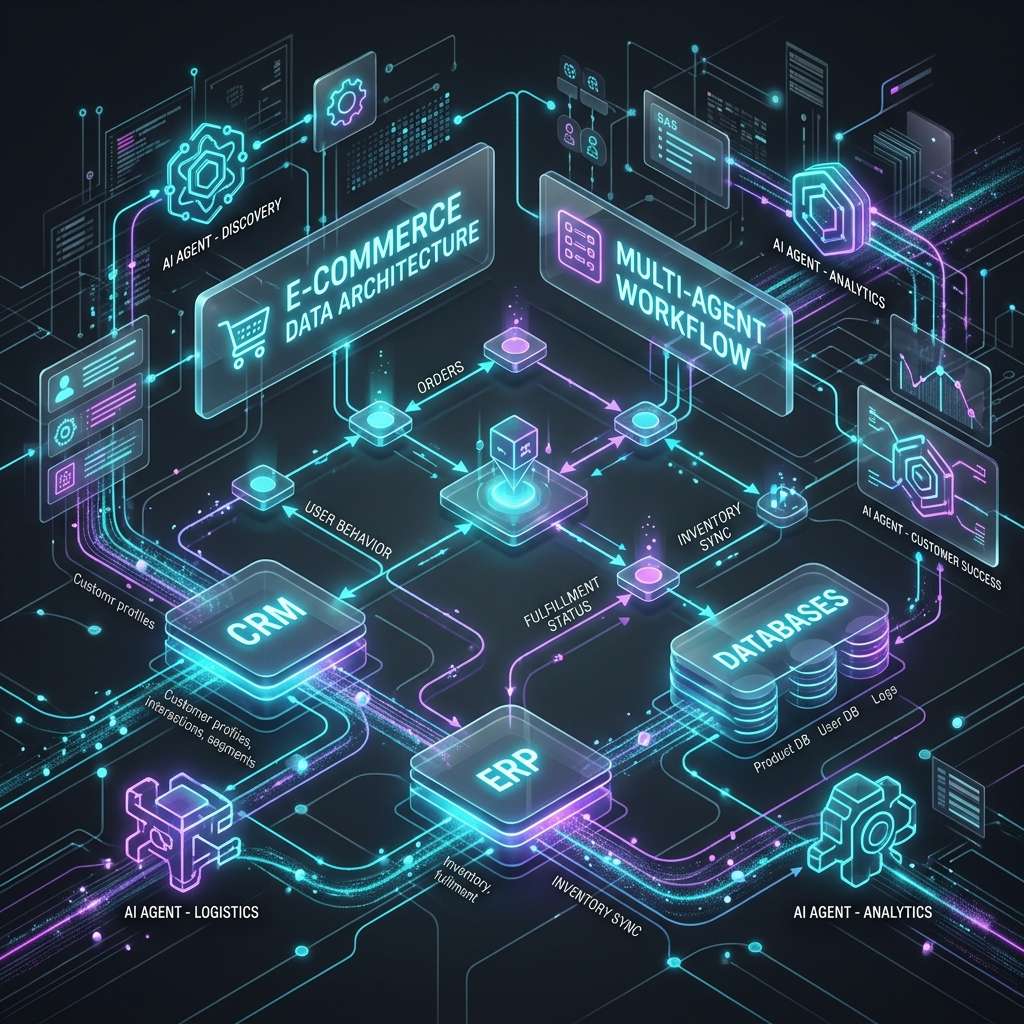
When a customer asks a question in a store with an agent-based sales channel, it launches a precisely orchestrated flow through four parallel system layers. This is a complex choreography where each layer has its specialization.
Experience Plane manages session state and interface. Here the system tracks what the user has already said, which products they've viewed, and what stage of the funnel they are at. This is the contextual memory layer – the agent knows that subsequent modifiers refer to the product in the active session. In practice, this is a distributed session store with TTL, often Redis or similar, that holds context throughout the entire customer journey.
Intelligence Plane interprets intent in natural language. When someone searches for "something waterproof for winter under 500 PLN", the system must understand that this is a query for shoes or jackets with specific technical parameters and budget. The LLM analyzes context, extracts structured parameters (category, price_max, features), and maps them to a catalog query. This is the NLU layer, carrying the greatest risk of hallucinations.
Coordination Plane executes business logic and makes decisions. The agent does not just search for products – it checks warehouse availability, calculates delivery costs, verifies promotions, and negotiates terms for bulk orders. This is where workflow engines and orchestrators like Temporal or Conductor operate, managing long-running processes (e.g., reservation → payment → fulfillment).
Operational Plane logs every action for compliance and audit. Every API call, every agent decision, and every state change is recorded in an immutable audit log. This is a regulatory necessity. When an agent makes a mistake or a customer disputes a transaction, a full trace must be available: who, when, why, and based on what data.
Three-level authorization enforcement is a key security mechanism. An agent must pass through three checkpoints before executing an action:
- Tool level: does it have access to this API?
- Workflow level: can it perform this action in this business context?
- Policy engine: does it violate governance rules?
Only when all three validate the action does it execute. This is managed via RBAC at the API gateway level, business rules in the orchestrator, and a central policy engine like Open Policy Agent. Without this, an agent could theoretically offer unauthorized discounts or disclose sensitive data.
Dual-Surface Architecture: Catalog as System Core
Traditional e-commerce was designed for human eyes – beautiful photos, readable typography, and intuitive layouts. Agentic commerce requires a dual-surface architecture, where the product catalog operates in parallel as a visual interface for humans and a structured dataset for machines.
The core is the catalog as an addressable resource. Every product specification, price, availability level, or promotional condition must exist as an independent resource accessible via API – not as an HTML fragment rendered by JavaScript. This represents a shift from "product page" to "product endpoint", where an agent can query specific inventory levels in milliseconds without parsing megabytes of HTML.
Machine-readable endpoints become the new sales surface. Serving agents Markdown or JSON instead of a full visual page cut token usage by roughly 80–96% in published examples[2][4], which makes it an architectural necessity rather than a nice-to-have.
Protocols standardizing this layout are emerging:
- Model Context Protocol (MCP) from Anthropic gives agents a standard way to connect to tools and data sources[6].
- Agent-to-Agent Protocol (A2A) enables direct negotiations between autonomous systems.
- Agent Payments Protocol (AP2) from Google and Agentic Commerce Protocol (ACP) from Stripe and OpenAI close the transactional loop[1][5].
GEO (Generative Engine Optimization) replaces traditional SEO. Instead of optimizing for search engine ranking algorithms, optimization targets how LLMs consume and synthesize information. This means structured product data, clear attributes in JSON-LD format, and factual content. Amazon Rufus does not read meta descriptions – it reads structured product attributes and customer reviews in a format the model understands natively[7].
Server-Side Rendering is a mandatory baseline. If a catalog requires client-side JavaScript execution to display prices or availability, it remains invisible to automated agents. SSR guarantees that the server generates complete HTML before sending, giving agents ready-to-parse content without running a client-side JavaScript engine.
Dynamic path protection is the second layer of infrastructure defense. Access is granted to static product detail pages, but costly dynamic paths (such as internal search engines, cart operations, or dynamic pricing APIs) are blocked or rate-limited. Without this, inefficient agents can exhaust the entire compute budget in an hour by querying every filter combination.
Edge Optimization and Token Cost Reduction: What the Case Studies Show
Dodo Payments documented an edge architecture that reduces the cost of serving agent traffic. A Cloudflare Worker intercepts every request, compares the User-Agent against 17 known AI crawlers, and sends bots a pre-built Markdown version of the page instead of HTML with JavaScript[3]. Interestingly, the team first tried server-side rendering for bots and dropped it, because it added 200–400 ms of latency per request and the HTML was still cluttered with navigation and styling noise[3]. Gcore reports that a blog post weighing about 110,000 tokens as HTML shrank to about 4,400 tokens as Markdown – a 96% reduction[4].
This is a major optimization. A traditional product page is 150-300 KB of HTML + CSS + JS that the agent must process into tokens. Markdown with clean product data is 5-10 KB. The difference in inference costs is significant, especially with thousands of daily requests from agents crawling the catalog.
Server-Side Rendering has become the de facto standard for agent readiness. The agent gets complete HTML without needing to execute JavaScript. SPAs with client-side rendering are highly inefficient for agents, requiring headless browser rendering and hydration, wasting execution time and tokens. SSR delivers ready content immediately.
A complementary practice is dynamic path protection – selective access control at the routing level. Static product detail pages are open to agents, while dynamic search endpoints, cart operations, and real-time pricing are blocked or rate-limited. This prevents agents from querying expensive APIs in loops, protecting compute budgets and telemetry data.
The CDN layer works with aggressive caching and stale-while-revalidate. An agent gets a cached version of product data, even if it is slightly stale, while the edge asynchronously revalidates the content. For most research and comparison use cases, short-term stale data is acceptable. For critical paths like checkout, fresh data is fetched directly from the origin server.
This architecture serves as a blueprint for e-commerce platforms adopting the agentic channel. Agents cannot be treated as regular users with a different user-agent header. They represent a distinct traffic pattern: higher request volumes, zero tolerance for bloated payloads, and sensitivity to latency and token costs. Edge optimization is a requirement for the economic viability of the entire channel.
Implementations in Practice: From Amazon Rufus to Middleware Architecture
The market is divided into three implementation models: retailer-native agents, platform-embedded assistants, and third-party agent frameworks. Each has different architectural and infrastructure implications.
Amazon Rufus is an example of a closed retailer-native ecosystem. The agent operates exclusively within the Amazon platform – users research, compare, and buy without leaving the system[7]. This model is convenient for the retailer (full control over data and experience), but locked-in for the user, preventing cross-platform comparisons by external agents.
Stripe went a different route: instead of building its own shopping agent, it co-developed the open Agentic Commerce Protocol (ACP) with OpenAI. ACP powers Instant Checkout in ChatGPT and lets merchants sell through AI agents while keeping control over their products, branding, and fulfillment[1]. It's a practical example of a protocol layer sitting between the merchant and any agent.
Server-Side Rendering has become the de facto standard for agent readiness. Major e-commerce platform providers recommend SSR as the baseline – the server generates complete HTML before sending, so agents get complete, ready-to-parse content without needing to execute JavaScript.
Equally important is dynamic path protection. Systems are configured to let agents into high-value static content (product cards, specifications), but block access to expensive dynamic paths – internal search engines, add-to-cart actions, dynamic pricing APIs. Without this, infrastructure burns on empty compute cycles.
Identity management requires a complete re-architecture. Traditional IAM systems assume human identity – sessions, cookies, and OAuth flows for people. Agentic commerce needs agent identities: persistent, verifiable identities for autonomous systems. This is the foundation of the trust layer, without which retailers cannot permit agents to execute transactions. Middleware must consolidate data sources (inventory, pricing, promotions) and manage traffic between agents and backends, enforcing policy at every boundary.
Agent Readiness Checklist: Practical Implementation Guide
Before allowing agents to navigate a store, seven critical checkpoints must be evaluated to transition from a proof-of-concept to a production-ready system.
Point 1: Rendering Infrastructure Audit
The foundation starts with the HTML generation architecture. Server-Side Rendering is a strict requirement to return complete, parseable documents. Client-side JavaScript dependency results in empty page skeletons for agents. Edge routing should detect headers and serve data-only templates, which cut token usage by 80–96% in published examples[2][4].
Point 2: Routing and Agent Traffic Detection
Implement middleware that classifies requests in real-time. Not all paths should be accessible to agents – product detail pages are open, but dynamic search results or cart operations are blocked. Define a whitelist of static resources and a blacklist of expensive endpoints to prevent compute budget depletion from aggressive crawlers.
Point 3: Catalog Structuring for Machine Reasoning
The product catalog must exist as an addressable resource, not just as rendered HTML. Every SKU needs JSON-LD markup with Schema.org vocabulary (Product, Offer, AggregateRating). Add machine-readable specifications: dimensions, materials, and compatibility matrices. This is a data layer that the agent will parse without interpreting the visual layout.
Point 4: Three-Level Authorization
Policy enforcement must work at three levels simultaneously:
- Tool level: is the API endpoint allowed?
- Workflow level: does the sequence of actions make business sense?
- Policy engine: do governance rules allow this operation?
All three checkpoints must validate the action before execution.
Point 5: Observability and Cost Tracking
Maintain a dedicated dashboard for agent interactions. Track: number of agent sessions, average conversation length, token consumption per session, conversion rate agent vs human, and failed requests with error codes. These signals show where agents encounter issues or where token budgets are being depleted. Set alerts on anomalies in token usage.
Point 6: Identity System Extension
User management must handle agent identities. An agent is not a user but represents a user. Implement a delegation model where the user delegates permissions to the agent, and the agent acts on behalf of the user with a defined scope. This requires extending OAuth flows, session management, and audit logs. Every agent action must be traceable to a specific user and delegation event.
Point 7: Integration Protocols – Adoption Roadmap
Start with implementing Model Context Protocol (MCP) to share context and tools with agents[6]. Next, prepare for Agent-to-Agent Protocol (A2A) for direct transactions between agents. Agentic Commerce Protocol (ACP) is the long-term goal for standardizing the entire shopping flow[1]. While full protocol support can be adopted incrementally, the underlying architecture must support these standards without core rewrites.
P.S. If you're building agentic workflows or managing e-commerce API layers, using a modern editor can significantly speed up your development. You can check out Cursor, which is an excellent AI-powered code editor for these tasks.
References
- Stripe powers Instant Checkout in ChatGPT and releases Agentic Commerce Protocol – Stripe (September 29, 2025)
- Introducing Markdown for Agents – Cloudflare Blog (February 12, 2026)
- How We Serve Markdown to AI Agents at the Edge – Dodo Payments Engineering (April 17, 2026)
- FastEdge Markdown Transformation – Gcore
- Announcing Agent Payments Protocol (AP2) – Google Cloud Blog
- Model Context Protocol – official documentation
- Amazon Rufus – About Amazon
Comments
Comments are powered by Cusdis. The widget only loads after you click.