Agentic RAG in E-commerce: When a Simple Chatbot Isn't Enough
Just a few months ago, implementing a RAG (Retrieval-Augmented Generation) system in an online store was considered the pinnacle of innovation. It allowed a language model to be fed with proprietary product data, bypassing the problems of hallucination and lack of up-to-date knowledge in foundational models. However, from the perspective of a practitioner building SaaS solutions for specialized retail, it quickly becomes apparent that traditional RAG has distinct limitations.
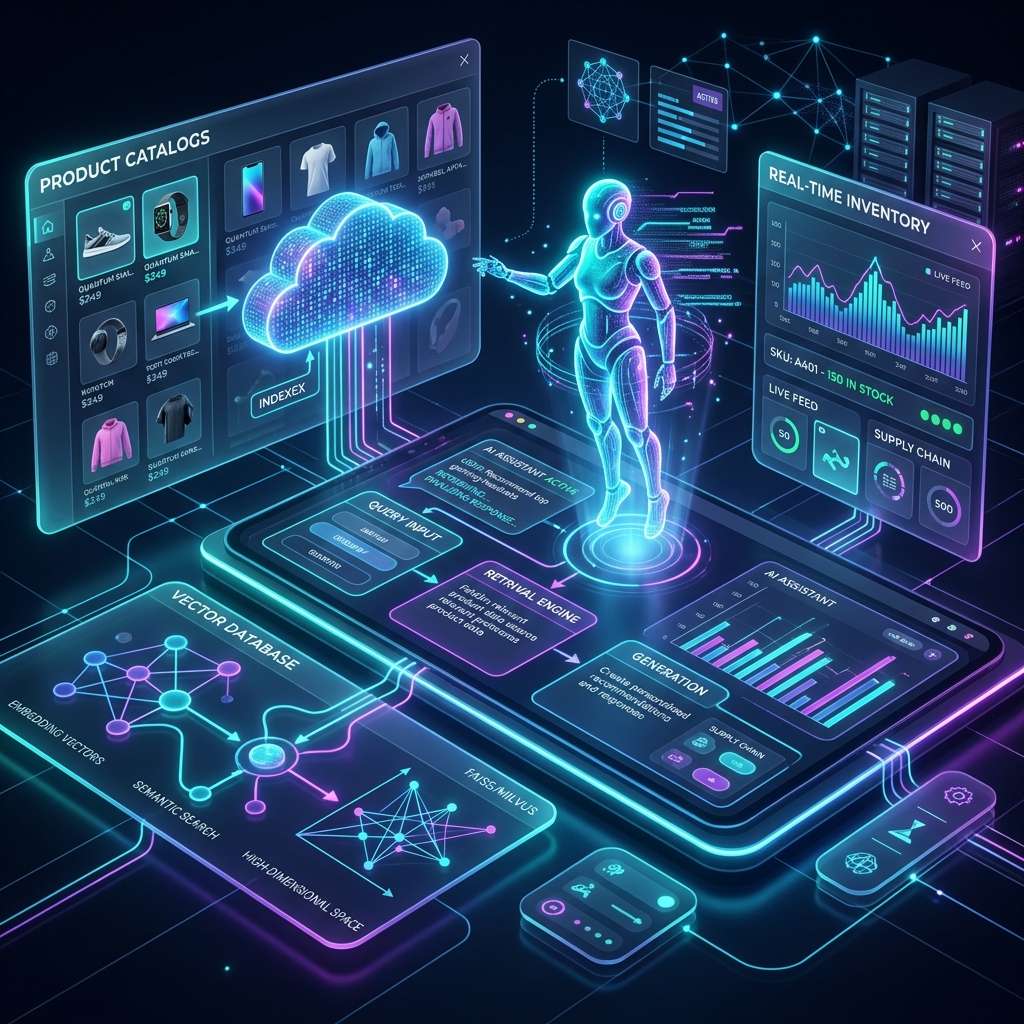
When we enter niches that require expert knowledge—such as advanced marine aquaristics, specialized gardening, or electronics—customers rarely ask simple questions like "What is the price of product X?". Their purchasing paths are multifaceted, and their questions are conditional. They require not only finding the right piece of text in the documentation but, above all, logic, deduction, and checking the current state of reality (e.g., inventory levels). This is where Agentic RAG and Multi-Agent Systems step onto the stage.
What is Agentic RAG and Why is it a Paradigm Shift?
Classic RAG operates linearly: the user asks a question -> the system converts it into a vector -> searches for similar vectors in a database -> pastes the found fragments into the prompt -> the LLM generates an answer.
The problem is that if the query is: "I'm looking for a return pump for a 500-liter aquarium, but it has to be quieter than my current brand X model, and I want to know if you have it in stock because I'm in a hurry," standard RAG will lose half of the context. It might find a pump, but it won't compare noise levels (because that requires an analytical operation across two different documents), and it certainly won't check the warehouse inventory.
Agentic RAG (Agentic Architecture) is an approach where the language model is not just a text generator, but a reasoning engine that can plan tasks and use external tools (Tool Use / Function Calling).
In an agentic architecture, a customer's query triggers a decision-making process:
- Understanding the intent and breaking down a complex question into subtasks.
- Deciding which tools to use (searching the vector database, calling an API to the ERP system, using a calculator to convert performance metrics).
- Executing actions, gathering results, and verifying if the answer is complete.
- Potential correction and iterative searching (iterative refinement of the response).
From a Simple Vector to a Swarm of Experts (Multi-Agent Systems)
Deploying advanced intelligent sales assistants shows that forcing one "large" agent to handle the entire process can be suboptimal. It is prone to losing instructions, generates long wait times (latency), and consumes massive amounts of tokens.
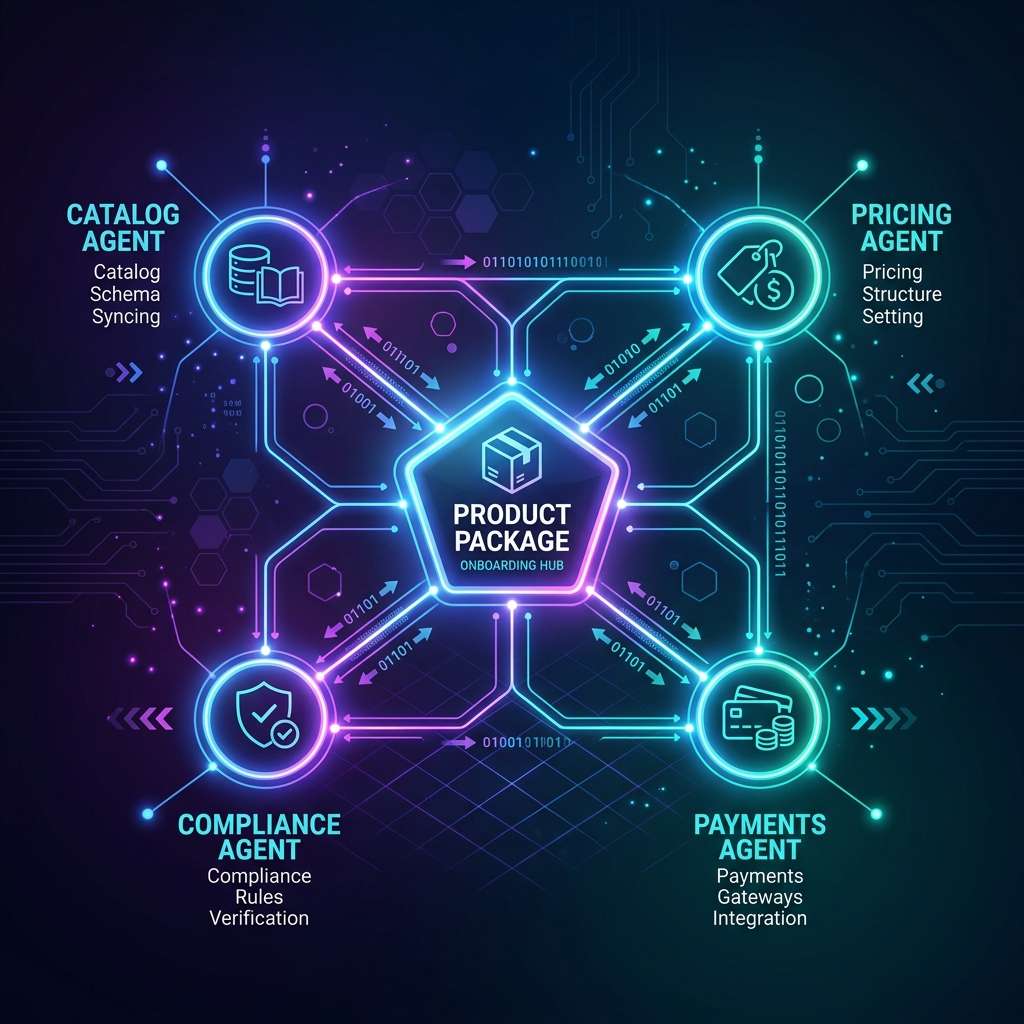
The solution currently gaining traction is Multi-Agent systems, built using tools like LangGraph or CrewAI. Instead of one monolithic prompt, we create a swarm of specialized, smaller agents, each with its own narrow domain of expertise.
Let's imagine the architecture of an intelligent sales assistant in a pet store:
- Router Agent (Receptionist): The first line of defense. It analyzes the query and decides where to route it. If it's a casual chat, it answers immediately. If it's a technical issue, it passes the case along.
- Product Expert Agent: Has access to the vector database with full hardware specifications. It can compare parameters (e.g., light spectrums in LED lamps).
- Inventory & ERP Agent: An agent with exclusive rights to call the APIs of warehouse systems (e.g., Subiekt, Baselinker). It doesn't need to understand water chemistry; its job is to take a query in JSON format (e.g.,
{"product_sku": "12345"}), query an SQL database or REST API, and return the current stock and price. - Synthesizer Agent: Receives raw data from the other agents and drafts a fluent, natural response in the brand's tone of voice, aimed at closing the sale and potential cross-selling (e.g., suggesting appropriate plumbing fittings for the selected pump).
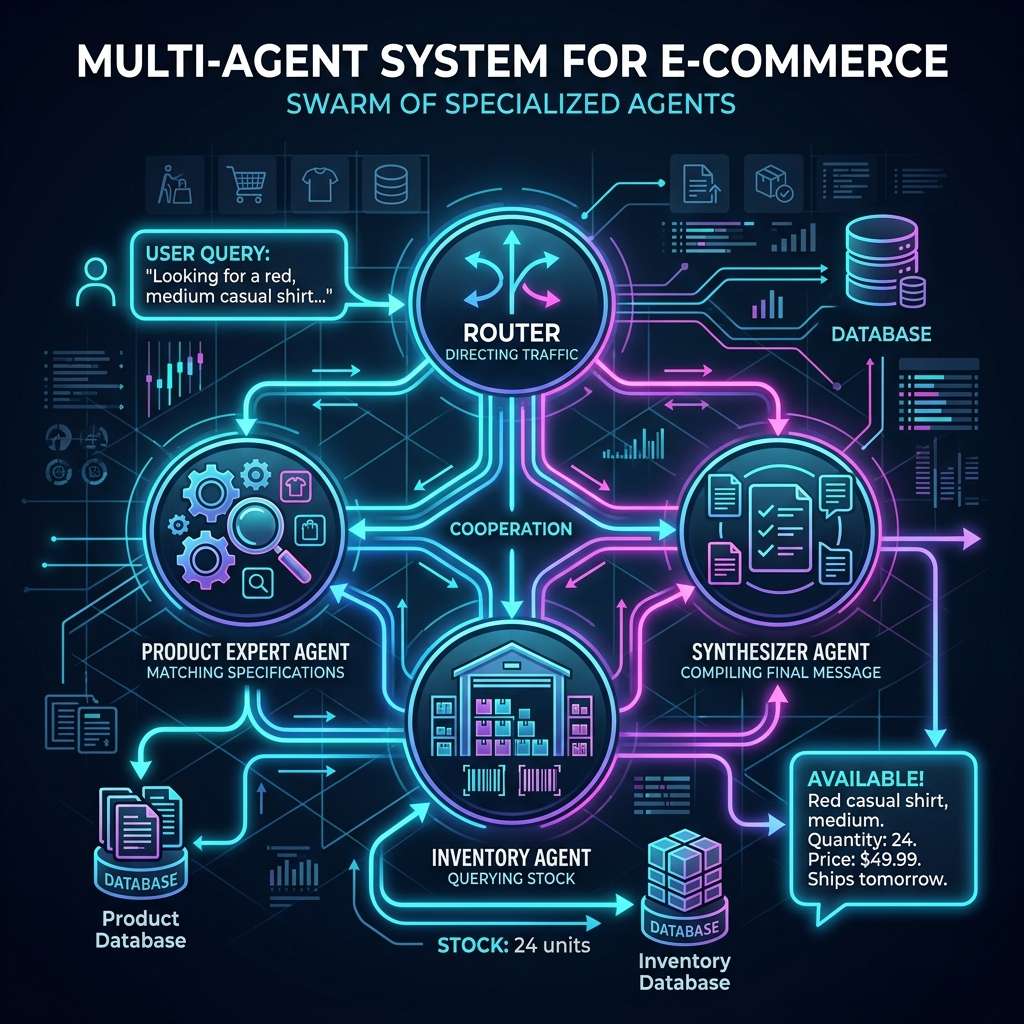
Separating roles like this allows for the use of smaller, cheaper, and faster models (like gpt-4o-mini or Llama 3) for specific, simple tasks, reserving heavy, expensive models only for the Chief Planner. This is the key to cost optimization in SaaS models.
Real Business Value for E-commerce
Moving from theory to practice—why does e-commerce, especially niche e-commerce, need this technology so badly?
- Automating Expert Advice: Specialty stores struggle with the bottleneck of expert time. Owners spend hours on the phone explaining product differences to customers. An assistant based on Agentic RAG can take over up to 70% of repetitive, albeit technically advanced, inquiries, operating 24/7.
- Integration with Hard Data in Real-Time: A standard chatbot operates on exported CSV files (product feeds), which quickly become outdated. An agent with access to API tools verifies stock levels on the fly, preventing customer frustration from being recommended a product that sold out an hour ago.
- Proactive Logic-Based Cross-Selling: If a customer is buying an advanced filtration system, Agentic RAG "knows" (thanks to access to business rules defined as a tool) that they also need specific filter media or startup chemicals. It can generate a complementary cart much more accurately than simple "others also bought" algorithms.
Implementation Challenges: What Can Go Wrong?
Of course, agentic systems are not a magic cure without flaws. In daily engineering work, we encounter several hard barriers that must be considered when designing SaaS architecture.
-
Latency Multi-Agent systems require multiple calls to underlying language models. Before the user sees an answer, 5-6 API requests might be executed in the background. This takes time. The solution is to use streaming (displaying the answer chunk by chunk) and informing the user about the ongoing process (e.g., "Checking warehouse stock...").
-
Robustness of Function Calling Even the best models sometimes hallucinate when generating arguments for tools (e.g., passing incorrect date formats to an API). It is necessary to build defense layers (fallback mechanisms)—intermediary Python scripts (e.g., in FastAPI) that verify structural correctness before hitting the store's database.
-
Infinite Loops A poorly designed agent, faced with an API error, can try to call the same tool endlessly. It is crucial to impose strict step limits (max_iterations) and clearly defined termination conditions for the workflow (Graph termination nodes).
Practical Implementation Checklist (Lessons Learned)
If you are planning to deploy an intelligent sales assistant based on Agentic RAG, here is a list of things to keep in mind at the start:
- Organize Source Data (Garbage In, Garbage Out): Before introducing agents, ensure that product descriptions and documentation do not contradict each other. No LLM will fix a mess in your PIM (Product Information Management) system.
- Start with One Tool Agent: Don't build a complex swarm right away. Create a simple RAG bot, give it only one tool (e.g.,
check_stock_level), and push its effectiveness to 99% in that narrow scope. - Track Costs and Tokens: Use LLM observability tools (like LangSmith or custom logging solutions) to monitor how many tokens a single conversation consumes. Optimize the system prompts of your agents—they are often unnecessarily bloated.
- Secure the API (Read-Only by Default): Agents should not be able to directly modify the database without authorization. Provide read-only (GET) endpoints, and implement modifying actions (like adding to a cart) by returning secure links or forms to the user.
Conclusion
The transition from traditional RAG to Agentic RAG systems is a natural but necessary evolutionary step in building a modern, tech-driven e-commerce business. Assistants are ceasing to be just talking search engines and are becoming proactive, integrated advisors who genuinely offload store staff and boost conversions.
This complex environment requires solid reverse engineering and a robust backend architecture, but the business value derived from shortening customer service time and providing precise support for high-margin niche products pays off handsomely.
Further reading
- Andrew Ng – How Agents Can Improve LLM Performance (agentic design patterns), The Batch – DeepLearning.AI (2024)
- LangGraph – Multi-agent systems (documentation)
- LlamaIndex – Building agents (documentation)
- Pinecone – Retrieval-Augmented Generation (RAG)
- McKinsey & Company – The economic potential of generative AI: The next productivity frontier (2023)
Comments
Comments are powered by Cusdis. The widget only loads after you click.