Autonomous AI Agents in E-commerce and SaaS 2026: Data Architecture, Business Models, and Implementation
2025 was the year of "copilots" and intelligent assistants designed to support our daily workflows. Now, in 2026, we are observing a profound, structural shift in the architecture of enterprise software. We are definitively transitioning from artificial intelligence that merely assists human workers to fully autonomous Multi-Agent Systems that successfully replace entire operational units. Software has stopped settling for a supportive role—it has begun to function and behave like independent structural divisions within a company.
As a practitioner who designs digital architecture and business automation processes daily, I notice a growing chasm between marketing hyper-optimism and ruthless technological reality. True value is rarely generated during the selection of the latest Large Language Model (LLM). Far more often, it is the underlying data infrastructure, the elasticity of software business models, and the clever acquisition of funding that dictate the market survival of modern enterprises.
The Twilight of the "Per-Seat" Model and Redefining SaaS Economics
For nearly two decades, the undeniable standard in the Software as a Service (SaaS) industry has been seat-based licensing. The logic from the vendor's perspective was simple and predictable: the more employees in your organization requiring access to a CRM or ERP system, the higher the generated revenue.
With the dawn of the agentic era, this foundational principle crumbles. If a fully Autonomous Finance Stack can independently manage invoicing, forecast liquidity gaps, and optimize liabilities on its own, it effectively eliminates the need to maintain a dozen separate accounts for financial analysts. The industry is rapidly adapting to this new reality. We are witnessing a widespread shift towards complex, hybrid models that blend payments for direct computational resource consumption (usage-based) with pricing rooted in measurable operational outcomes (outcome-based pricing). This generates new layers of complexity in both deployment and budgeting of business systems, forcing the adoption of advanced telemetry.
Agentic Commerce: Purpose-Built Systems in Digital Retail
The e-commerce sector has always rewarded extreme speed. Today, AI agents act as the central operational core of modern online stores. According to a Clutch survey from January 2026, 65% of consumers already use AI to research products before buying, and Morgan Stanley, cited by commercetools, expects nearly half of online shoppers to use AI shopping agents by 2030. This compels merchants to migrate their resources from traditional SEO towards machine-readable data formatting—Answer Engine Optimization (AEO).
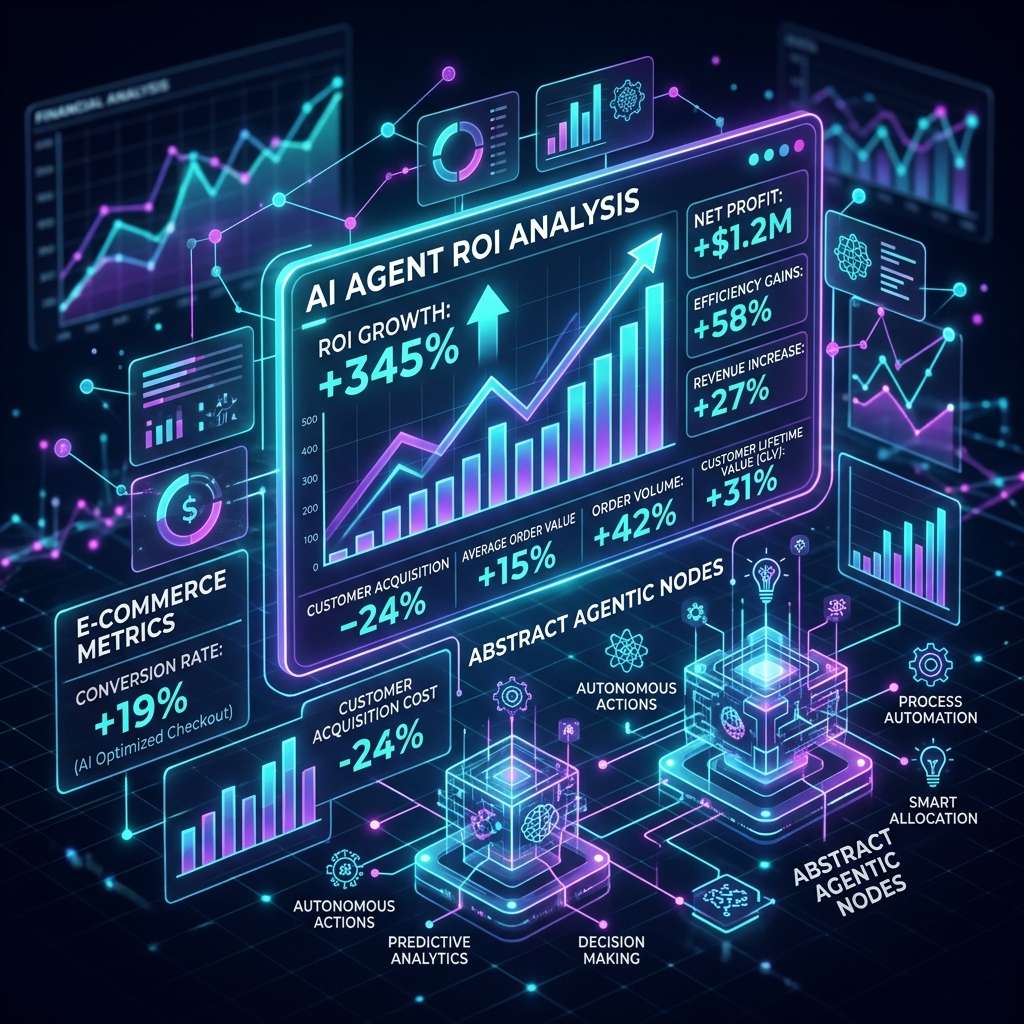
Enterprises are shifting away from fantasies regarding global, conscious super-systems (A2A), focusing instead on highly targeted deployments that yield rapid Returns on Investment (ROI). Personalization agents, continuously analyzing the behavioral vectors of every shopper on the site, can raise Average Order Value (AOV). Meanwhile, customer support algorithms handle the vast majority of repetitive tickets (checking statuses, enforcing return policies), significantly reducing operational support costs. Dynamic, real-time pricing adjustments help protect gross margins and inventory profitability.
The Three-Layer Architecture: Why Do Business AI Models "Lie"?
The general infatuation with the eloquence of modern LLMs masks the primary cause of corporate failures: when you deploy an analytics system, ask it for the net profitability after deducting Cost of Goods Sold (COGS) and returns, and it confidently presents a fabricated number, it is usually not the AI's fault. The catastrophe originates from structural errors in the underlying data layer.
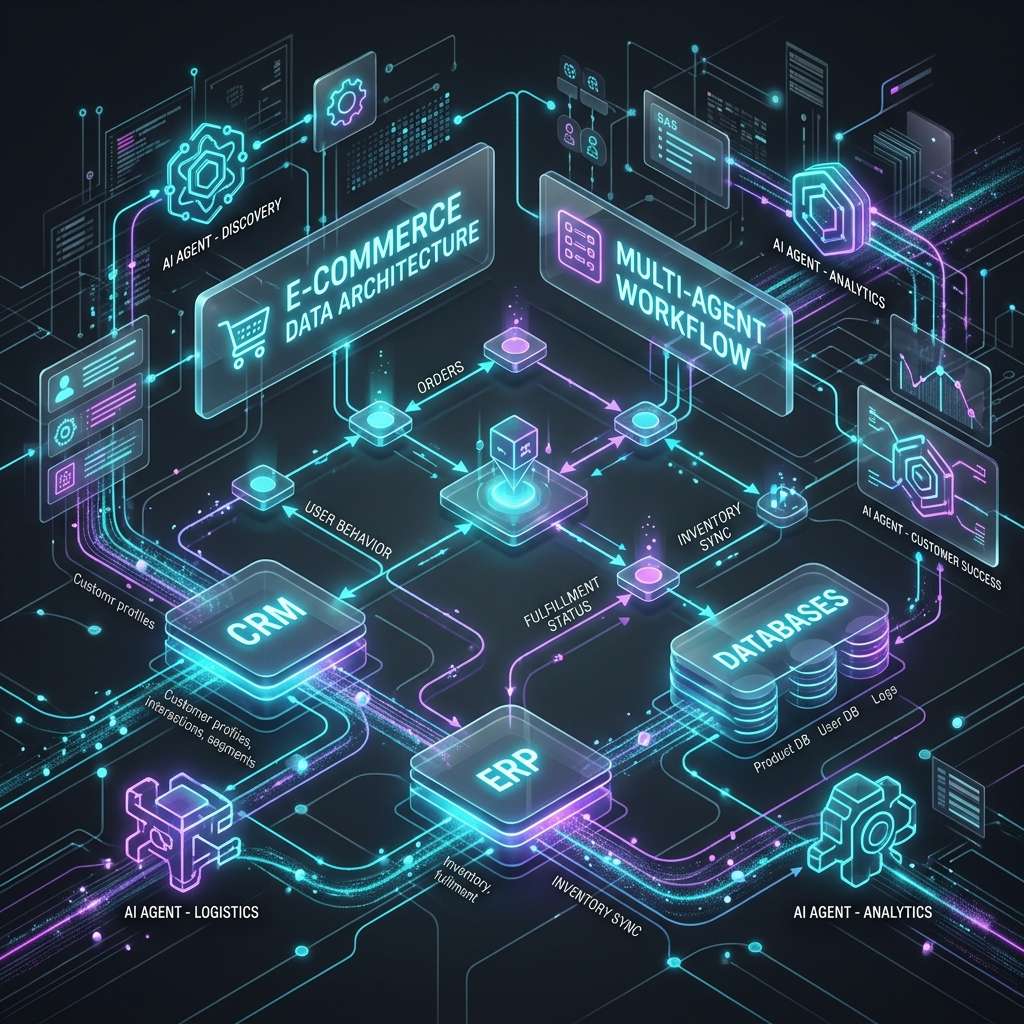
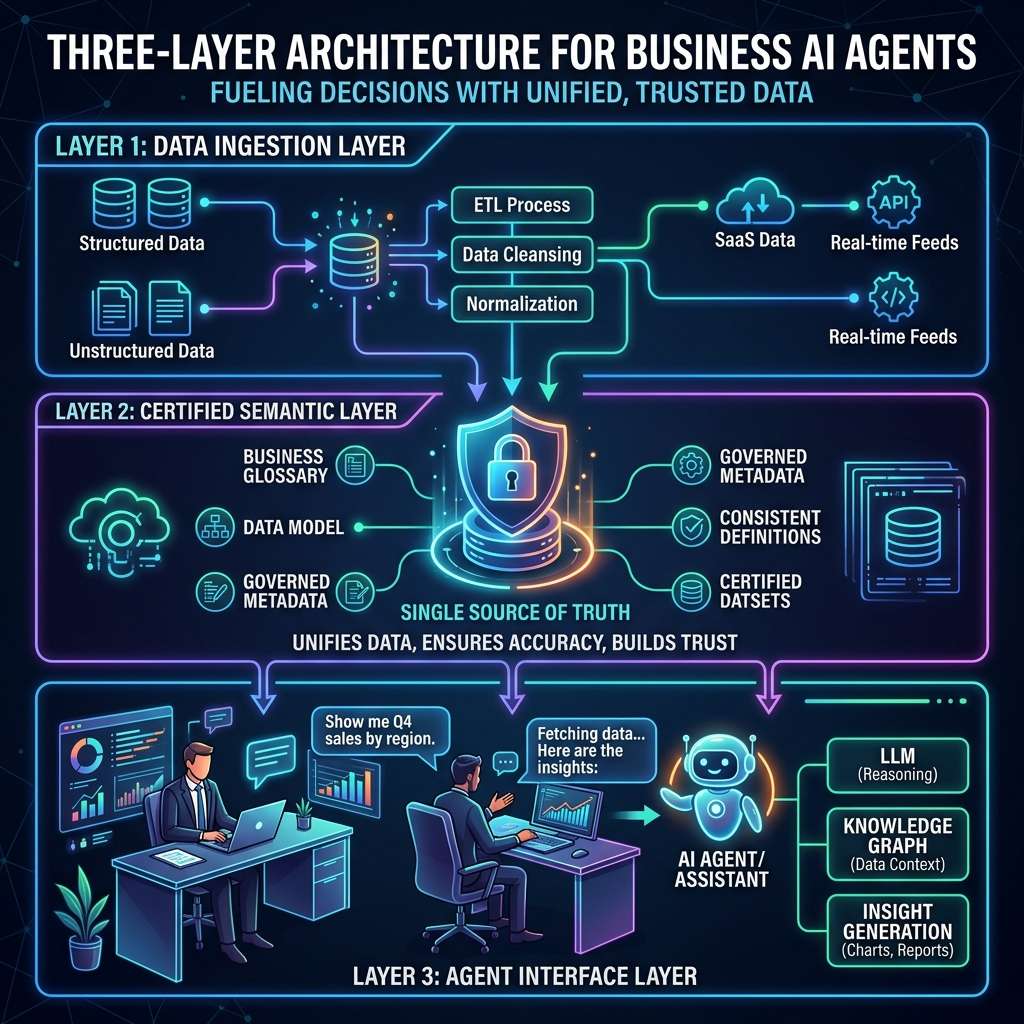
To ensure a system is trustworthy enough to handle critical decisions, companies are massively implementing the Three-Layer Architecture:
- Data Ingestion Layer: This must interconnect absolutely all operational tools. Omitting even a single 3PL logistics system or external ad platform ensures the agent operates blindly, forcing it to hallucinate conclusions to fill knowledge gaps.
- Certified Semantic Layer: This is an absolutely critical component. It serves as the "single source of truth" where hard business rules are unambiguously defined. The mathematical definition of a revenue metric or the multi-touch attribution logic must be locked down securely so the model cannot override them with its own creative assumptions.
- Agent Interface Layer: The final front-end interface queried by an analyst communicates solely with the certified semantic layer. It is never directly connected to raw, unorganized relational database tables. This architecture establishes secure failure mechanisms (safe failure settings), stopping the agent from producing false insights just for the sake of giving an answer.
SME Digitalization: The Funding Window via Measure 2.4
Building an organized data warehouse, deploying PIM/ERP solutions, and training an operational team involves immense capital outlay. Many regional SME leaders sideline these tasks due to financial constraints, risking massive marginalization when confronted by automated corporate giants.
Fortunately, for entities located in regions such as the Lubelskie Voivodeship in Poland, an unprecedented lifeline has been launched—the operational program under Measure 2.4 Digitalization of Lubelskie SMEs. This targeted structural fund offers a maximum co-financing rate of up to 70% of total eligible expenses. Such a profound financial shield drastically shortens the amortization period for costly IT projects, eliminating the barriers to entry for top-tier technology typically reserved for massive corporations and venture-backed startups.
Practical Deployment Checklist
Before you get swept away by the capabilities of new tools, adopt a cold, strategic approach:
- Foundations over Models: Begin the project with an exhaustive audit of your data infrastructure and architecture. No agent in the world can compensate for a messy ingestion and semantic certification layer.
- Focus on Volume: An iterative approach works best. Instead of building a sophisticated negotiation assistant for a highly nuanced niche market, start by automating boring, repetitive back-office tasks like answering "Where Is My Order" (WISMO) queries.
- Review Software Costs: Gather your current SaaS licensing agreements. Look for tools offering migration paths from per-user subscriptions to consumption-based systems.
- Apply for Grants: Do not squander opportunities provided by mechanisms like European Funds (e.g., Measure 2.4). These funding windows will not remain open indefinitely.
Conclusion
2026 spells the end of playing around with AI. Today, autonomous systems are defending margins and ensuring market survival in environments dominated by price pressure. Integrating deep knowledge of data engineering, comprehending new monetization methods, and agile sourcing of external funding create a ruthless recipe for maintaining a competitive edge in this technological decade.
Sources:
- Clutch Report: 65% of Consumers Use AI to Research Products Before Making a Purchase – Business Wire (January 22, 2026)
- AI trends shaping agentic commerce in 2026 – commercetools
- AI tools for ecommerce – Saras Analytics
- Technology, Media & Telecommunications Predictions 2026 – Deloitte
- Ministry of Funds and Regional Policy / Lubelskie Voivodeship – Measure 2.4 "Digitalization of Lubelskie SMEs" (FELU 2021–2027)
Comments
Comments are powered by Cusdis. The widget only loads after you click.