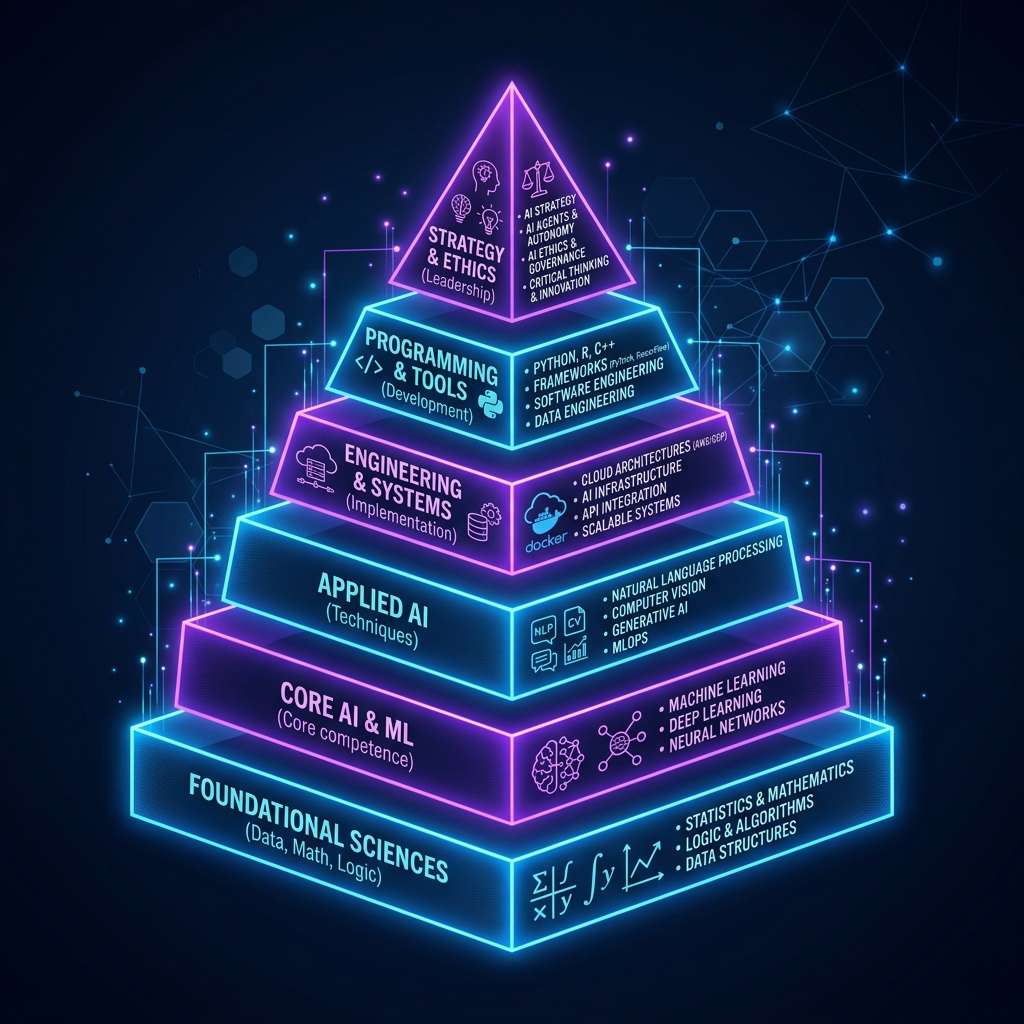
AI Business Roles 2026: Career Maps in the Digital Age
By April 2026, the talent landscape in technology and business has undergone radical transformation. It's no longer sufficient to have "an ML Engineer" or "a Data Scientist." Modern enterprises now seek specialists with precisely defined roles that blend deep technical knowledge with business acumen, ethical judgment, and strategic thinking. McKinsey Global Institute reports that demand for AI fluency in US job postings grew sevenfold in two years, faster than any other skill[1].

This article maps real positions that exist in organizations as of Q2 2026, required competencies, and the future trajectory of these roles.
1. Chief AI Officer (CAIO) – The Strategic Leader
Role Definition
The Chief AI Officer is a C-suite position responsible for enterprise-wide AI strategy. By 2026, when AI became an operational layer of business itself, more and more large organizations appoint a dedicated executive to own it.
Responsibilities
- Defining AI-first business strategy
- Overseeing ethical AI frameworks and governance
- Managing risks associated with hallucinations and algorithmic bias
- Integrating multi-agent systems into core business processes
- Building organizational cultures capable of working with autonomous agents
- Negotiating access to GPU resources and computational capacity
- Compliance with evolving AI regulations (EU AI Act, national mandates)
Required Competencies
- Deep understanding of capabilities and limitations of frontier LLMs
- Experience leading organizational transformation
- Knowledge of compliance, AI regulations, and risk management
- Ability to communicate between technical teams and C-suite executives
- Strategic ROI thinking for AI investments
- Background in technology, finance, or operations
2. Prompt Engineer / AI Director – The Digital Orchestrator
Role Definition
Prompt Engineering has evolved from simple "instruction writing" to a role comparable to a film director. By 2026, a Prompt Engineer:
- Understands capabilities of competing models (Claude, GPT-5, Gemini)
- Designs workflows for multi-agent systems
- Creates instructions enabling agents to act autonomously with minimal supervision
Emerging Specialization: "Agentic Architect"
Due to the dominance of multi-agent systems in Q2 2026, a new specialization emerged:
Agentic Architect – a professional who:
- Designs orchestration between multiple AI agents
- Defines knowledge graphs for reliability and factuality
- Creates failsafe mechanisms when agents behave unexpectedly
- Integrates agents with legacy systems (CRM, ERP, HR platforms)
Agentic Architect Responsibilities
- Mapping business processes for agentic automation potential
- Building knowledge graphs (still largely manual work)
- Creating "personas" for agents (e.g., a sales agent that understands company culture)
- Testing agents in edge cases and failure scenarios
- Monitoring "agent drift"—when agents deviate from intended goals
- Setting up audit trails and explainability mechanisms
Required Competencies
- Advanced prompting knowledge (chain-of-thought, few-shot learning, tool use)
- Systems thinking and process design
- Knowledge graphs and data structure expertise
- Experience with agentic frameworks (AutoGen, CrewAI, LangChain)
- Testing and debugging AI systems at scale
- Understanding of emergent agent behaviors
3. AI Governance & Ethics Officer
Role Definition
With EU AI Act obligations phasing in and initiatives like Anthropic's Project Glasswing[3] showing how capable frontier models have become, mid-sized and large organizations increasingly need someone responsible for AI safety and ethics. This role combines legal, technical, and philosophical perspectives.
Responsibilities
- Auditing AI models for bias and discrimination
- Ensuring compliance with regulations (GDPR, AI Act, national frameworks)
- Managing risks from adversarial attacks and model vulnerabilities
- Creating documentation (model cards, data sheets, system prompts)
- Monitoring hallucinations in critical systems (finance, healthcare, legal)
- Interfacing with regulatory bodies
- Building "explainable AI" (XAI) processes
- Establishing ethical guardrails for agent behavior
Required Competencies
- Knowledge of AI regulations (especially EU AI Act)
- Ability to read and interpret technical papers on AI bias
- Compliance and regulatory affairs background
- Basic understanding of how models work (PhD not required)
- Communication skills for non-technical stakeholders
- Interest in applied ethics
4. Machine Learning Engineer – Evolution and Specialization
Changes from 2024 to 2026
In 2024, an ML Engineer was primarily a research-and-implementation role. By 2026, the role has fragmented into highly specialized tracks:
4a. MLOps Engineer (Infrastructure Track)
Responsible for:
- Deploying models to production at scale
- Monitoring model performance and detecting drift
- GPU scheduling and compute cost optimization
- CI/CD for ML pipelines
- Scaling inference to millions of requests per second
- Setting up monitoring and alerting systems
Required Skills: Kubernetes, PyTorch, Ray, vLLM, system design, distributed systems
4b. Fine-Tuning Specialist
Expert who:
- Adapts frontier models to specific business tasks
- Works with LoRA, QLoRA, and adapter techniques
- Reduces hallucinations through fine-tuning on factual data
- Optimizes inference costs for specific use cases
- Manages trade-offs between accuracy, latency, and cost
Required Skills: PyTorch, Hugging Face, advanced mathematics (gradients, loss functions), quantization techniques
4c. Alignment Engineer
Newest specialization – professional who:
- Trains models to be "aligned" with company values
- Works with RLHF (Reinforcement Learning from Human Feedback)
- Reduces dangerous or undesirable model behaviors
- Creates systems that agents can reliably coordinate with
- Implements safety constraints without degrading capability
Required Skills: RLHF, safety engineering, deep RL, preference modeling
5. Knowledge Graph Architect
Role Definition (New in 2026)
By late 2025 and early 2026, it became clear that LLMs without structured knowledge hallucinate, and knowledge graphs started to serve as the shared memory and audit trail for multi-agent systems[4]. That makes people who can design them increasingly valuable.
Responsibilities
- Mapping business data into graph structures (nodes, edges, properties)
- Integrating diverse data sources (databases, wikis, documentation)
- Ensuring ontology consistency and semantic correctness
- Optimizing queries for real-time systems
- Verifying graph accuracy (fact-checking and validation)
- Building reasoning layers on top of graphs
Primary Tools
Neo4j, Amazon Neptune, Wikidata, custom solutions
Required Competencies
- Deep understanding of ontologies and semantic modeling
- SQL and graph query languages (Cypher, SPARQL)
- Data modeling and database design experience
- Logical reasoning and systems thinking
- Meticulous attention to detail
- Ability to work with domain experts to capture knowledge accurately
6. Data Governance Officer
Role Definition
Professional responsible for:
- Data used to train AI models
- GDPR compliance in AI context (Article 10 of AI Act)
- Audit trails for training data
- Procedures for removing "poisoned" or low-quality data
- Data provenance documentation
- Privacy-preserving techniques for AI training
Responsibilities
- Conducting data audits for bias and quality
- Managing data lineage and retention
- Implementing differential privacy techniques
- Coordinating with Legal and Compliance teams
- Building data quality dashboards
7. Business Analyst – AI Enhancement
Evolution from 2024
In 2024, a BA primarily gathered requirements. By 2026, BAs must:
- Identify processes suitable for AI automation
- Evaluate ROI from agentic system investments
- Translate LLM capabilities into business language
- Define KPIs for AI systems
- Quantify impact on operational efficiency and cost
Required Competencies
- Working knowledge of contemporary LLM capabilities (at least user-level)
- Ability to estimate compute costs and cloud expenses
- Analytical thinking and business acumen
- Cross-functional communication
- Process mapping and workflow design
- SQL for basic data exploration
8. AI Safety Researcher
Role Definition
Researcher who:
- Identifies weak points and vulnerabilities in models
- Reduces risks from adversarial attacks
- Publishes research on AI safety and security
- Works on "AI alignment" (ensuring AI does what we want)
- Collaborates with frontier labs
- Tests new safety techniques in production settings
Typical Employer
- Anthropic, OpenAI, Google DeepMind
- Enterprise AI labs (Meta, Amazon, Microsoft)
- Government agencies
- Academic institutions
9. Customer Success Manager – AI Products
Role Definition
Professional who:
- Onboards enterprise customers to AI solutions
- Educates teams on best practices for prompt engineering and agent design
- Addresses "AI hallucination" issues in customer deployments
- Supports the transition from legacy systems
- Gathers feedback for product development
- Reduces time-to-value for customers
Required Competencies
- Deep product knowledge
- Strong communication and presentation skills
- Understanding of AI limitations (realistic expectations)
- Technical troubleshooting ability
- Customer empathy
- Sales and account management instincts
10. AI Trainer / Educator (Internal)
Role Definition
Due to the rapid pace of change, enterprises now require in-house educators who:
- Train staff on new AI technologies and frameworks
- Create internal documentation and best practices
- Organize workshops and hackathons
- Monitor technological trends
- Build AI literacy across the organization
- Mentor junior staff
Required Competencies
- Deep AI knowledge
- Teaching and communication skills
- Ability to explain complex concepts simply
- Patience and empathy
- Organizational skills
- Awareness of learning styles
Cross-Functional Competencies (For All Roles)
Regardless of specialization, every AI professional in 2026 should possess:
- AI Literacy – Understanding what LLMs can and cannot do
- Prompt Writing – Ability to formulate clear instructions for AI systems
- Critical Thinking – Testing and questioning AI outputs
- Ethics Awareness – Understanding ethical implications of AI decisions
- Change Management – Adapting to rapidly evolving technologies
- Collaboration – Working across teams (engineers, ethicists, business leaders)
- Continuous Learning – Staying current with quarterly model releases
Job Market Reality: What the Data Actually Shows
Reliable, role-by-role data for brand-new titles like "Agentic Architect" or "Knowledge Graph Architect" simply doesn't exist yet – job boards and salary platforms classify them inconsistently. What we do have are broader signals:
- AI fluency is the fastest-growing skill. McKinsey Global Institute found that demand for AI fluency in US job postings grew sevenfold in two years, faster than any other skill[1].
- Skills are shifting fast. The World Economic Forum's Future of Jobs Report 2025 projects 170 million new jobs and 92 million displaced by 2030, with employers expecting about 39% of workers' core skills to change[2]. AI and big data top the list of fastest-growing skills[2].
- Most of the change happens inside existing roles. The growth in AI-fluency requirements shows up largely in non-technical positions – managers, analysts, marketers – rather than only in new job titles[1].
Where the Shortages Are Most Visible
- Senior prompt and agent engineers – the roles are too new for anyone to have a decade of experience
- AI governance specialists who combine regulatory knowledge with technical understanding
- Enterprise agent integration specialists who can connect agents to legacy systems
- Risk assessment specialists for AI systems
A Note on Salaries
You'll find plenty of confident salary tables for AI roles online, but for most of the titles in this article there is no trustworthy public data yet. For established roles such as ML or MLOps engineer, check current, self-reported data on platforms like Levels.fyi or Glassdoor for your specific market rather than relying on a single headline number.
Future of These Roles (2026-2028 Outlook)
Roles Expected to Decline
- Basic Prompt Engineer – Will fade as a standalone position within 2 years (becomes embedded in all roles)
- Data Labeler – Increasingly replaced by synthetic data generation from AI models
- Traditional Business Analyst – Role evolves into "AI-aware BA" or disappears
Roles Expected to Grow
- Agentic Architect – Likely to grow fastest as multi-agent systems move into production
- AI Safety Specialist – With new regulations, demand will be enormous
- AI + Domain Expert Hybrids – ("AI for Healthcare," "AI for Finance," "AI for Legal")
- Agent Auditor – New role overseeing autonomous agent behavior
Predicted New Roles (2027-2028)
- Synthetic Data Curator – Creating high-quality synthetic training data
- Agent Auditor – Auditing and certifying autonomous agent systems
- AI Organizational Psychologist – Helping firms manage "AI transformation anxiety"
- Multimodal Integration Specialist – Working with video, audio, text simultaneously
Getting Started: Practical Career Guidance
For Career Switchers / Job Seekers
- Build AI Literacy – Take foundational courses (Andrew Ng's ML course on Coursera)
- Master Prompt Engineering – e.g. DeepLearning.AI's "ChatGPT Prompt Engineering for Developers" course and the prompting guides from OpenAI and Anthropic
- Choose a Specialization – Pick your path (MLOps, Fine-tuning, Knowledge Graphs, etc.)
- Build Portfolio – Create 2-3 real-world projects on GitHub
- Network Actively – Join AI communities, attend conferences, participate in online forums
For Current Employees
- Get Certified – Google Cloud, AWS, or DeepLearning.AI machine learning certificates
- Read Academic Papers – Follow Arxiv, OpenAI, Anthropic, and Google DeepMind research
- Propose Internal Projects – Launch an AI pilot in your department
- Cross-Train – Combine skills (e.g., BA + MLOps = highly valuable combination)
- Stay Current – Subscribe to newsletters (The Batch, Import AI, Interconnects)
Recommended Learning Path (6-12 months)
Month 1-2: AI fundamentals, Python basics Month 3: Prompt engineering and LLM capabilities Month 4-5: Choose specialization track Month 6-12: Deep specialization, build projects, interview preparation
Market Insights: Who's Hiring
Examples of Companies Hiring for AI Roles
- OpenAI – Research, applied AI, and alignment roles
- Anthropic – Safety, Research, and deployment roles
- Google DeepMind – Research and infrastructure roles
- Meta – Large-scale deployment and infrastructure
- Microsoft Azure AI – Enterprise AI roles
- Amazon AWS – MLOps and SageMaker experts
- Enterprise AI startups – Beam, Scale AI, Cohere, etc.
Geographic Hotspots
- San Francisco Bay Area – Highest salaries, most opportunities
- New York City – Growing hub for enterprise AI
- London – European AI talent center
- Toronto – Emerging AI hub
- Singapore – Asia-Pacific growth center
Summary: The AI Workforce in 2026
By April 2026, AI is no longer a peripheral R&D function. It's operational necessity for every enterprise. AI-related roles span a wide spectrum—from strategic (Chief AI Officer) to highly technical (Alignment Engineer) to business-focused (Customer Success Manager).
Key Trend: Specialization
It's no longer sufficient to be "an ML Engineer." You must be a "Fine-Tuning Specialist," "MLOps Engineer," or "Agentic Architect."
The Moment to Act
For those considering a career change: now is the ideal time. Demand exists, supply is inadequate, and compensation is competitive. In 2-3 years, when more professionals upskill, demand will normalize. This is the window of opportunity.
The Skills That Matter Most
- Ability to learn quickly – The field changes every month
- Systems thinking – Understanding how AI fits into business processes
- Communication across silos – Speaking to engineers, executives, and ethicists
- Ethical judgment – Making responsible decisions about AI deployment
- Practical experimentation – Building and testing, not just theorizing
Final Thought
The rise of AI in business creates unprecedented opportunities for those willing to learn, adapt, and specialize. The roles outlined above will continue to evolve, but the fundamental need—people who can bridge technology, business, and ethics—will only grow.
The future belongs not to those who know everything about AI, but to those who can navigate its complexities responsibly, translate its potential to business value, and guide organizations through this transformation ethically.
Sources
Comments
Comments are powered by Cusdis. The widget only loads after you click.