RAG vs Fine-Tuning: What Teams Are Choosing in 2025? Data from Practice
New benchmarks show: hybrid approach (RAG + fine-tuning) delivers 86% accuracy vs 75% for base GPT-4. How to choose in practice?
Breakthrough in Benchmarks: Concrete Numbers from Production
For years, the RAG vs fine-tuning discussion was largely theoretical – everyone had an opinion, but hard, comparable numbers were scarce. One of the most cited data points comes from a Microsoft research team that compared both approaches – and their combination – on an agriculture question-answering dataset[4].
Numbers that Change the Game
In that study, base GPT-4 achieved 75% accuracy. After fine-tuning on domain data it reached 81%, a gain of about 6 percentage points[4]. Now pay attention: adding RAG on top of the fine-tuned model raised accuracy to 86%[4]. This is not a cosmetic improvement – that's an 11 percentage point advantage over the base model.
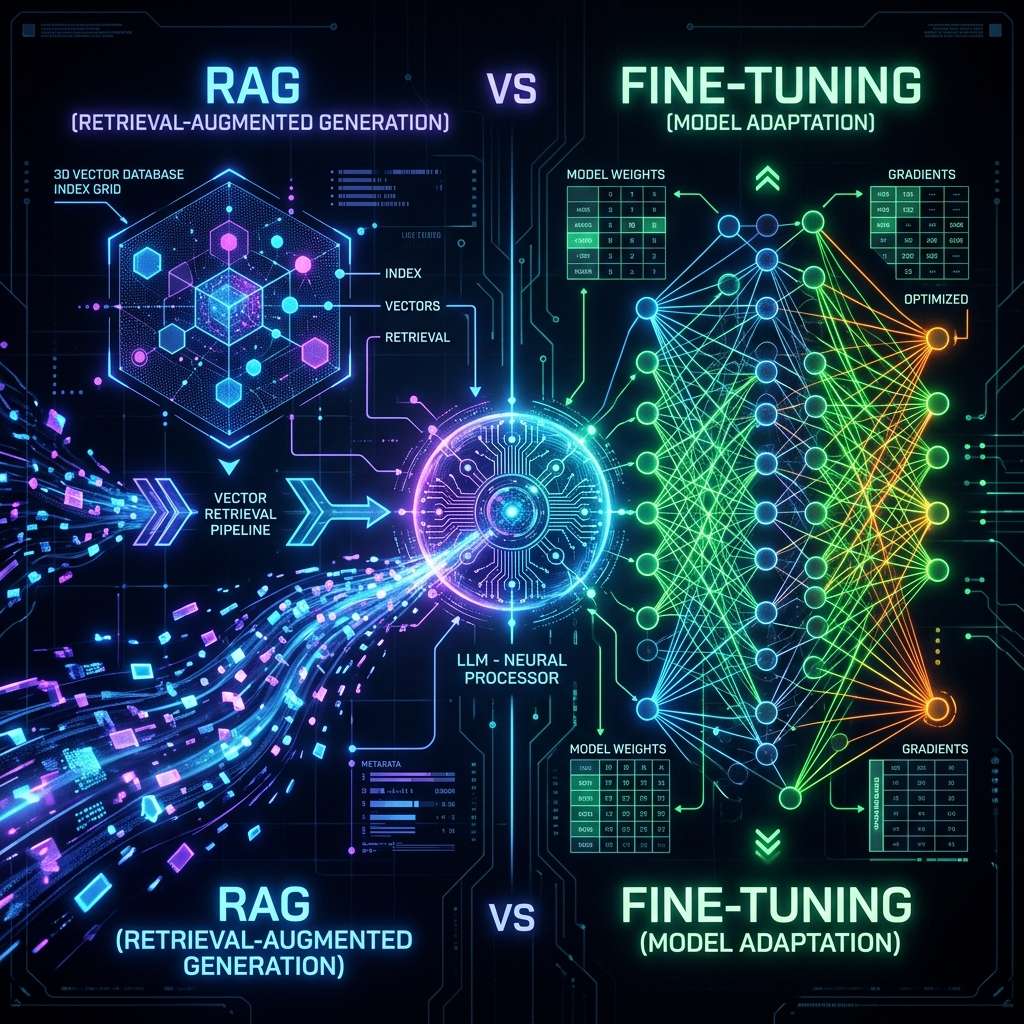
These numbers change the entire discussion. It is no longer about "RAG or fine-tuning", but about how to intelligently combine both approaches. Fine-tuning teaches the model how to think – how to format responses, what tone to write in, and what structure to maintain. RAG provides what the model should know at a given moment [4].
Why Only Now?
For a long time, comparisons relied on subjective "response quality" or internal tests without a published methodology. This paper describes its pipeline in detail, so it's a useful reference point – with one caveat: it's a single domain (agriculture), so treat the numbers as an illustration, not a universal law[4].
Economics of the Hybrid Approach
Let's look at this through the lens of costs. Fine-tuning is a one-time investment – large compute cost upfront, but then a smaller model (e.g. 7B instead of 70B) delivers comparable results on a specific task [6]. RAG eliminates the training phase, but adds overhead on every query – embedding, retrieval, and context injection.
In practice, the hybrid wins economically: you fine-tune once for behavior and format (which reduces the size of the needed model), and RAG ensures knowledge freshness without the need to retrain with every data change. Case studies indicate that switching from pure RAG to a hybrid architecture can achieve savings of up to 40% in monthly inference costs.
New Standard for Enterprise
Scifiniti's position confirms what is observed in practice: RAG enriches responses at runtime through retrieval, while fine-tuning embeds knowledge in model parameters [6]. Each approach has its trade-offs in the context of compute costs, data requirements, and update frequency.
But the key change is a shift in thinking. Instead of choosing one of two, enterprise teams design architectures where fine-tuning defines the model's "personality" and behavior, and RAG ensures access to fresh, verifiable knowledge. This is not a theoretical possibility – it is a new standard, confirmed by concrete metrics from production.
The available data allows designing LLM systems analytically rather than intuitively. 86% accuracy is not the limit – it is a starting point for further optimization.
RAG: When Retrieval Beats Training
RAG is an architecture that in practice solves one fundamental problem: data changes, but models do not. When product documentation updates weekly and pricing monthly, retrieval beats training with simple math – zero retraining costs and immediate knowledge updates.
The numbers speak for themselves. RAG eliminates the training stage, which in the case of fine-tuning can cost thousands of dollars in compute and days of team work [3]. Existing infrastructure—such as vector databases, embedding models, and base LLMs—can be leveraged to launch a production-ready system in hours rather than weeks.
Transparency is the killer feature that fine-tuning will never provide. In RAG, every response has provenance – it displays exactly which document the model extracted information from. This is not just a nice-to-have; it is a regulatory requirement in healthcare, finance, and legal sectors. This allows auditing every model decision, showing the source in the interface, and building user trust [7].
The RAGAS framework changed the game in RAG evaluation. It measures three dimensions: precision/recall retrieval (are you pulling the right documents?), faithfulness (is the response faithful to sources?), and relevance (does the response hit the question?). These represent concrete metrics that can be tracked in production rather than academic abstractions [3].
Customer support is RAG's natural habitat. A typical product knowledge base grows every sprint, API documentation updates with each release, and FAQs evolve with customer support tickets. Fine-tuning on such data is an operational nightmare – you have to re-train the model after every major change.
In practice, teams typically start with RAG because time-to-market bobs everything. It is faster to build a prototype in a week than to spend a month preparing a dataset for fine-tuning. This allows rapid iteration, hypothesis testing, and user feedback before considering behavioral fine-tuning [5].
RAG scales better with knowledge base size. Adding new documents to the vector store makes them immediately accessible to the model, without training context limits, dataset balancing overhead, or the risk of catastrophic forgetting [3].
Practical case: an e-commerce support system with 50k products and technical documentation. Product added = document in vector DB. Zero downtime, zero retraining. The model answers questions about new products the same day. This is impossible with fine-tuning without a continuous training pipeline, which costs.
But RAG has its ceilings. When retrieval fails (weak embeddings, poorly chunked documents), the entire system degrades. Latency is typically higher than pure inference since retrieval and generation must run sequentially. Furthermore, RAG does not teach the model a new response style, it only provides context [7].
Fine-Tuning: When You Need to Change Model Behavior
When teams reach for fine-tuning, it is usually not about adding knowledge to the model – that is a job for RAG. Fine-tuning changes how the model thinks, not what it knows [5]. If a model understands a domain but fails to respond in the required format, mixes styles, or fails to adhere to specific patterns, fine-tuning becomes necessary.
For instance, a model might understand medical reports but generate them in a casual blog style instead of a clinical one. Similarly, a support chatbot might alternate between friendly and corporate tones. Fine-tuning ensures behavioral consistency by training the model on a specific response pattern regardless of context [2].
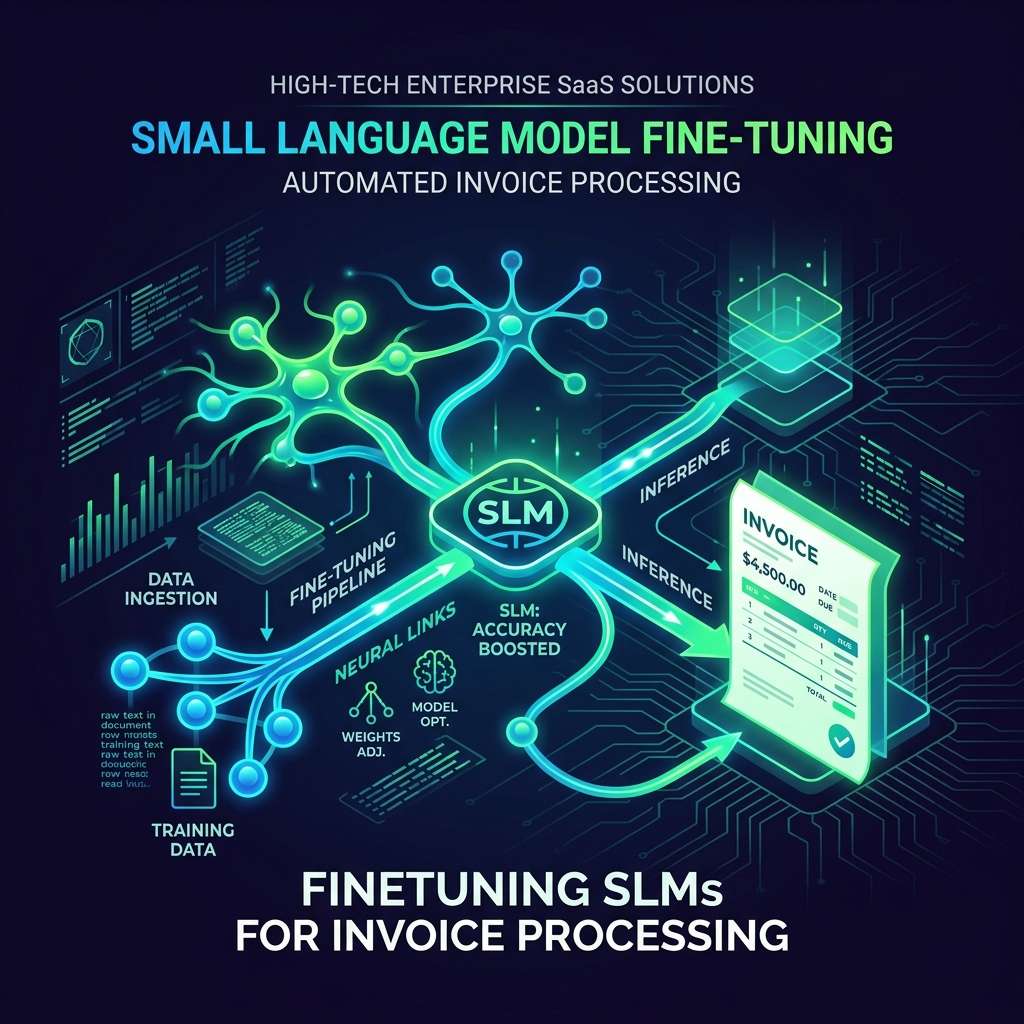
Key Business Value: after fine-tuning, a smaller model can perform like a significantly larger one on your specific task [3]. In practice, this means that instead of paying for GPT-4 in production, you can train a smaller model to similar effectiveness on a narrow scope – and drastically lower inference costs. Case studies show that training a smaller model to perform a specific task can reduce monthly inference costs by 60-70% compared to using general frontier models like GPT-4.
The study gives concrete numbers: fine-tuning alone raised GPT-4's accuracy from 75% to 81% – about 6 percentage points[4]. Doesn't sound spectacular? For many business tasks, that's the difference between a prototype and a production-ready system. The fine-tuned model also got better at combining knowledge across geographies: answer similarity across regions rose from 47% to 72%[4].
Starting requires a minimum of several hundred high-quality training examples [5]. A few hundred well-curated input-output pairs are sufficient for most tasks. But "high quality" is the key word: low-quality training data yields poor results, without exception. Experience shows that 300 manually verified examples often outperform 2,000 automatically generated ones.
How to measure effects? It depends on the task type. For classification: accuracy and F1 score – standard metrics every ML engineer knows from basics [3]. For text generation: BLEU and ROUGE – measure similarity of generated text to reference [3]. In practice, add human evaluation – no automatic metric catches all nuances of style or tone.
The process involves collecting examples, preparing a dataset (usually in JSONL format), and running a training job via API or private infrastructure. For smaller models, this represents a low cost, whereas larger models require more investment but remain predictable.
When NOT to use fine-tuning? When data changes frequently. If the knowledge base updates weekly, fine-tuning becomes operationally impractical due to constant retraining loops. RAG resolves this by allowing instant updates, making fine-tuning suitable only for stable behavioral patterns rather than dynamic knowledge [2].
The recommended approach is to deploy fine-tuning only to solve specific behavioral issues rather than as a starting step [5]. Building an MVP on RAG first helps identify style or formatting gaps before investing in a fine-tuning dataset.
Case Study: Enterprise GPT-4 Tests
The Microsoft team's comparison on GPT-4 gives us concrete numbers. The base model achieved 75% accuracy. Fine-tuning raised the result to 81% – about 6 percentage points. And when they added RAG to the fine-tuned model, accuracy rose to 86% – 11 percentage points above the base model[4].
In practice there's a clear division of competencies. RAG shines where context is critical – when the model has to work with fresh, dynamic data. Fine-tuning, on the other hand, is the tool for response style, conciseness, and formatting precision. If a model must consistently return structured JSON or adhere to a strict tone, fine-tuning is the optimal path.
Industry frameworks suggest using RAG for knowledge and fine-tuning for behavior [2]. If there is a gap in what the model knows, RAG is the solution; if the issue is how it behaves, fine-tuning is required. For customer support with weekly product updates, RAG allows integrating new data dynamically, whereas inconsistent brand voice requires fine-tuning.
A hybrid approach is not a buzzword, it is a concrete strategy. The 11-point gain in the Microsoft study came from combining both: fine-tuning teaches the model how to think in your domain, RAG provides it with what to think about in real time[4]. Where accuracy translates directly to ROI, a jump from 75% to 86% is often the boundary between a POC and production.
Key takeaway? Stop thinking "either-or". Teams achieving the best results treat RAG and fine-tuning as complementary tools, not competitive options. The question isn't "what to choose", but "in what order and proportion".
Decision Framework: How to Choose in Practice
Production experience suggests starting with RAG in almost all scenarios [5]. This allows validating business assumptions before investing in training compute.
RAG as Starting Point: Why Almost Always
Numbers don't lie. RAG lets you launch a prototype in days, not weeks. This approach avoids upfront training costs, does not require large datasets, and provides built-in provenance to track response sources [5]. In practice, this means the team can test business hypotheses before investing in training infrastructure.
Algoworks confirms: RAG is more cost-efficient than fine-tuning because it eliminates heavy training stages [3]. RAG eliminates the training phase, allowing database updates to reflect instantly. For applications with weekly data changes, this is the most practical starting point.
When to Add Fine-Tuning: Concrete Signals
Fine-tuning is introduced when RAG fails to control model behavior—such as when the model ignores schema requirements, output formats, or tonal guidelines [5].
Shirin Khosravi Jam puts it precisely: "Fine-tuning changes how the model thinks; RAG changes what the model knows at query time" [5]. If the issue is missing knowledge about Q4 products, RAG is appropriate. If the issue is formatting output into a specific schema, fine-tuning is required [5].
If cost reduction is a goal, fine-tuning a smaller model can match the performance of larger models on specialized tasks at a fraction of the inference cost [3], provided several hundred high-quality examples are available [5].
Hybrid Approach: Strongest Combination
The data shows that combining both methods gives the biggest accuracy jump. Base GPT-4 achieved 75% accuracy, fine-tuning raised this to 81% (+6 pp), and adding RAG to the fine-tuned model gave 86% – 11 percentage points over the baseline[4].
This isn't theory – these are published results, though from a single domain[4]. In practice, RAG tends to be most effective where context is critical (customer support, document analysis), while fine-tuning shines in generating concise, consistently formatted outputs.
In a hybrid architecture, fine-tuning enforces style, format, and tone, while RAG feeds in real-time context. This is highly suitable for regulated domains like fintech compliance or medical assistants [3][7].
Decision Tree for Practitioners
The decision path starts by distinguishing knowledge from behavior. Knowledge gaps (such as proprietary or changing data) are resolved with RAG, while behavioral issues (such as format and tone) suggest fine-tuning once a training dataset is prepared [5].
The second criteria is the frequency of data updates. Daily or weekly updates point to RAG due to retraining costs. If data changes monthly or less, and a stable dataset exists, fine-tuning is feasible [3].
Infrastructure budget is also a factor. RAG requires a vector database and retrieval pipeline, which is generally a set-and-forget setup. Fine-tuning requires MLOps, GPU resources, and model versioning, which adds complexity [7].
Finally, auditability is critical in regulated fields. RAG provides instant citation tracing out of the box, whereas fine-tuning does not document source references [5].
Costs and Scalability: Trade-Off Analysis
Cost Mathematics: What You Really Pay
RAG has zero upfront training costs. Documents are ingested into a vector store and indexed immediately. However, query execution incurs ongoing costs for retrieval and the processing of additional context.
Fine-tuning involves upfront training costs but enables a smaller, cheaper model to perform specialized tasks [3]. This is long-term optimization. For stable, high-volume workloads with millions of queries, hosting a fine-tuned model can be more cost-effective than using frontier APIs.
A hybrid setup combines the strengths of both methods, ensuring consistent formatting via fine-tuning and real-time knowledge via RAG[3]. The Microsoft study is a good illustration: fine-tuning alone gave +6 pp (75%→81%), and adding RAG pushed this to 86% – +11 pp over the base model[4]. RAG itself was introduced by Facebook AI researchers in 2020 as a way to connect a language model with an external knowledge source, and today we see that this architecture scales well.
Scalability: Where Each Approach Breaks
RAG scales horizontally. New data is simply indexed in the vector store without retraining, and multiple indexes can be combined. However, latency can increase due to retrieval and long context processing. In real-time applications, that's a killer.
Conversely, fine-tuning requires a new training run for every knowledge update, which typically limits retraining cycles to every few months. This is a blocker for weekly data updates.
Flexibility vs precision - that's the key trade-off [6]. RAG is suited for broad, multi-domain applications, whereas fine-tuning is optimal for executing a single specialized task (such as natural language to SQL translation) with high precision [3].
A practical rule of thumb: use RAG for knowledge (what the model knows) and fine-tuning for behavior (how the model responds). This lets you update factual information on the fly while maintaining a consistent tone and output format. Many mature implementations go exactly this way.
Practitioner's Checklist: What to Do in Your Project
Step 1: Start with RAG – Always
A practitioner with 6 months of experience building LLM applications says it straight: "Start with RAG, almost always" [5]. This delivers a working prototype quickly, validating business assumptions before investing in training compute, while providing built-in citation tracking [5].
Step 2: Measure Baseline – Without Metrics You're Flying Blind
Before training, measuring retrieval precision, recall, and answer faithfulness using frameworks like RAGAS is essential [2]. This helps isolate knowledge gaps from formatting issues. If retrieval quality is below 80%, chunking and embedding strategies should be optimized first. If answer relevance is lacking, maybe a better prompt is enough.
Step 3: Behavioral Problems? Time for Fine-Tuning
When style, formatting, or guidelines are ignored, fine-tuning is required to adjust how the model thinks rather than what it knows [5]. This is where fine-tuning helps and RAG doesn't. Plan for a solid set of high-quality training examples – a few hundred well-curated ones are a sensible starting point – to avoid wasting compute.
Step 4: Collect Training Data – Quality > Quantity
Building a fine-tuning dataset requires 200 to 500 clean, consistent pairs [5]. Because curating this data is time-consuming, RAG remains the preferred starting point. If you don't have budget for dataset curation, stay with RAG + better prompting.
Step 5: Hybrid Approach for Enterprise Critical Apps
The most interesting numbers come from combining both methods. In the Microsoft study, adding RAG to fine-tuned GPT-4 raised accuracy to 86% – 11 percentage points above the base model[4]. A hybrid setup combines the strengths of both methods, ensuring consistent formatting via fine-tuning and real-time knowledge via RAG[2]. Although infrastructure costs are higher, it delivers the most robust production results.
Step 6: Monitor Different Things for Different Approaches
RAG requires monitoring retrieval precision, embedding drift, and query patterns. Fine-tuned models require monitoring model drift and running regression tests in production. RAG avoids training overhead [4], while fine-tuning reduces inference costs by enabling smaller models [2].
Golden Rule: Knowledge vs Behavior
The core rule is that RAG manages what the model knows, while fine-tuning adjusts how it thinks [5]. Knowledge gaps are resolved with RAG, and formatting or stylistic issues are resolved with fine-tuning. Most production systems start with RAG, introduce fine-tuning as needed, and combine them into a hybrid architecture for critical applications [4].
P.S. If you're building RAG applications or fine-tuning models, using a modern editor can significantly speed up your development workflow. You can check out Cursor, which is an excellent AI-powered code editor for these tasks.
References
- Fine tune a 70B language model at home | Hacker News
- Fine-tuning vs RAG: A Decision Framework for Practitioners - Medium
- RAG vs Fine-Tuning: Choosing Right AI Strategy for Enterprises
- RAG vs Fine-tuning: Pipelines, Tradeoffs, and a Case Study on Agriculture – Balaguer et al., Microsoft (arXiv, January 2024)
- Shirin Khosravi Jam's Post - RAG vs Finetuning - LinkedIn
- Fine-Tuning vs. RAG: A Position Paper from the Perspective of LLM ...
- RAG vs Fine-Tuning: How to Choose for LLMs | Let's Data Science
- Fine-tuning vs RAG: why most teams pick wrong and how to decide
Comments
Comments are powered by Cusdis. The widget only loads after you click.