Your AI Skills Stack: Building Competencies That Survive the Next Six Months
AI capability doubles every six months. That's not a metaphor — it's real pressure on everyone who works with technology, manages a team, or builds a product. Łukasz Foks from Microsoft asked a timely question at Warsaw IT Days: how do you build competencies with lasting value in the middle of such a revolutionary change? A year later the question is even more relevant — and the data from Microsoft's 2026 Work Trend Index gives us a solid empirical foundation for the answer.
Why "Learn to Prompt" Is No Longer Enough
For the past two years, a certain pattern of thinking about AI skills dominated: learn to write prompts, use Copilot, and you're "AI-ready." The problem is that this level of skill has become table stakes. According to Microsoft's 2026 Work Trend Index, which surveyed 20,000 workers across 10 countries, only 16% of AI users reach the "Frontier Professionals" level — those who genuinely transform how they work, rather than merely accelerating old ways.
Frontier Professionals differ from the rest not in tools, but in approach: they use agents for multi-step workflows, routinely redesign processes, and create AI work standards that can scale beyond the individual. Meanwhile, over 85% of workers in AI-adopting organizations remain at the task assistance and delegation stage — not transformation.
The AI Skills Stack: Six Levels
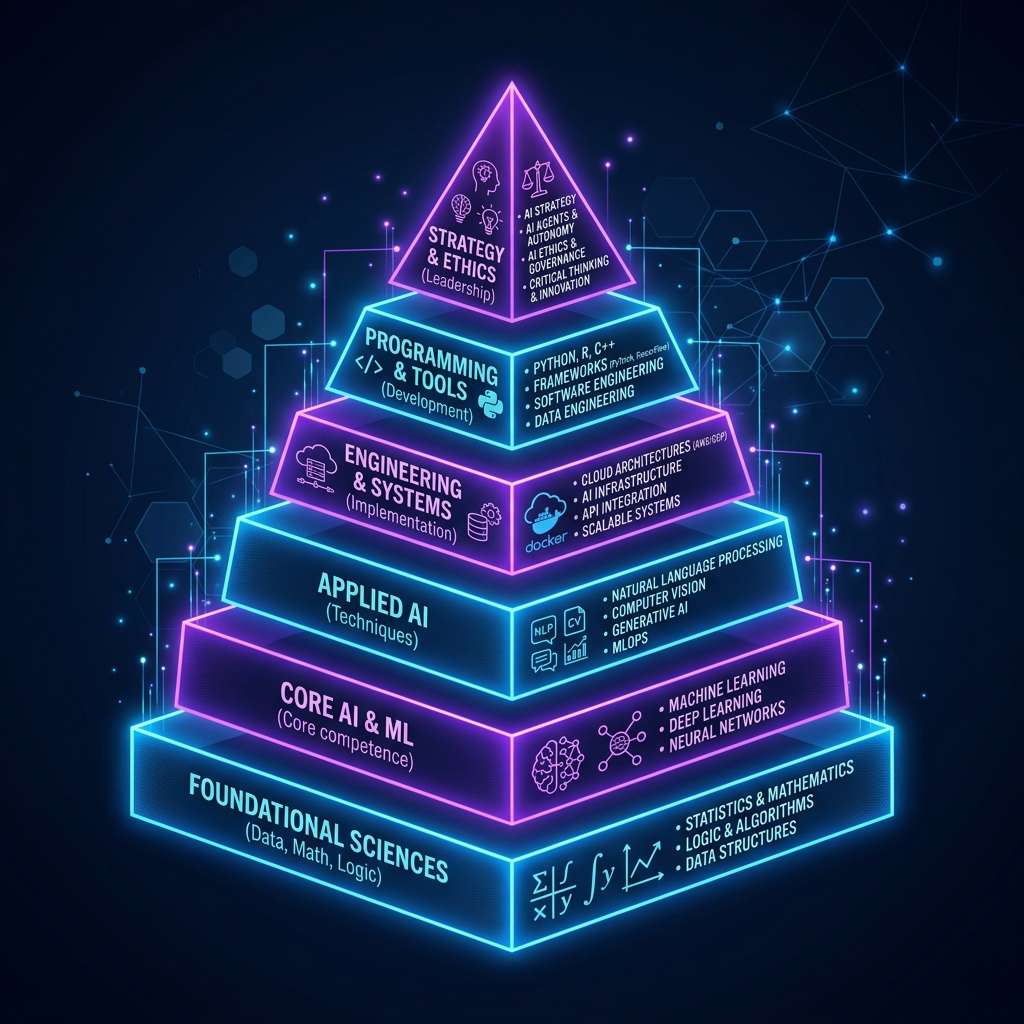
Foks proposed a framework visible on one of the presentation slides. The "AI Skills Stack" is a hierarchy of six levels — from basic programming language knowledge to founding companies and conducting research:
- Technical foundation — fluency in at least one programming language and software engineering basics
- Collaborating with AI in code — using Copilots and models for writing, refactoring, and explaining code, with your own quality control of the output
- Informed model use — selecting the right models (LLM/SLM), designing prompts, evaluating quality and cost, combining multiple models within a single task
- Assembling solutions from cloud building blocks — building end-to-end workflows from ready-made AI services (vision, speech, search, documents, agents) without training custom models
- Adapting models to your domain — fine-tuning, RAG, custom training pipelines on company data, quality monitoring, and model versioning
- Creating new products and career paths — designing and launching AI products (SaaS, internal platforms) or conducting research that expands organizational capabilities rather than merely streamlining existing processes
Each level delivers real value. You don't need to aim for level 6 immediately — but you need to know where you stand and consciously build the path upward.
What the Data Shows: Microsoft's Future of Work Research
Microsoft's 2026 Work Trend Index delivers several numbers worth knowing when building your own competency strategy:
Productivity is real, but uneven:
- 66% of AI users say AI has allowed them to spend more time on high-value work
- 58% of AI users are producing work they couldn't have a year ago
- Among Frontier Professionals, that figure rises to 80%
Organizations are falling behind their people:
- Only 19% of AI users operate in the "Frontier" zone — where high individual readiness meets high organizational readiness
- 10% face "blocked agency": people with strong skills whose organizations aren't built to utilize them
- Organizational factors (culture, manager support, talent practices) account for more than 2× the AI impact of individual mindset and behavior
Agents are accelerating:
- Active agents in the Microsoft 365 ecosystem grew 15× year over year, rising to 18× in large enterprises
Human skills matter more than ever:
- When asked which human skills are growing in value, respondents cited: quality control of AI output (50%) and critical thinking (46%)
- 86% of AI users treat AI output as a starting point, not a final answer
How Fast the Market Is Moving: WEF and PwC Data
The pressure to reskill is systemic. According to the World Economic Forum's Future of Jobs Report 2025, 170 million new jobs will be created by 2030, but 92 million will disappear — and nearly 40% of required job skills will change. PwC and WEF estimate that 80% of workers will need to acquire new AI skills by 2027.
LinkedIn's 2026 Labor Market Report noted that in the past two years, employers have created at least 1.3 million new AI-related positions — data annotators, AI engineers, forward-deployed engineers. Roles that didn't exist five years ago.
A Practical Plan: Building the Stack Under Continuous Change
Since AI capability doubles every six months, annual training plans are by definition already outdated by the time they're implemented. What instead?
The "Tier Up Every 60 Days" Principle
Research shows that a structured plan with daily practice and weekly projects allows you to advance one AI skill tier in 60 days. A four-phase framework:
- Days 1–15: Daily AI use, baseline assessment — keep a log of what AI saves or improves for you
- Days 16–30: Prompt engineering and advanced features — complete one project entirely with AI
- Days 31–45: Multi-tool workflows and automation — deploy one automated workflow to production
- Days 46–60: Teaching others and governance basics — run a team session or create an AI playbook
What Frontier Professionals Do Differently
Three behaviors that distinguish the top 16%:
- Intentionally do some work WITHOUT AI (43% vs. 30% of others) — to prevent skill atrophy
- Pause before starting work to decide what AI does vs. what the human does (53% vs. 33%)
- Document and scale standards — agent workflows, human handoffs, and quality standards are described and repeatable
Governance as a Skill
One of the most overlooked layers of the stack is AI governance — a skill becoming mandatory in regulated industries in 2026. It includes: detecting bias in AI output, data privacy management, AI output validation, and audit trail documentation. Companies building these competencies today avoid costly remediation tomorrow.
What This Means for You
Foks's talk had a sharp opening thesis: in the middle of the AI revolution, there's no "safe" place where you can stop learning. But there's something you can control — your conscious position in the skills stack and your rate of advancement.
Microsoft's 2026 Work Trend Index adds an organizational dimension: even the best individual competencies are blocked by organizations that haven't created conditions to leverage them. Building an AI skills stack is therefore both an individual and a leadership task — for everyone who manages a team or a product.
Sources
- Łukasz Foks, Microsoft — "Your Personal AI Skills Stack in the Age of Artificial Intelligence", Warsaw IT Days 2025
- Microsoft Work Trend Index 2026 — "Agents, Human Agency, and the Opportunity for Every Organization": https://www.microsoft.com/en-us/worklab/work-trend-index/agents-human-agency-and-the-opportunity-for-every-organization
- Microsoft New Future of Work Report 2025: https://www.microsoft.com/en-us/research/project/the-new-future-of-work/
- World Economic Forum — "Future of Jobs Report 2025": https://www.weforum.org/press/2025/01/future-of-jobs-report-2025-78-million-new-job-opportunities-by-2030-but-urgent-upskilling/
- Digital Applied — "AI Upskilling 2026: Stay Relevant as 80% Must Retrain": https://www.digitalapplied.com/blog/ai-upskilling-workforce-guide-stay-relevant-2026
- Forbes / Moorinsights — "Microsoft Work Trend Index 2026 Shows AI Productivity Is Not Enough": https://www.forbes.com/sites/moorinsights/2026/05/19/microsoft-work-trend-index-2026-shows-ai-productivity-is-not-enough/
- LinkedIn Labor Market Report 2026 (via Microsoft WTI 2026)
Comments
Comments are powered by Cusdis. The widget only loads after you click.