World Models vs LLM: Revolution in AI Based on the Physics of Reality
Major AI labs are transitioning from language models to World Models. Analysis of NVIDIA's Cosmos architecture and the future of physical AI.
The End of the Pure LLM Era: Why Text Statistics Aren't Enough
LLMs are masters of statistics. GPT-4, Claude, Gemini – all predict the next token based on billions of examples from the internet. The problem? They have no concept of physics. Ask ChatGPT if a ball thrown upward will fall – it will answer correctly because it has seen thousands of such sentences in the training corpus. But this isn't understanding. It's pattern recognition in text.
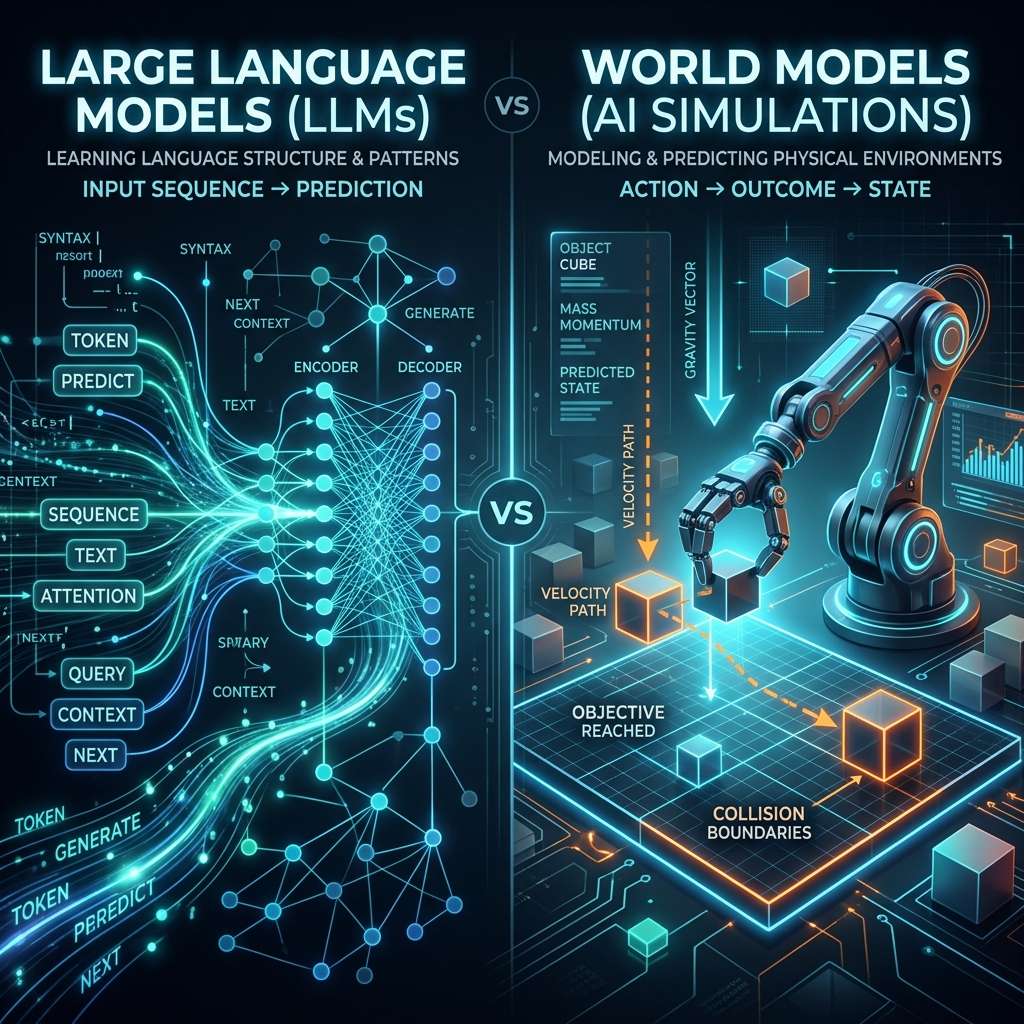
World Models work fundamentally differently. Instead of predicting words, they learn the dynamics of reality: how objects move, collide, fall under gravity [1]. This is the transition from "Word Models" to World Models – as someone on HackerNews put it [1]. LLMs model language. World Models model the world.
The difference is brutal in practice. An LLM can generate a description of a robot lifting a box. A World Model simulates this action: calculates the arm's trajectory, predicts the grasp point, models physical contact with the surface. That's why NVIDIA trains its Cosmos on 20 million hours of video – the model must see how reality works, not how we write about it [7].
Yann LeCun has been saying for years that LLMs are a dead end for true intelligence. Fei-Fei Li bet on World Models in her new company [4]. Why? Because language captures only a small slice of what we know about the world. A child learns gravity through observation, not by reading Newton. AI must follow the same path.
Key LLM limitation: zero spatial reasoning. Ask about 3D object rotation, robot motion planning, collision prediction – text statistics break down. World Models train on vision: every video frame is a lesson in physics, geometry, causality [1]. That's why autonomous cars need World Models, not ChatGPT.
The industry understands this. NVIDIA released Cosmos as a foundation model precisely so developers can fine-tune it on their own physical data [4]. Instead of building a model from scratch (years of work), you take Cosmos and specialize it for your factory, warehouse, autonomous vehicle. Development time drops from years to months [4].
The paradigm is shifting. LLMs will remain – they're excellent for conversational interfaces, text generation, document analysis. But the future of AI that operates in the real world – robots, vehicles, physical simulations – belongs to World Models. This isn't competition. It's complementarity: LLM as interface, World Model as reasoning engine about reality.
Technical Architecture: Autoregressive vs Diffusion Transformers
Modern World Models are based on Transformer architecture but use two fundamentally different mechanisms for generating world states. These aren't variants of the same approach - they're two philosophies of processing reality.
Autoregressive Transformers generate the world token-by-token, frame-by-frame, where each state is conditioned on all previous states [2]. In practice, this means the model understands causality - it knows that if a robot hits a ball, that ball will roll in a specific direction. This naturally lends itself to sequential decision-making and long-term planning [2]. I've seen this in action in robotics: the system predicts not just the next second of motion, but the entire task trajectory.
Diffusion Transformers start from noise and progressively denoise it into a coherent, photorealistic world [2]. This approach produces higher visual fidelity and better spatial coherence - crucial for synthesizing rich simulation environments [2]. The quality difference is visible to the naked eye: diffusion generates scenes where light, shadows, and reflections behave physically correctly.
The real breakthrough is latent spaces. Instead of predicting every pixel in a 4K frame, the model compresses frames into compact vectors - mathematical fingerprints - and predicts the next fingerprint [6]. This prediction in latent space is the source of computational efficiency. The model discards irrelevant information (e.g., the exact color of the sky) while preserving the core physics of the scene [6].
In practice, architecture choice depends on the task. Autoregressive works great in industrial robotics and route planning for autonomous vehicles - where long-term strategy and cause-effect understanding matter [2]. Diffusion dominates in generating training environments and video synthesis (like Sora) - where visual realism and spatial coherence are priorities.
Key lesson: compression to latent space preserves physics with dramatic computational reduction [6]. This isn't a trade-off between accuracy and performance - it's a fundamental change in representation that makes World Models practical in production.
NVIDIA Cosmos: State-of-the-Art in World Foundation Models
NVIDIA Cosmos is currently the most advanced commercial World Foundation Model on the market. It was trained on 20 million hours of video material focused specifically on physical dynamics [7]. This isn't another language model – it's a neural network that learned to predict how reality behaves.
Architecture: Transformers in Service of Physics
Cosmos is based on Transformer architecture with billions of parameters, but uses it in a completely different way than LLMs [2]. Instead of predicting next text tokens, the model operates in latent space – compresses video frames into compact mathematical vectors and predicts the next vector instead of each pixel individually [2]. This is key for computational efficiency.
NVIDIA offers two architectural variants, each optimized for different applications:
Autoregressive Transformers generate the world token-by-token (frame-by-frame), where each state is conditioned on all previous states [2]. They naturally lend themselves to sequential decision-making, long-term planning, and causal understanding over time [2]. This is the ideal solution for robotics, autonomous vehicles, and strategic AI.
Diffusion Transformers start from noise and progressively "denoise" it into a coherent, photorealistic world [2]. They produce higher visual fidelity, better spatial coherence, and excel at generating rich synthetic environments [2]. They're used for generating simulations, video synthesis (like Sora), and creating 3D environments.
Transfer Learning: From Years to Months
Cosmos is a foundation model that can be post-trained on proprietary data to specialize it for specific Physical AI tasks [2]. This is where the real revolution in development time happens: instead of training a model from scratch for years, companies can adapt Cosmos to their needs in months [2].
The model is openly available to the developer community for simulation and reasoning about physical environments [2]. This changes the economics of AI – small teams can now build advanced Physical AI applications without Google or OpenAI infrastructure.
Real-World Deployment
Cosmos isn't a proof-of-concept – it's already working in production. NVIDIA uses it to train robots in factories and autonomous cars in simulation, allowing them to learn from synthetic data before real-world deployment [2]. This drastically reduces costs and risk.
The same family of techniques underpins AI video generation such as Sora – convincing video requires modeling how objects physically interact over time. It's not just about "pretty pictures," but physical coherence between frames.
Concrete metrics show the scale of achievement: 20 million hours of training data [7], reduction of development cycle from years to months through post-training [2], deployment in real industrial applications. This isn't a research project – it's production infrastructure for a new generation of AI.
Production Implementations: From Robotics to Autonomous Vehicles
Cosmos isn't a research project – it's a production platform that's already training robots in factories and autonomous cars in simulation today [4]. NVIDIA released it to developers as a foundation model that can be post-trained on proprietary data. The result? Development cycle shortened from years to months [2].
The mechanism is simple: instead of teaching a robot in the real world (expensive, dangerous, slow), you generate millions of scenarios in simulation. The robot learns physical interactions – collisions, gravity, friction – before you touch hardware. This is alignment through simulation: you test edge cases that would take years in reality [4].
DreamerV2 showed this works at scale. As the first World Model Agent, it achieved human-level performance on the full benchmark of 55 Atari games [6]. Not through brute force, but by learning a latent world model – compressing the world into mathematical vectors that predict the next state. NVIDIA scales the same approach to Physical AI.
Cosmos was trained on 20 million hours of video [7]. This isn't random YouTube – it's carefully curated data of physical dynamics. A car turning in rain. A robot assembling a component. An object falling from different heights. The model learns not just "what the world looks like," but "how the world works."
Video generation is a side effect, not the goal. The more convincing systems like Sora get, the more they have to model physical interactions of objects over time. They don't generate pixels – they predict the next state of the world. That's why water looks like water and gravity looks like gravity. This isn't statistical pattern matching – it's learned physics.
In factories, I see a concrete use case: a robot must learn precise assembly. In simulation, you generate 10,000 variants – different angles, forces, material deformations. The model learns what works. You transfer the policy to the physical robot. NVIDIA argues that starting from a pretrained world model and post-training it can cut development "from years to months" compared with training from scratch [2].
Autonomous vehicles are the second key vertical. You test in simulation scenarios that are rare but critical in the real world: aquaplaning, sun glare, sudden pedestrian braking. The World Model predicts physical consequences of each decision. You train the planning policy without risk.
Technical bottleneck: latency. Autoregressive transformers predict frame-by-frame, which gives better cause-and-effect reasoning but is slower [2]. Diffusion transformers are faster and give better visual fidelity, but handle long-horizon planning worse [2]. In robotics, you use autoregressive. In generating training environments – diffusion.
NVIDIA positions Cosmos as a platform of openly available world foundation models for physical AI development [7]. It's a foundation model you post-train on your data – similar to fine-tuning an LLM. The difference: you're teaching not language, but physics specific to your use case. An automotive factory has different physics than an e-commerce warehouse.
The numbers are concrete: 20 million hours of training video for Cosmos [7], human-level performance on the Atari benchmark for DreamerV2 [6], and development cycles shortened "from years to months" according to NVIDIA [2].
Latent vs Generative World Models: Key Research Differences
Two Approaches, Two Architectural Philosophies
In practice, we have two competing approaches to building World Models, each with a fundamentally different way of representing reality.
Latent World Models operate in compressed vector space. Instead of predicting every pixel in a 4K frame, the model compresses the entire scene into a compact vector (a mathematical "fingerprint") and predicts the next fingerprint [6]. It's like JPEG for physics – you discard irrelevant details, keep the essence of dynamics. DreamerV2, using this approach, was the first to achieve human-level performance on the full benchmark of 55 Atari games [6]. Computational efficiency? Brutal. Long-term planning? Natural, because the model operates on abstractions, not raw pixels.
Generative World Models go the other way – they generate a full, photorealistic representation of the world. Diffusion Transformers start from noise and progressively "denoise" it into a coherent image of reality [2]. Cost? Higher. Interpretability? Much better – you see exactly what the model "thinks" about the world. NVIDIA Cosmos, trained on 20 million hours of video [7], uses both approaches depending on the task: autoregressive transformers for sequential decision-making, diffusion for generating simulation environments [2].
The Fundamental LLM Problem: Lack of Visual-Spatial Reasoning
LLMs predict the next text token based on statistical patterns [1]. Sounds innocent, but the consequences are brutal for physical tasks. A language model has no concept of gravity, momentum, or energy conservation – because its loss function doesn't require it. You optimize cross-entropy on tokens, not compliance with Newton's laws.
A common informal test is to ask a language model to predict an object's trajectory step by step. Models often produce physically implausible paths, because their "knowledge" of physics comes from statistical correlations in text, not from a dynamics model. This isn't a bug – it's a feature of architecture optimized for word prediction, not reality simulation.
American Century Investment aptly summarizes: "LLMs lack the visual-spatial reasoning required for physical tasks" [3]. You can ask GPT about equations of motion, you'll get correct LaTeX. But ask it to simulate a collision of two 3D objects? The model doesn't even have a representation space for this problem.
Hybrid Approaches: LLM as Physics Orchestrator
The most pragmatic solution? Don't replace LLMs with World Models, combine them. In hybrid architecture, the LLM serves as a "high-level controller" – understands user intent, reasons about the task in natural language, but delegates physical simulations to a specialized World Model [3].
Example from practice: a factory robot receives the command "move the box to the shelf." The LLM parses intent, decomposes the task into steps, but actual trajectory planning, collision avoidance, and physical motion simulation? That's the domain of a World Model trained on robotics data [2].
NVIDIA Cosmos shows how this works in production: the physical foundation model is post-trained on client proprietary data, shortening the development cycle from years to months [2]. The LLM can call this model to explain physical scenarios but doesn't try to simulate them itself.
Key difference: World Model has a loss function that accounts for physical dynamics – prediction of the next world state is validated against actual laws of physics, not just statistical plausibility of text [6]. This is a fundamental difference in learning architecture, not just in training data.
Technical Challenges and Production Solutions
World Models present ML engineers with a completely different class of challenges than LLMs. While GPT-4 "only" predicts the next text token, a world model must understand physical dynamics, spatial relationships, and cause-effect in continuous time. This is a fundamental difference in computational complexity.
Data and Computational Power Hunger
NVIDIA Cosmos was trained on 20 million hours of video focused on physical dynamics [7]. For comparison – that's equivalent to over 2200 years of video material. Each frame isn't text, but thousands of pixels with information about depth, motion, and spatial context. Raw processing of this amount of data in 4K resolution would be computationally impossible even on H100-class GPU clusters.
The solution is compression to latent spaces [6]. Instead of predicting each pixel individually, the model compresses entire frames into compact vectors – mathematical "fingerprints" of the scene. Then it predicts the next fingerprint, not millions of pixels. This technique allows discarding irrelevant visual information while preserving only key physical properties of the scene [6]. In practice, this is the difference between training lasting years versus months.
Multimodal Integration: More Than Video
World Models must combine heterogeneous data sources: camera video, LiDAR scans, IMU readings, GPS data. In autonomous vehicles, this is real-time fusion of data from 8-12 cameras, radars, and ultrasound. Each modality has different sampling frequency, resolution, and mathematical representation.
Transformer architecture has proven surprisingly flexible here. NVIDIA uses two paradigms: autoregressive transformers generate the world frame-by-frame, ideal for sequential planning in robotics [2]. Diffusion transformers start from noise and progressively "denoise" it to a coherent scene – better for generating photorealistic simulations [2]. This dualism allows optimizing the trade-off between physical fidelity and cost.
Scaling to Billions of Parameters
The jump from million-parameter to billion-parameter models isn't just about bigger GPUs. It's a fundamental training stability challenge. In latent spaces, small perturbations can cascade through prediction sequences, leading to physically impossible states – a car penetrating through a wall, gravity acting upward.
Key here are physics-specific regularization techniques: energy constraints, momentum conservation, geometric consistency. NVIDIA doesn't disclose details, but from DreamerV2 publications we know that stability requires careful tuning of learning rate schedules and gradient clipping adapted to latent dynamics [6].
Trade-off: Fidelity vs Cost
The toughest production decision: how much physics is "enough"? Full molecular simulation would be computationally senseless. On the other hand, overly simplified models generate artifacts – robots learn exploits instead of real skills.
NVIDIA Cosmos solves this through post-training on proprietary data [2]. The foundation model learns general physics from public datasets, then fine-tuning on client-specific scenarios. This shortens the development cycle from years to months [2], but requires expertise in selecting training data. In practice, we see models with 1-10B parameters depending on domain: smaller for warehouse robotics, larger for autonomous vehicles in urban environments.
The ultimate test isn't a benchmark, but deployment: can the robot pack a box in warehouse chaos? Can the car predict pedestrian behavior in rain? These are questions World Models must answer with 99.99%+ accuracy – otherwise they remain a research curiosity.
Practical Guide: When to Choose World Model Over LLM
Decision Checklist: When to Bet on World Models
The decision between World Model and LLM isn't about "better-worse," but tool-to-problem fit. If your system must predict physical consequences of actions in time and space – World Model. If you're processing language, generating content, or building a conversational interface – LLM.
Choose World Models when:
- Developing embodied AI: factory robots, autonomous vehicles, drones
- Need simulation of physical interactions before real-world deployment
- Planning long-term action sequences in 3D space (e.g., object manipulation)
- Want to generate realistic training environments for physical agents
NVIDIA Cosmos, trained on 20 million hours of video focused on physical dynamics, is the foundation for such applications [7]. You use it to train robots in simulation before launching them on the production floor – this is standard in physical AI [4].
LLM is your choice when:
- Building chatbots, conversational assistants, Q&A systems
- Generating, summarizing, or translating text
- Analyzing sentiment, classifying documents, extracting information from text
- Creating code or technical documentation
LLMs predict the next token based on statistical patterns in language – they don't understand that "if I push a cup, it will fall off the table." World Models do exactly that [2].
Hybrid Approach: LLM + World Model
The most advanced systems combine both paradigms. The LLM acts as a conversational interface and user intent understanding layer. The World Model is the physical reasoning and action planning engine.
Example: a warehouse robot receives a voice command (LLM parses intent), then the World Model simulates the sequence of movements to execute the task, predicting collisions and optimizing trajectory. The LLM translates the world of language into the world of physics, the World Model does the work.
NVIDIA Cosmos works as a foundation model – post-training on your proprietary data shortens development from years to months [2]. Instead of building a world model from scratch, you fine-tune Cosmos for a specific environment: factory, warehouse, specific robot type.
ROI and Performance Metrics
DreamerV2 achieved human-level performance on the full benchmark of 55 Atari games – the first world model agent to do so [6]. This is proof that latent world models have mastered complex sequential tasks.
Cosmos uses 20 million hours of video to learn world dynamics [7]. Data scale comparable to LLMs, but focused on physics, not language.
Key business metric: reduction of development time from years to months using foundation models [2]. Instead of collecting your own millions of hours of training data, you start with Cosmos and fine-tune for your use case.
The Future: Unified AI Systems
The boundary between World Models and LLMs will blur. We're already seeing architecture convergence: both use Transformers, differing mainly in training data and world representation method [2].
The future is unified AI systems that understand both language and physics. A system that reads the instruction "place the red cup on the shelf" and immediately knows what movements to execute, predicting the consequences of each action. LLM + World Model in one model.
NVIDIA Cosmos is a step in this direction – open to developers, ready for customization for specific physical environments [4]. If your product operates in the world of atoms, not just bits, World Models stop being an option – they become a necessity.
References
- Hacker News discussion on world models vs LLMs
- What Are World Models? – NVIDIA Glossary
- AI World Models vs. LLMs – American Century Investments
- World Models – Not Boring by Packy McCormick
- Beyond Language Models: Understanding World Models – Diana Wolf Torres
- Mastering Atari with Discrete World Models (DreamerV2) – Hafner et al. (arXiv)
- Nvidia releases its own brand of world models – TechCrunch (January 6, 2025)
Comments
Comments are powered by Cusdis. The widget only loads after you click.