Hybrid Human-AI Teams: A Review of Recent Trends and Challenges
Artificial intelligence is ceasing to be a tool, becoming a full-fledged team member. A review of key concepts and challenges in building hybrid teams.
Introduction: From Tool to Collaborator
Over the past 18 months, we've observed a fundamental shift in how organizations perceive AI. It's no longer just another tool in the tech stack – AI is becoming a full-fledged team member with whom we collaborate daily. Dillinger aptly puts it: "artificial intelligence and human intelligence will coexist and will not replace each other" [1]. AI's goal is to augment human capabilities, not eliminate them.

The numbers confirm this evolution. According to Workday's report, 74% of Spanish workers experience real productivity gains thanks to AI, saving 1 to 3 hours weekly on routine tasks [9]. That's up to about 7.5% of a 40-hour week that can be allocated to tasks requiring human judgment and creativity. There's a catch, though: the same study found that 42% of employees spend up to an hour a week reviewing and correcting AI output [9].
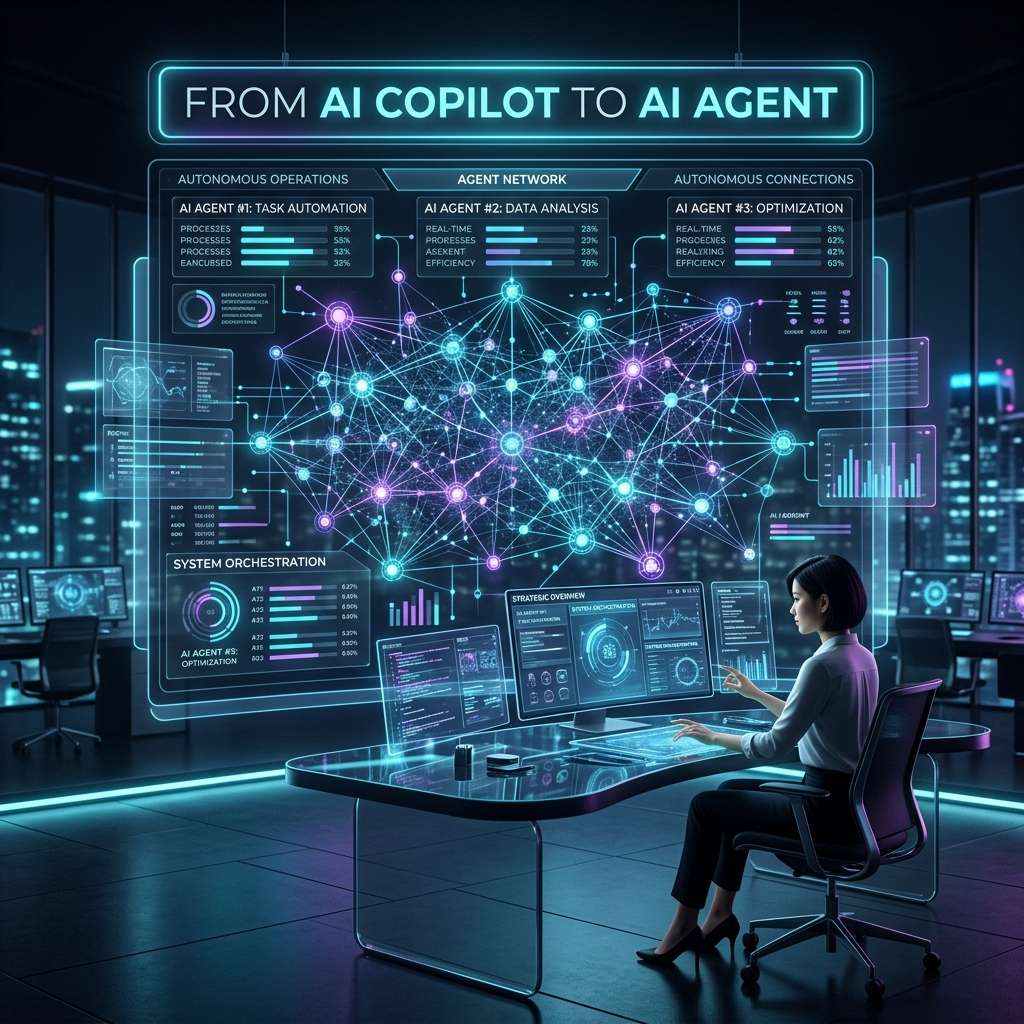
The key paradigm shift involves transitioning from a "human-in-command" model to "human-AI copilot". AI stops being a passive tool executing commands and becomes an active participant in decision-making processes. In practice, this means systems integrated with Slack or Microsoft Teams that not only analyze data but also manage projects and communicate with the team [8]. This is no longer an assistant – it's a colleague who has their specializations and brings concrete value to discussions.
However, this change requires a new approach to management. Gerardo proposes a framework based on four axes: ethics, economic results, social impact, and human impact [1]. His concept of "responsible co-intelligence" assumes an environment where humans and AI systems make decisions together, generating economic and social value. This isn't utopia – it's a practical model that the most mature organizations are already implementing.
The biggest challenge remains redefining roles and responsibilities. When AI becomes a team member, we must clearly define where its autonomy ends and human oversight begins. Especially in high-risk tasks, we need explicitly defined "stop" mechanisms and decision escalation to humans. This isn't a technology issue – it's a matter of governance and organizational culture.
Definition and Fundamentals of Hybrid Intelligence
Hybrid Intelligence isn't just another buzzword, but a fundamental change in thinking about human-machine collaboration. In practice, we're talking about the ability to achieve complex goals through combination of human and artificial intelligence, where both sides learn from each other [7]. This isn't a master-tool relationship, but a partnership where AI becomes an active team member – analyzing data, managing projects, and communicating through Slack or Teams [7].
Key observation: Hybrid Intelligence develops in two directions simultaneously. On one hand, we have AI augmented by humans – systems that, thanks to human feedback, context, and oversight, achieve better results than fully autonomous solutions. On the other hand – humans augmented by AI, who gain superhuman capabilities in data processing and decision-making thanks to machines [7]. Dillinger states directly: "Artificial intelligence and human intelligence will coexist and will not replace each other" [1]. AI's goal isn't human elimination, but augmentation of their capabilities.
The foundation of this collaboration? Continuous learning by both sides. AI learns from human judgment, intuition, and situational context. Humans learn to interpret AI output, understand its limitations, and effectively delegate tasks. The problem is that AI lacks tacit knowledge, emotions, and systems thinking [7]. It doesn't understand the nuances of organizational culture, doesn't sense team tension, doesn't have intuition developed through years of experience.
That's why we talk about a hybrid, not substitution. In practice, this means designing systems where human and AI have clearly defined roles, but also mutual feedback mechanisms. AI processes hundreds of variables in milliseconds, humans verify the result through the lens of ethics, business strategy, and long-term consequences. It's an iterative process – each interaction improves the AI model and raises human competencies in AI literacy.
Most importantly: Hybrid Intelligence isn't technology, it's an operating model. It requires redefining processes, KPIs, team structure, and decision-making methods. Without this, even the best ML model remains just a tool, not a partner.
Four Axes of Responsible Co-Intelligence According to Gerardo
Gerardo proposes a map with four axes meant to be a compass when building Human-AI teams: Ethics, Economic Results, Social Impact, and Human Impact [2]. This isn't philosophy - it's a decision-making framework that allows assessment of whether we're implementing AI responsibly or just chasing KPIs.
Ethics comes first for a reason. In hybrid teams, AI is no longer a passive tool - it's a "copilot" embedded in Slack or Teams that genuinely influences decisions [2]. That's why Gerardo emphasizes the necessity of defining explicit oversight mechanisms and "stop buttons" for sensitive tasks [2]. If AI recommends firing an employee or denying credit, someone must have a red button.
The second and third axes - Economic Results and Social Impact - are measurable goals. It's not just that 74% of Spanish workers feel more productive thanks to AI, saving 1-3 hours weekly on routine tasks [9]. It's about whether this productivity translates into business and social value simultaneously. Does automation create space for strategic work, or does it just increase the pace of burnout?
Human Impact - the fourth axis - is well-being, development, and meaning of work in the AI era [2]. Here's the catch: AI lacks tacit knowledge, emotions, and systems thinking [7]. It can analyze data and manage projects, but won't replace the context that people bring through years of practice. Gerardo calls the equilibrium point "responsible co-intelligence" - an environment where humans and AI decide together, generating economic and social value [2]. It's not human vs AI, but human + AI as a new form of team intelligence.
AI as an Active Team Member: New Roles and Competencies
In 2025, AI stopped being a "support tool" - it's a full-fledged team member with concrete roles and KPIs. This is visible in project implementations: AI assistants sit in Slack, answer questions, escalate problems, and generate reports without human intervention. This isn't science fiction - it's today's reality in mature organizations.
Concrete AI Roles in the Team
The most interesting implementations occur in three areas. First: AI as data analyst - collects metrics from Jira, GitHub, and Datadog, catches anomalies, and pings component owners. Second: AI project manager - monitors sprints, identifies blockers, and suggests backlog re-prioritization. Third: AI communicator - summarizes long Slack threads, prepares daily standups for distributed teams [5].
Microsoft shows how AI workflows integrate with Microsoft Teams - the agent gets access to calendars, documentation, and project history, allowing it to act contextually [8]. This isn't a chatbot answering simple questions. It's a system understanding dependencies between tasks, people, and deadlines.
Measurable Impact on Productivity
The numbers are brutal: 74% of workers in Spain report productivity increases thanks to AI, saving 1-3 hours weekly on routine tasks [9]. Similar results are observed in practice – mainly on code review, documentation, and ticket triage. Those 3 hours are about 7.5% of a 40-hour week – significant, but not revolutionary, especially since part of the saved time goes into reviewing AI output [9].
More interesting is what people do with the saved time. In the best teams: deep work on architecture, mentoring juniors, experimenting with new technologies. In worse ones: more meetings and Slack. AI provides space - but leaders decide how to use it.
Competencies for Collaboration with AI
The competency profile in teams is changing. We need people who can: define clear contexts for AI (prompt engineering isn't enough), verify AI outputs for biases and errors, escalate edge cases to humans [5]. This is a new skill - "AI supervision" - becoming as important as code review.
ACM research shows that effective Human-AI teams need an agile collaboration framework: clear roles, feedback loops, continuous learning [5]. You can't throw AI into a team and expect magic. You need to design interactions, define KPIs, and iterate.
Integration Challenges
The biggest problem? Teams don't know when to trust AI and when to verify. Stanford and Carnegie show that hybrid Human-AI teams beat fully autonomous agents by 68.7% [2] - but only when humans know where their input is critical. This requires training, experimentation, and mistakes.
Second problem: communication tools aren't ready. Slack and Teams treat AI like bots - no context, no memory between sessions, zero workflow integration. We need a new generation of collaboration tools designed for Human-AI teams from the ground up.
AI Limitations and Key Implementation Challenges
AI in hybrid teams isn't just a support tool – it's an active participant making decisions and influencing outcomes. But to avoid naivety: AI has fundamental limitations we must know before deploying it to production.
Lack of Tacit Knowledge and Context
AI doesn't have tacit knowledge – that undocumented knowledge you acquire after years working in a domain [7]. When a senior engineer says "this solution sounds technically reasonable, but won't work in our organization," they're relying on hundreds of unwritten observations about company culture, politics, project history. The model doesn't have this. It also doesn't understand team emotions – won't catch that tension in the daily standup is a signal of a bigger problem. And crucially: it lacks systems thinking. AI optimizes locally well, but might not notice that its recommendation will lower team morale by 30% and cause attrition.
Bias as a Time Bomb
If your training data is mainly decisions by white men from Silicon Valley, AI will replicate these patterns – and call it "optimization". The best-known example is Amazon's experimental recruiting tool, which learned to penalize résumés mentioning women because it had been trained on a decade of applications submitted mostly by men; Amazon scrapped the project [10]. The problem isn't theoretical: models trained on skewed data reproduce that skew. In hybrid teams, this means AI can systematically promote certain profiles at the expense of others – and do so with the apparent objectivity of numbers.
Control Mechanisms Aren't Optional
For sensitive tasks, you need hard oversight mechanisms and "stop" buttons [2]. This isn't paranoia – it's engineering. Imagine an AI recommending cost cuts in the QA team because the metrics make it look optimal, or suggesting a Friday-evening deployment because traffic is statistically lower. Both are "rational" on the numbers and wrong in context. That's why at Stanford-Carnegie they define explicit supervision mechanisms for critical decisions – human-in-the-loop not as decoration, but as a condition of system operation.
Practically: every high-impact decision (finances >$50k, team changes, customer-facing changes) should have a human approval gate. And it's not about clicking "OK" – it's about real review by someone who understands business context and consequences.
Coexistence Instead of Replacement: Vision of the Future of Work
The IT industry has lived for years in the shadow of the question: when will AI replace us? The answer is simpler than we think – never. As Dillinger aptly put it: "artificial intelligence and human intelligence will coexist, not replace each other" [1]. This is a fundamental perspective shift – from fear of automation to a strategy of competency augmentation.
AI's goal isn't to displace humans from the decision-making process, but to improve human evolution and augment our capabilities [1]. In practice, this means that instead of building autonomous systems, we design work environments where AI acts as a copilot. This can be observed in practice – teams that adopted this model don't lose jobs. They gain time for tasks requiring creativity and systems thinking.
Data confirms this direction. 74% of Spanish workers feel more productive thanks to AI, saving 1 to 3 hours weekly on routine tasks [9]. This isn't replacement – it's augmentation. A junior developer with AI-copilot can review code at mid-senior level. A data scientist with an AI assistant can explore datasets much faster.
The key question is: how to design this coexistence? AI lacks tacit knowledge, emotions, and systems thinking capability [1]. That's why the most effective teams are those where AI handles pattern matching and data processing, while humans handle context, ethics, and strategy. It's not about a 50/50 split, but finding the optimal point where competencies complement, not duplicate. In practical deployments, this sweet spot usually lies at 70% human oversight in critical decisions.
Practical Conclusions: Checklist for Hybrid Team Leaders
Managing hybrid teams isn't theory – it's concrete operational decisions you make every day. Here's a checklist that works in practice.
Define Oversight Mechanisms and "Stop Button"
AI on the team isn't autopilot. You need clear protocols: who has the right to stop an AI decision? In what situations? Gerardo, an expert cited in the Stanford-Carnegie study, emphasizes the necessity of "explicit supervision mechanisms" and stop mechanisms for critical tasks [2]. In practice, this means e.g. a workflow where every AI decision regarding B2B clients requires human approval before sending.
Data Diversity Isn't a Buzzword
Your model is only as good as the data it was trained on. If your dataset is mainly US market data, don't expect AI to work well in Asia. Research shows that AI without diverse data develops bias and lacks systems thinking capability [7]. Audit your datasets regularly – not once a year, but quarterly.
Measure Impact on Four Axes
Gerardo proposes a framework we use in practice: Ethics, Economic Results, Social Impact, Human Impact (well-being, development, meaning of work) [2]. This isn't abstraction – each of these axes has concrete metrics. Example: we measure the "People" axis through team turnover, engagement survey results, number of burnout reports. If you introduce AI and turnover grows, you're doing something wrong.
Onboarding for AI Like for a Junior
Treat AI as a new team member. It needs onboarding: what are its tasks, what are its competency boundaries, how to escalate problems. In Slack or Teams, AI isn't a "tool" – it's an active communication participant [2]. This means concrete channels, clear @mentions, defined response SLAs.
Monitor Well-being – It's Your Leading Indicator
74% of Spanish workers feel more productive thanks to AI, saving 1-3 hours weekly on routine tasks [9]. But productivity isn't everything. Ask the team: do you feel your work has meaning? Does AI take away interesting tasks or boring ones? If people lose a sense of meaning, no productivity will compensate for that. It's a signal that your AI integration strategy needs correction.
References
- The Rise Of The Hybrid Workforce: Humans And AI Working Together
- The New Stanford–Carnegie Study: Hybrid AI Teams Beat Fully ...
- The Future of HR: Human and AI Collaboration - LinkedIn
- Uncovering the dynamics of human-AI hybrid performance
- An Agile New Research Framework for Hybrid Human-AI Teaming
- [PDF] A Multidisciplinary Framework for AIs to Work in Human Teams
- High Speed Tech Delivery with Hybrid Agent and Human Teams
- Hybrid work in 2026: How AI workflows are driving results - Microsoft
- El 74% de los trabajadores españoles se siente más productivo gracias a la IA – Workday Newsroom (January 14, 2026)
- Amazon scraps secret AI recruiting tool that showed bias against women – Reuters (October 2018)
Comments
Comments are powered by Cusdis. The widget only loads after you click.