AI Agents in E-commerce and SaaS: When Is ROI Real, and When Is It Just Hype?
Let me start with an admission: I was a skeptic for a long time.
I heard about AI agents revolutionizing businesses, saw slide decks full of upward arrows, and read case studies that sounded like they were written by a PR department. And every time I asked the same question: "But where are the hard numbers? Where's the ROI?"
In 2026, I finally have an answer. And it's more complicated than I'd like.
Two Studies That Seem to Contradict Each Other
When I started pulling data together for this article, I ran into something that looked, at first, like a methodological error. Two serious reports, the same year, completely different conclusions.
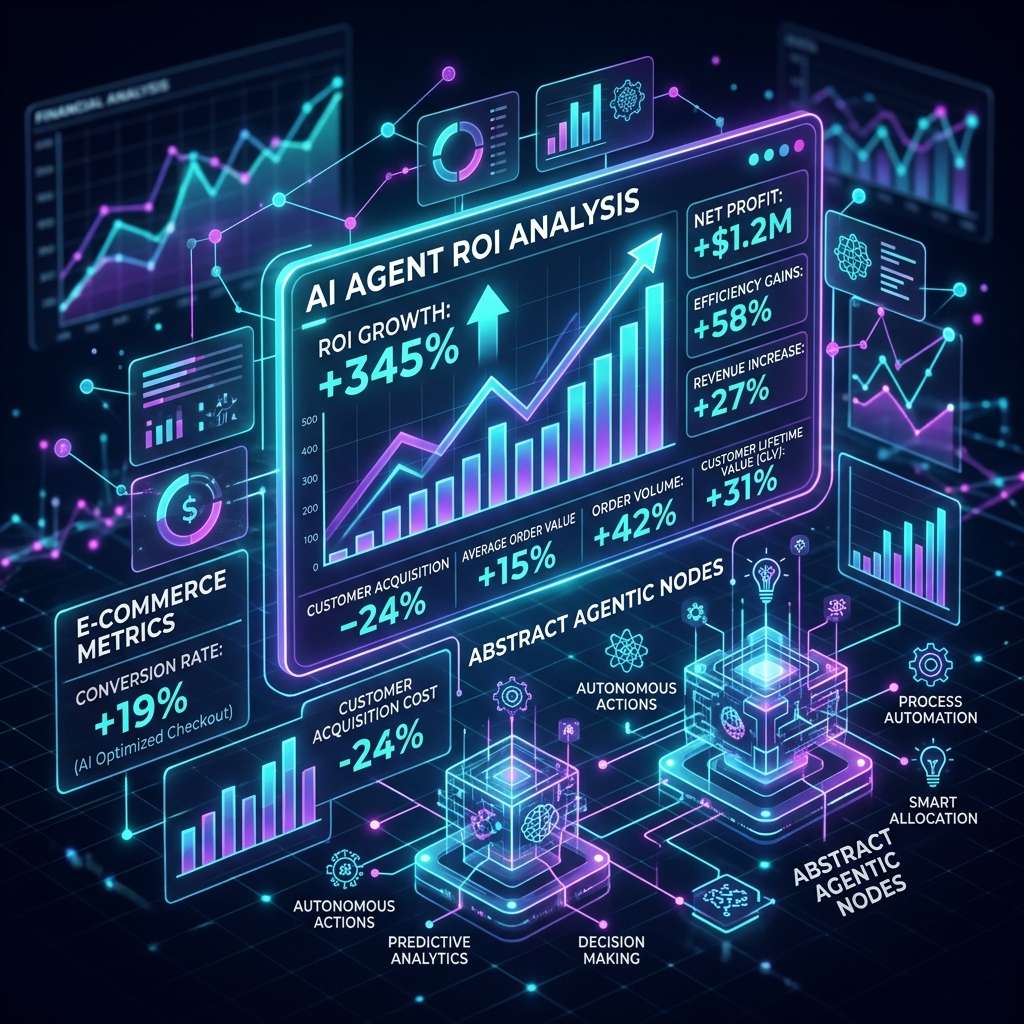
Omdia (in research conducted with Snowflake) says: 92% of early adopters see a positive return on their gen AI investments. Respondents who quantified their ROI reported $1.49 back for every $1 invested. And 44% of organizations with multiple gen AI use cases in production are already using agentic AI.
Deloitte (1,854 executives across Europe and the Middle East) says something else: the typical organization waits 2–4 years for satisfactory ROI on AI. Only 6% see payback within a year. For agentic AI specifically — only 10% of organizations see significant, measurable results right now.
How is this possible? Same phenomenon, same technology, same year — and such a massive gap?
Both studies are right. They're just measuring different things.
Where the Gap Comes From
Omdia measured "early adopters" — companies that deliberately chose a narrow, measurable use case and shipped it to production. Deloitte surveyed the general population of organizations — including those that "deployed AI" broadly, without specific business objectives, because they needed to show the board they were doing something with AI.
That explains everything.
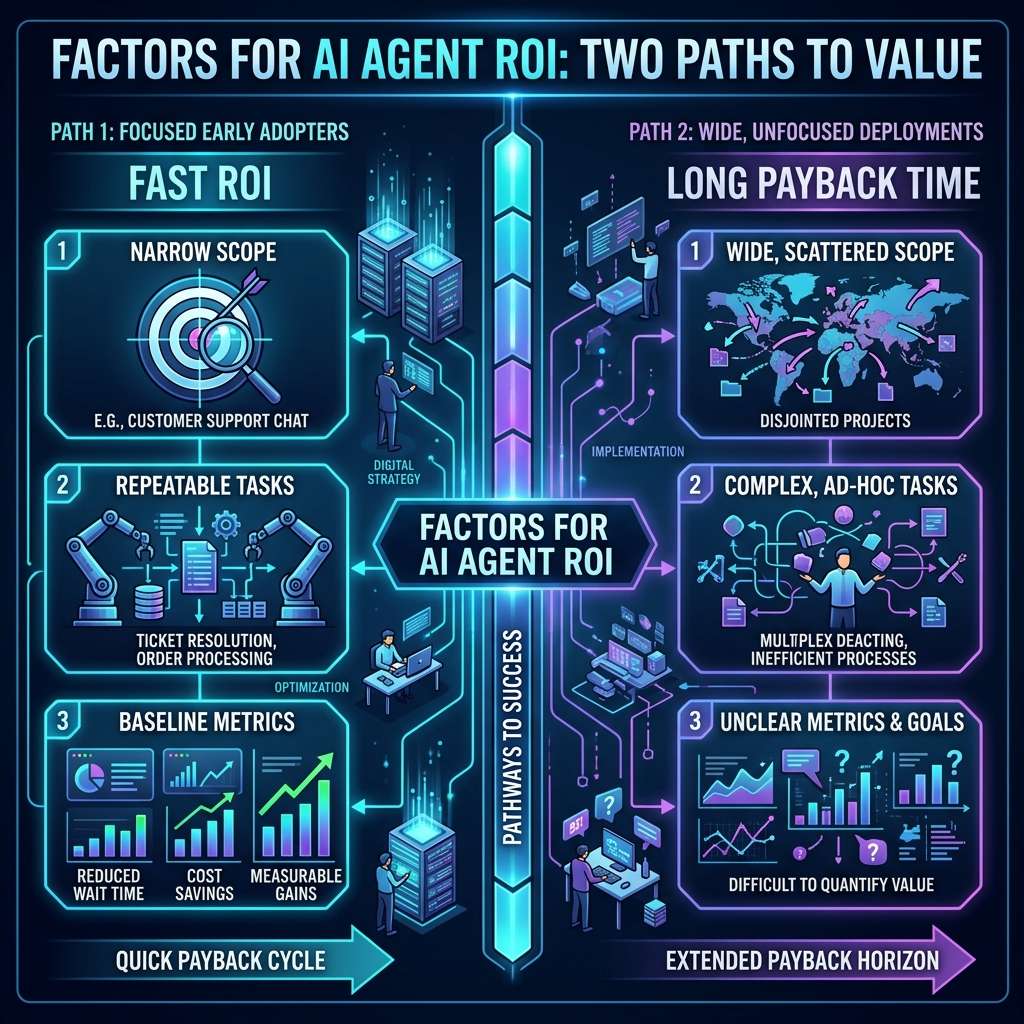
AI agent ROI isn't evenly distributed across companies. It concentrates where specific conditions are met. And this isn't theory — it's a pattern visible across every serious study and every credible case study.
Those conditions are:
Narrow scope. One agent, one task, one goal. Not "AI across all departments," but "an agent to handle return requests in our e-commerce store."
Repeatability. The task must run multiple times — daily, hundreds of times. An agent that does something once a week will rarely deliver ROI before the next annual budget cycle.
Measurable output. Do you have a defined KPI before you deploy the agent? Did you measure the baseline? If not — after deployment, you won't know if it's working or just seems to be working.
Adoption that actually happens. Possibly the most overlooked point. An agent can be technically excellent, but if the team bypasses it because "it's faster the old way" — you won't see ROI.
One person accountable for the result. Not "IT deployed it," not "the AI project is in progress." A specific person, a specific goal, a specific date.
When these five conditions are met, the data says: payback within 13 months, average 2.3x ROI. When they're absent — you fall into Deloitte's 4-year horizon.
Three Case Studies That Convinced Me
I spent months looking for examples with concrete, verifiable numbers — not "we improved efficiency," but hard before-and-after data. Here are three I consider most representative.
Madison Reed — subscription management agent
Madison Reed is a US hair salon chain and hair color brand. In 2024/2025 they deployed an AI agent called "Madi" on the Sierra platform — it handles subscription management, appointment booking, and product questions.
Results: the agent now handles 90% of all website traffic. Subscription cancellation rate dropped fivefold. Savings generated by the agent cover more than half the annual customer service team cost. The key success factor, according to CEO Amy Errett: they started with one very narrow task — subscription handling — before expanding scope.
Klarna — the largest public agentic AI deployment in customer service
Klarna, the Swedish fintech powering payments for Nike, Macy's, and Expedia, launched an AI agent built with OpenAI in February 2024. In its first month, the agent handled 2.3 million conversations — two-thirds of all CS inquiries — equivalent to the work of 700 full-time agents. Response time dropped from 11 minutes to under 2 minutes (82% improvement), repeat inquiries fell 25%. Estimated 2024 savings: $40M. By Q3 2025, the agent was doing the work of 853 agents, with savings growing to $60M annually.
But — and this is the most valuable part of the story — in May 2025, CEO Sebastian Siemiatkowski publicly acknowledged that pushing too hard on cost-cutting at the expense of quality was a mistake. Klarna began rehiring human agents for complex cases. Siemiatkowski put it this way: "Basic tasks AI handles better than humans. Complex problems still require human interaction — and that's where satisfaction is higher with a skilled agent."
Lesson learned for any company: narrow scope works. An AI agent handles "check payment status," "reschedule delivery," "process a refund" excellently. But escalation to humans — and the quality of that escalation — isn't a detail. It's half the success of any deployment.
Reddit — Agentforce for advertiser support
Reddit deployed Salesforce Agentforce to handle B2B advertiser inquiries. Result: chat inquiry resolution time shortened by 84%. This case is particularly interesting because Reddit operates a complex, multilingual user base — and even there, agentic AI delivered a measurable result in a narrow, well-defined task.
What's Actually Changing in E-commerce in 2026
I write about SaaS and e-commerce together because these two worlds are converging faster than anyone predicted.
In e-commerce, there's a real shift underway that I've started calling "Agentic Commerce." The traditional model — customer opens a browser, filters products, clicks "buy" — is being displaced by a model where a shopping agent acts on behalf of the customer.
What does this mean practically?
Your product page stops being a destination. It becomes structured data that an AI agent analyzes in milliseconds before making a purchase decision. If your data is incomplete, stale, or machine-unreadable — the agent just picks a competitor.
Already, 60% of Google searches end without a click. And that's before mass adoption of shopping agents. Traditional SEO won't disappear, but something new is growing beside it — GEO (Generative Engine Optimization) and AEO (Answer Engine Optimization). If you're not thinking about this, you're building a 2020 visibility strategy.
40% of B2B SaaS companies adopted outcome-based pricing in 2026, not per-seat. This is a direct response to AI agents replacing humans as system "users." Seat-based licensing starts losing its logic — because an agent doesn't have a seat.
A Checklist for Deploying Your First Agent with Real ROI
Before you deploy anything — before you open your IDE, before you call a platform vendor — answer these questions honestly:
Problem definition:
- Can I describe the agent's task in one sentence?
- Is this task performed at least once a day?
- Do I have historical data to establish a baseline?
Measurability:
- Which specific KPI will change after deployment?
- Do I know what success looks like after 90 days?
- Who in the organization owns this KPI?
Technical readiness:
- Is the source data current and consistent?
- Do I have an API or integration with the system where the agent will operate?
- Do I know when the agent should escalate to a human?
Deployment:
- Am I starting with 2–3 agents max, not an "AI workforce"?
- Do I have monitoring from day one?
- Was the team that will work with the agent involved in designing it?
Three or more "don't know" answers? Before you invest in an agent, invest in your data and processes. Seriously — better ROI.
The Traps I've Seen Most Often
The breadth trap. "We'll deploy AI across all departments at once" — that's a recipe for Deloitte's 4-year horizon. Start narrow. One agent, one problem.
The tool trap. You pick a platform before defining the task. Remember: an agent isn't a tool — it's an employee. Write the job description first, then hire.
The adoption trap. The agent works but nobody uses it — because "the old way is faster" or "I don't trust it yet." This is the most expensive deployment mistake. Measure adoption like conversion. Treat it like a product.
The observability trap. You don't know what the agent is doing or why it's making decisions. Companies with the best results aren't those with the best models — they're those who can see every agent decision and quickly identify failure patterns. Agent monitoring isn't optional. It's the foundation.
One Last Thing
Let me circle back to where I started: I was a skeptic. Now I'm a cautious optimist.
The data is clear: when scope is narrow, the task repeatable, and the output measurable — ROI follows. Not in four years. Much sooner.
But when those conditions aren't in place? You get another pilot that never reaches production, and another slide in the board presentation about "digital transformation."
So before asking "are we doing enough AI?" — ask yourself one question: "Do we have a specific task, a measurable output, and a clear definition of success?"
If yes — start. If not — spend two hours defining that first. It's the best investment you can make before any deployment.
Sources
- Omdia for Snowflake – The Radical ROI of Generative AI (survey fielded August–September 2025) – https://www.snowflake.com/en/lp/radical-roi-generative-ai-short-form/
- Ajelix – What AI Studies Say About Agentic AI ROI & Stats (And What They Don't), 2026 – https://ajelix.com/ai/agentic-ai-roi-stats/
- Salesforce – Lessons in ROI from the World's Largest Agentic AI Deployment, 2025 – https://www.salesforce.com/eu/blog/lessons-in-roi-agentic-ai-deployment/
- PBI Analytics / LinkedIn – The ROI of Agentic AI: Real-World Case Studies and Numbers, 2026 – https://www.linkedin.com/pulse/roi-agentic-ai-real-world-case-studies-numbers-pbi-analytics-vlpwc
- SalesManago – Agentic Commerce: How E-commerce Will Change in 2026 – https://www.salesmanago.pl/blog/agentic-ai-ecommerce
- EITT – AI Agents 2026 — Guide from LLM to Multi-Agent Systems, 2026 – https://eitt.pl/baza-wiedzy/ai-agenty-2026-przewodnik-od-llm-do-multi-agent-systems/
- IdeaProof – State of AI Agents & Automation 2026, 2025 – https://ideaproof.io/reports/state-of-ai-agents-automation-2026
Comments
Comments are powered by Cusdis. The widget only loads after you click.