AI-first vs Data-first: Which strategy wins in production systems?
Experts agree: data quality surpasses model size. Analysis of AI deployment approaches in production shows that durability requires a data-first strategy.
Paradigm shift: from AI-first to Data-first
Over the past 18 months, we've observed a fundamental shift in how teams deploy AI in production. The consensus is clear: "Data-first is the new AI-first" for systems meant to run for years, not weeks. This isn't an academic discussion – it's the difference between a prototype and a system that will survive the next quarter.
The numbers speak for themselves. The performance gap between the top model and the tenth has shrunk from 11.9% to 5.4% in a year, and the two best models are separated by just 0.7%[1]. When all models are "good enough," the choice between GPT-4 and Claude ceases to be a strategic decision. The real differentiator becomes what we feed these models – data quality, context, retrieval pipeline.
At the same time, inference costs have dropped over 280-fold between November 2022 and October 2024[1]. This isn't incremental improvement – it's a category change. Access to computational power has ceased to be a barrier to entry. Any startup can now launch an API with a GPT-4-level model for a fraction of the budget from two years ago. The democratization of AI means that competitive advantage has shifted from "we have access to the model" to "we have the data and infrastructure that leverages it."
Practitioners see this firsthand. Analysis of bottlenecks in production systems shows that the problem doesn't lie in model speed, but in data pipelines – retrieval, preprocessing, context assembly[2]. Clean, well-structured data raises performance more than switching between models. Retrieval quality – what exactly you feed the model at runtime – often matters more than the size of that model.
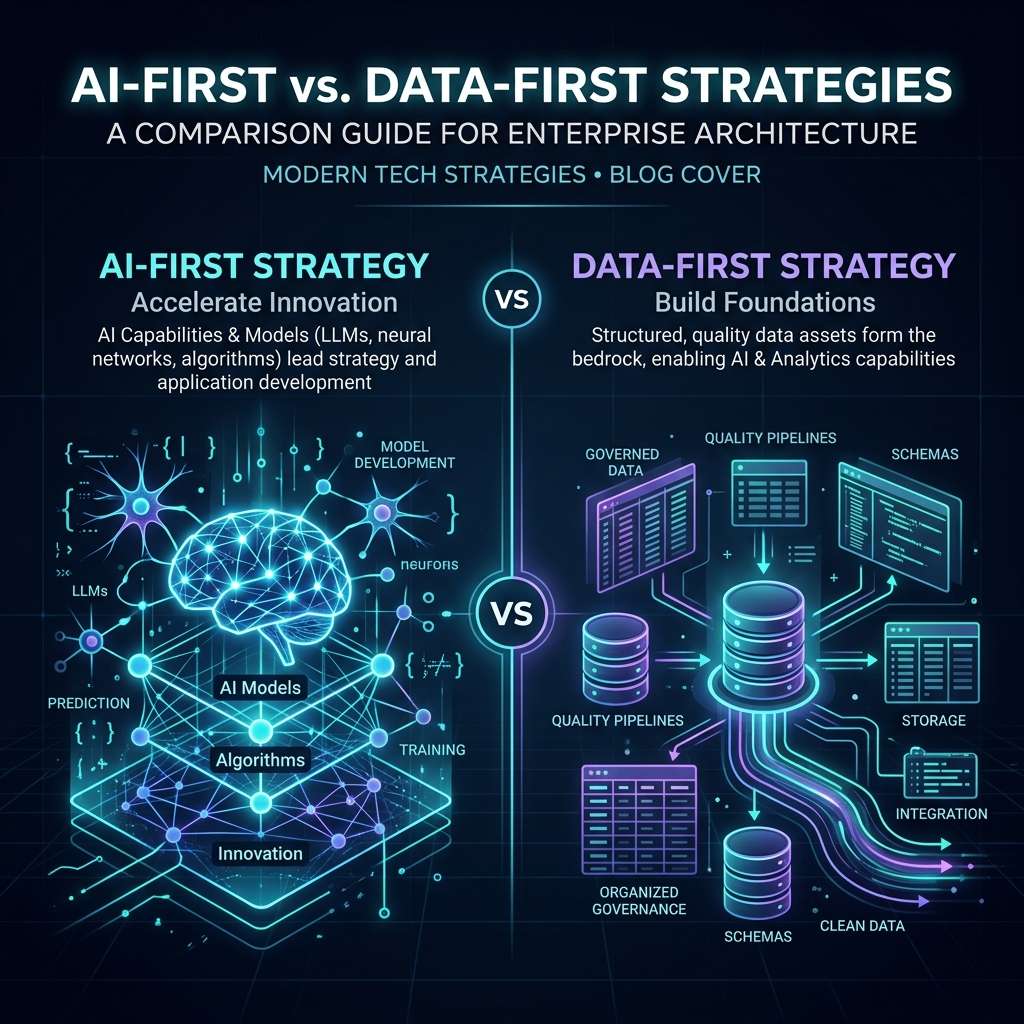
The difference in approaches is brutal. AI-first is: choose model → integrate → fix data when something doesn't work. Data-first is: collect → clean → unify → govern → only then apply AI. The first gives you a quick demo, the second gives you a system that will survive an audit, scaling, and team rotation. In production, durability counts, not the wow-effect at a board presentation.
Waymo delivers over 150,000 autonomous rides weekly – this isn't an experiment, it's an operation at scale[1]. Such systems don't emerge by throwing the latest model at a problem. They emerge through years of building data infrastructure that ensures quality, governance, and reproducibility. This is the difference between AI-first and Data-first in practice.
Strategy comparison: AI-first versus Data-first in numbers
We're talking about two fundamentally different approaches to deploying AI in production. AI-first is a "model first" strategy – you choose GPT-4, Claude, or another model, integrate it, and adjust the data along the way. Data-first reverses this order: first you collect, clean, unify, and govern data, only then do you apply AI.
The difference in results is brutal. AI-first gives you proof-of-concept in weeks, sometimes days. You show the board a demo, everyone is thrilled. The problem? When you go to production, it turns out you have leaky data, the model drifts, and the compliance team blocks deployment. I've seen projects where 80% of time after MVP went to rewriting data pipelines.
Data-first is slower at the start, but wins in production over the long haul. Lower operational risk, compliance out-of-the-box, proven ROI. Key observation from practice: clean, well-structured data improves model performance more than switching from GPT-4 to the latest Claude. Retrieval quality (what you actually feed to the model at runtime) often matters more than the size of the model itself.
Numbers from the Stanford AI Index 2025 show something significant: the gap between the top and 10th model in rankings dropped from 11.9% to 5.4% in a year, and the top 2 are separated by only 0.7%[1]. Models are commoditizing. At the same time, inference cost for a GPT-3.5-class system dropped over 280-fold between November 2022 and October 2024[1]. This means that competitive advantage no longer lies in model choice, but in the quality and architecture of data that reaches it.
In practice, I see it this way: AI-first works in R&D, experiments, quick prototypes for business. But if you're building a production system that needs to run 24/7, handle millions of requests, and meet regulatory requirements – Data-first isn't an option, it's a necessity. Waymo delivers over 150,000 autonomous rides weekly – this doesn't happen without rock-solid data infrastructure[1].
Technical realities: where the real bottlenecks lie
In production today, we have a paradox: the performance gap between the top model and the tenth in rankings dropped from 11.9% to 5.4% in a year. The two best models are now separated by only 0.7%[1]. At the same time, inference cost for GPT-3.5-class systems dropped 280-fold between November 2022 and October 2024[1]. Sounds like an AI-first success? In practice, these very numbers show that the battle has moved elsewhere.
The real bottleneck: retrieval, not inference
As models become cheaper and more aligned, what matters is what you feed them at runtime. Retrieval quality – what data reaches the context at query time – often has greater impact on results than choosing between GPT-4 and Claude. I've seen projects where switching from model A to B gave 3% accuracy improvement, while organizing the vector store and better document chunking – 18%.
The problem is that data pipelines at most companies weren't designed for real-time retrieval. They emerged as batch ETL for reporting, now we're trying to overload them with queries with <200ms latency. The effect? Your models wait for data longer than they generate responses.
Data cleaning > model shopping
We now have a situation where clean, well-structured data improves model performance more than switching between models. This isn't theory – it's a consequence of LLM capability alignment. When the difference between models is in the per mille range, a quality gap in input data on the order of 15-20% (typical in uncleaned enterprise datasets) dominates the entire equation.
Example from automotive: Waymo delivers 150,000+ autonomous rides weekly[1]. This works not because they have the best perception model, but because they have the cleanest, most structured training and validation data collected over years. A model can be replaced in weeks, but recreating such a dataset takes years of work.
Where to actually optimize
In a typical production ML system, 60-70% of request-response time is retrieval and preprocessing, 20-30% is inference, the rest is postprocessing. Optimizing the model? You're attacking 20-30% of the problem. Optimize the data pipeline – vector indexing, caching, chunking strategy, metadata filtering – you get 2-3x greater leverage.
Data-first doesn't mean "forget about models." It means: invest in infrastructure that allows you to quickly swap models without rewriting the entire system. Because in a year you'll want an upgrade, and your data pipeline will either enable it or block it.
Risk profile and durability of production systems
When you deploy a model to production, the question is: how long will this survive? Market data is brutal – AI-first systems show higher risk of model drift, bias, and data gaps. Why? Because you start with model selection, integrate it, and only then adjust data "as needed". It's like building a house from the roof.
Model drift isn't an abstraction, it's an operational cost
In practice, I've seen teams that rebuild pipelines every 3 months because the model stopped working on new data. The Data-first approach reverses this dynamic: collect → clean → unify → govern → only then apply AI. Sounds slower? Maybe at the start. But in production, this translates to lower operational risk and compliance. When you have a solid data layer, swapping the model (and you will do this – the gap between top models is now only 0.7%) doesn't require rewriting the entire system[1].
SaaS sprawl: symptom, not disease
Teams buy more tools because they don't have access to information. Slack, Notion, 5 different dashboards – this is compensation for poor data access. A Data-first strategy reduces this chaos through a context layer. Instead of 10 tools for "finding things," you have one coherent layer that knows where data is and who can see it. This isn't just budget savings – it's reducing the surface area for errors and security gaps.
Resilience to change is foundation, not feature
The AI ecosystem changes every quarter. Inference cost dropped 280-fold in 2 years, new models come out every month[1]. Systems based on solid data foundations are resilient to these changes – you swap the model like a cartridge in a printer. AI-first? Every change is potentially rewriting integrations, because data was "adapted to the model." I've seen projects where migration from GPT-3.5 to GPT-4 took 4 months. Not because of the API – because all preprocessing was hardcoded for the previous model.
Governance isn't an add-on
In Data-first, compliance and governance are built in from day zero. You know where data comes from, who changed it, what transformations it went through. Audit? You have logs. GDPR? You have lineage. In AI-first, you add governance post-factum, when the regulator knocks on the door. And then it turns out you don't know which training data contained PII, because "the model was already trained by the vendor."
Plain truth: retrieval quality (what data you provide at runtime) matters more than model size. You can have the best LLM on the market, but if you feed it garbage from 5 unintegrated sources, you get garbage responses. Data-first isn't philosophy – it's an engineering discipline that determines whether your system survives more than one sprint.
Model convergence: why data becomes the differentiating factor
The performance gap between the best and second-best AI model today is just 0.7%. A year earlier, the gap between the top model and the tenth in rankings was 11.9% – now it's only 5.4%[1]. When all perform at a similar level, competitive advantage must come from something else.
That "something else" is data. Not quantity – quality, freshness, context. In production, we already see the effects of this convergence: clean, well-structured data improves performance more than jumping to a newer model. Retrieval quality – what you actually feed the model at runtime – often matters more than the model size itself.
Waymo delivers over 150,000 autonomous rides weekly[1]. This is no longer an experiment or pilot – it's production scale. And this scale wasn't achieved through a better perception model, but through massive infrastructure for collecting, validating, and utilizing data from real road scenarios. Each ride generates gigabytes of training data for edge cases.
At the same time, inference cost dropped over 280-fold between November 2022 and October 2024[1]. Models are becoming commodity – available through APIs, cheap, interchangeable. Organizations that invested in solid data pipelines can swap models in an hour. Those that bet everything on a specific model must rewrite entire systems.
In practice, this means a shift from the question "which model to choose?" to "how to build infrastructure that will survive the next 5 generations of models?". Google Cloud already documents over 100 enterprise GenAI use cases, but the common denominator of successful deployments isn't model choice – it's governance, lineage, and quality assurance at the data level[3]. Companies that understand this build an advantage that competitors won't catch up to by buying access to GPT-5.
Practical implications for system architecture
If you start with the model and only later "tune" the data, you're building on sand. In production, this ends the same way – rewriting the pipeline in six months, because nobody predicted where training data should actually flow from or how to version it.
The data-first sequence (Collect → Clean → Unify → Govern → Apply AI) sounds boring, but gives predictability. You know what data you have, in what state, who's responsible for it, and how quickly you can refresh it. Only then do you choose a model – and then the choice is informed, based on actual data attributes, not assumptions from a demo.
The AI-first sequence (Select model → Integrate → Tune data) means quick PoCs and board presentations. The problem starts at scale: the model requires data in format X, but production sources give format Y. Tuning turns into an ETL nightmare, and every model change requires rewriting transformations. This is classic technical debt – quick start, expensive payback.
Context layer – an abstraction layer over data sources – reduces this friction. Instead of integrating each model directly with databases, lakes, and APIs, you build one unified interface. The model retrieves data through the context layer, which knows how to normalize it, tag it with metadata, and log access. Source change? You fix it in one place, not in ten models. Bonus: less SaaS chaos, because you don't buy tools for every new use case.
Data pipeline requires the same attention as the model – this isn't "just engineering". If retrieval is slow, the model will wait. If data is dirty, no tuning will help. In practice, I see this constantly: teams spend weeks on hyperparameters, while the pipeline that delivers features is held together with duct tape and prayer. Data-first reverses priorities – first solid foundation, then model. And this works in the long term.
Checklist: how to choose a strategy for your production system
Before deploying AI in production, you must answer one key question: is your data infrastructure ready? The difference between success and costly refactoring often comes down to the order of steps. Data-first is collect → clean → unify → govern → apply AI. AI-first is select model → integrate → tune data as needed. The first gives you reliable, scale-ready AI with proven ROI, the second quick PoCs with high rework risk.
Assess infrastructure maturity
Start with a pipeline audit. If your model inference takes 50ms, but data retrieval 2 seconds – the bottleneck isn't in AI. Recent analysis states directly: "Your AI Models Aren't Slow, but Your Data Pipeline Might Be"[2]. Measure latency at each stage: data retrieval, preprocessing, feature engineering, inference, postprocessing. In 80% of cases, the problem lies before the model, not in it.
Check data quality metrics: completeness (what % of records have all fields), consistency (are values coherent between systems), timeliness (how old is data at inference time). Clean, well-structured data improves model performance more than switching between models. The gap between top and 10th model is now only 5.4%, between top 2 just 0.7%[1]. This means that jumping from GPT-4 to Claude 3.5 will give you less than improving input data quality.
Governance and context layer
Build a context layer before you start multiplying AI tooling. This is a layer that aggregates data from different sources and delivers it in a unified format. It reduces SaaS sprawl – teams stop buying more tools just because they don't have access to information. In practice: instead of 5 different AI tools for different departments, you have one data layer and model selection at the application level.
Governance isn't bureaucracy, it's an insurance policy. Set up data lineage (where each feature comes from), access controls (who can use what data), retention policies (how long you store training data). Without this, every compliance audit is a nightmare, and reproducing production results – a lottery.
Monitoring: drift isn't optional
In production, monitor model drift and data drift as equal metrics. Model drift: accuracy drops from 94% to 89% in 3 months. Data drift: income distribution in training data had median $45k, in production you see $62k. Both kill performance, but data drift is more insidious – the model "works," just on wrong data.
Set alerts for: feature distribution changes (have input values changed), prediction distribution (is the model producing different outputs), ground truth performance (are accuracy/F1 dropping). Retrieval quality matters more than model size – if your RAG system retrieves outdated documents, even GPT-4 won't help.
When AI-first makes sense
Use AI-first only for quick experiments: hackathons, proof-of-concepts, exploration of new use cases. You have 2 weeks to show value? Take a ready model, connect it to a database, see if it works. But if the PoC succeeds and you're going to production – return to data-first. Otherwise, in 6 months you'll rewrite everything, because "worked in demo" doesn't equal "scales to 100k requests/day".
Plan a data-first strategy for durability. This means: budget for data engineering, time for cleaning and governance, infrastructure for monitoring. AI-first gives speed, data-first gives durability. In production, durability always wins.
References
Comments
Comments are powered by Cusdis. The widget only loads after you click.