Lakehouse, RAG and Vector Databases: What from the Modern Data Stack Makes Sense for SaaS?
Pinecone for speed, pgvector for cost control, or Lakehouse for governance? Concrete metrics and case studies for small SaaS teams.
Modern Data Stack for Small SaaS: Hype vs Reality
The brutal truth is that most small SaaS companies implement RAG completely backwards: they choose a model, and only then think about the data. It is like building a house from the roof down. RAG at scale is primarily a data engineering challenge, not a choice between GPT-4 and Claude. The retrieval layer defines whether the system responds in 30 ms or 700 ms, whether it costs $50 or $5000 monthly, and whether users can trust the output.
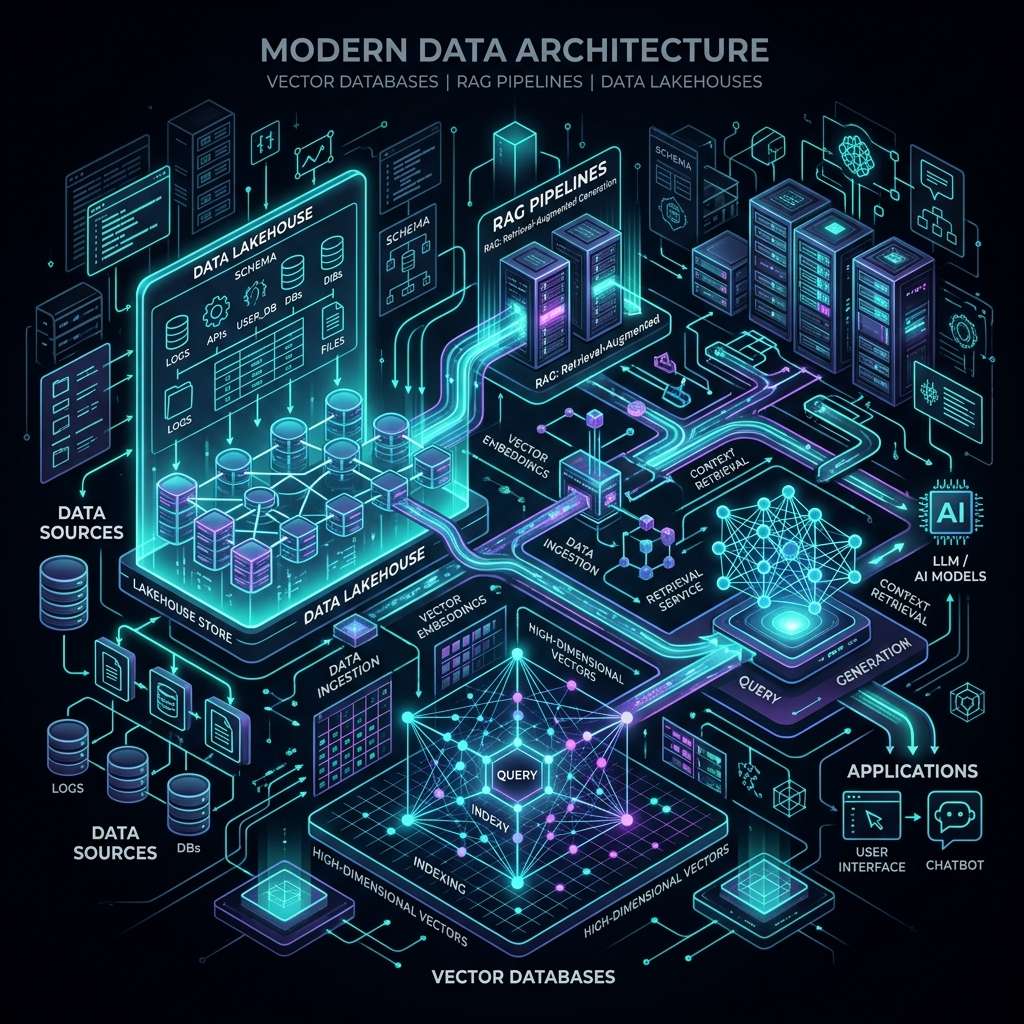
Looking at concrete numbers, pgvector with the pgvectorscale extension delivers 471 QPS at 99% recall on 50M vectors[1]. While this is an excellent result, it also represents a performance ceiling – above 50-100M vectors, performance becomes unpredictable. On the other hand, serverless Pinecone scales to billions of vectors with p99 latency in the tens of milliseconds[2] without requiring 3 AM alerts. The trade-off lies between query costs and operational overhead.
For a small SaaS, there are three main decision axes. Speed and experimentation: Pinecone – zero administration, deployable in an hour, paying per query. Cost and control: pgvector – if PostgreSQL is already in use and the vector count is under 50M, savings of 70-80% of infrastructure costs can be achieved. Trust and governance: Lakehouse (Snowflake Cortex[7], Databricks Vector Search) – when compliance requires tracing the complete path from data source to final answer.
Most teams choose a hybrid path: Pinecone for prototyping, pgvector for small-scale production, and a Lakehouse when data governance becomes a business blocker. The key question is not which database is best, but what trade-offs can be accepted at the current scale and budget, as no single solution provides low latency, full cost control, and enterprise governance simultaneously.
Vector Databases: Concrete Numbers and Scalability Thresholds
Looking at the specifics, pgvectorscale achieves 471 QPS at 99% recall on a dataset of 50 million vectors[1]. That is solid performance for a small SaaS, but there is an important caveat: above the 50-100M vector threshold, this architecture begins to face performance ceilings. At this point, dedicated vector engines stop being optional and become a necessity.
Serverless vector stores like Pinecone have raised the bar significantly higher. They scale to a billion vectors per index with p99 latency under 100 ms; for 10M records Pinecone reports a p99 of about 33 ms[2], handling traffic spikes without manual capacity planning or night alerts. This is a fundamental operational benefit: there is no need to plan storage nodes or handle alerts when traffic increases 10x.
Under the hood, two key algorithms dominate: HNSW (Hierarchical Navigable Small World) and IVF (Inverted File Index)[5]. Both provide Approximate Nearest Neighbor search with extreme speed while maintaining high accuracy even at massive scale. HNSW builds a graph of connections between vectors, while IVF divides the vector space into clusters; the choice depends on the trade-off between recall and latency.
The metrics that really matter in production are Recall@K (how often relevant results land in the top K positions) and query latency (response time). In a live environment, whether the system responds in 10ms or 100ms defines the user experience.
If immediate deployment and zero administration are required, Pinecone is a strong choice. This provides convenience while saving weeks of engineering time. For teams looking for open-source performance and cost control, Qdrant (written in Rust, Apache 2.0) is the preferred choice. Its Rust architecture gives it a clear advantage in high-throughput scenarios.
Weaviate offers strong hybrid retrieval and built-in multi-tenant isolation[4] – crucial for SaaS platforms serving multiple clients. Data isolation between tenants is not just a feature, but a compliance requirement. Milvus is optimized for billion-scale, heavy-ingestion RAG with excellent ingest/query separation, though it has a steep operational learning curve.
For MongoDB-native applications, MongoDB Atlas Vector Search eliminates stack sprawl[8], but is less specialized for vector-first workloads. It is a pragmatic choice when MongoDB is already in the stack and there is no desire to onboard another system.
In practice, RAG at scale is less about the LLM itself, and more about the data pipeline. The choice of retrieval layer defines system speed, trustworthiness, and cost-effectiveness. Vector databases win in low-latency, high-scale similarity search, whereas Lakehouses (Snowflake Cortex, Databricks Vector Search) dominate in governance, lineage, and enterprise integration.
Often, a hybrid approach is a pragmatic solution as Lakehouses mature in their vector capabilities. Choosing one is not strictly necessary; a vector database can be used for hot queries, and a Lakehouse for cold analytics.
Ignoring security leads to row- or column-level access failures. Unexpected costs result from different pricing models: storage and query costs in dedicated vector databases versus compute and storage in Lakehouses. Both scenarios need to be calculated before deciding.
For a small SaaS, the recommendation is straightforward: if the vector count is below <50M and costs must be controlled, pgvector is the recommended path. This leverages the existing PostgreSQL stack and avoids vendor lock-in. If immediate deployment is required and query costs can be absorbed, Pinecone is a suitable choice, saving time that would otherwise be spent on infrastructure debugging.
Pinecone vs Qdrant vs Weaviate: Which to Choose for Your SaaS?
Choosing a vector database is a decision that will determine operational costs for the next 2-3 years. This is not about feature parity – all top solutions have HNSW and metadata filters. It is about whether payment is based on query or compute, whether out-of-memory (OOM) alerts will occur, and whether data isolation between clients is guaranteed.
Pinecone is the choice for teams that want to move fast. Zero administration means scaling to billions of vectors with p99 latency in the tens of milliseconds[2] without manual alerts. Serverless architecture handles traffic spikes automatically without the need to predict load patterns. The limitation is that query costs grow linearly with traffic. While highly cost-effective for initial prototyping, at a scale of 1000 clients and 50M queries monthly, serverless billing can scale significantly.
Qdrant is an open-source engine written in Rust (Apache 2.0) – a high-performance engine built for production workloads[3]. The Rust architecture gives it an advantage in high-throughput workloads. For teams with DevOps capacity who want to control costs, this is a strong candidate, allowing hosting on a custom Kubernetes cluster and paying for compute and storage rather than query volume. While pgvectorscale shows 471 QPS at 99% recall on 50M vectors, exceeding 50-100M vectors can lead to scale ceilings. Qdrant gives headroom to billions of vectors without rewriting the stack.
Weaviate offers strong hybrid retrieval and built-in multi-tenant isolation[4]. For multi-tenant SaaS platforms requiring strict data separation where each client has separate embeddings, Weaviate has this built-in. It also supports hybrid search (dense and sparse vectors) out of the box without custom pipelines. This is crucial when keyword matches and semantic search must be combined. The operational overhead is higher than Pinecone, but query costs are lower at high traffic volumes.
A practical heuristic for a small SaaS:
- Below <50M vectors: stick with pgvector to leverage the existing PostgreSQL database without adding new services.
- Above 50M or with unpredictable traffic spikes: Pinecone for speed-to-market.
- DevOps team and high-volume cost optimization: Qdrant.
- Multi-tenant SaaS with strict compliance: Weaviate.
Case studies show that migrating from Pinecone to self-hosted Qdrant can reduce monthly infrastructure costs from $15k to $2k for systems with 200k users. Conversely, attempting to save by hosting complex setups without dedicated resources can result in months of debugging memory leaks instead of developing core features. The choice should align with the main bottleneck: engineering time versus infrastructure budget.
Alternatives: From PostgreSQL to MongoDB Atlas
Before adopting a dedicated vector database, the existing stack should be evaluated. pgvector is often underestimated – benchmarks with pgvectorscale show 471 QPS at 99% recall on 50M vectors. However, after exceeding 50-100M vectors, performance begins to degrade, making dedicated engines a safer choice.
For MongoDB-native teams, MongoDB Atlas Vector Search eliminates stack sprawl, but this comes at the cost of specialization. It benefits teams by avoiding new tool onboarding and synchronization pipelines, allowing them to add a vector index directly to an existing collection.
Milvus is optimized for billion-scale and heavy-ingestion RAG and designed to separate ingestion from querying at scale[9]. However, the operational learning curve is steep, requiring expertise in distributed systems and Kubernetes.
For zero-ops managed deployment, Pinecone remains the leader, scaling to billions of vectors with p99 latency in the tens of milliseconds[2] and handling traffic spikes without manual alerts. Qdrant (Rust, Apache 2.0) is the open-source answer with the best performance in its category, while Weaviate dominates in hybrid retrieval and multi-tenant isolation.
In short: under <50M vectors with PostgreSQL → pgvector; MongoDB-native app → Atlas Vector Search; billion-scale with DevOps resources → Milvus; fast start with zero-ops → Pinecone; maximum control and performance → Qdrant.
Lakehouse: When Governance Wins Over Latency
Lakehouse architecture is highly relevant when governance and data lineage are more important than the last 3 milliseconds of latency. Snowflake Cortex and Databricks Vector Search give you something that dedicated vector databases don't offer out-of-the-box – full integration with the data catalog, automatic embedding lineage, and row-level security from the start.
The trade-off is straightforward: Lakehouses charge for compute and storage, while dedicated vector databases charge for storage and queries. In practice, analytical warehouses like Snowflake cost more per query, but consolidate raw data, feature engineering, and vector search. Dedicated stores like Pinecone or Qdrant offer lower query costs but require managing external data pipelines, adding operational overhead.
For small SaaS startups, a full Lakehouse is often overkill. Unless compliance requirements dictate auditing every retrieval operation and tracking the source of every embedding, dedicated vector databases are more efficient. However, if Snowflake or Databricks is already the core data platform, a hybrid approach is highly pragmatic.
In a hybrid architecture, hot data (e.g., the last 30 days of active embeddings) is kept in Pinecone for low latency, while cold data and historical records remain in the Lakehouse for compliance. Synchronization is handled via CDC or nightly batch jobs. While complex, this scales with organizational maturity.
If the data stack already relies on a Lakehouse and the engineering team has Spark expertise, Databricks Vector Search can accelerate development[6]. If not, deploying a Lakehouse solely for vector storage is not recommended.
Performance Metrics and Cost Traps
Production RAG performance depends on two metrics: Recall@K (how many relevant results hit top-K) and query latency. Pinecone in serverless mode reports p99 latency of about 33 ms for 10M records and under 100 ms at a billion vectors[2], and pgvector with pgvectorscale extension delivers 471 QPS at 99% recall on 50M vectors, but exceeding this threshold impacts performance. These metrics represent the difference between stable production and critical on-call incidents.
Most production failures stem from ignoring row-level and column-level access control. Storing multi-tenant data in a single index without proper isolation risks exposing sensitive customer data across boundaries. Weaviate provides built-in multi-tenant isolation, though this must be planned from the initial design phase.
Cost spikes are often only discovered after the first billing cycle. Vector databases charge for storage and queries (per similarity search), while Lakehouses bill for compute and storage (transformations and analytical queries). If the vector count is under <50M and PostgreSQL is in place, pgvector is the logical choice. Above 100M or when facing traffic spikes, a dedicated engine like Pinecone or Qdrant is required.
The key lesson is that RAG is a data engineering problem, not an ML problem. Indexing algorithms like HNSW and IVF are commodity; the value lies in data pipelines, monitoring recall drift, and caching strategies. Speed/experimentation → Pinecone; cost/control with Postgres → pgvector; governance and enterprise integration → Lakehouse with Snowflake Cortex or Databricks Vector Search. Most teams use a hybrid: a fast vector store on the hot path, and Lakehouse for cold storage and compliance.
Decision for Small SaaS: Practical Checklist
For a small SaaS evaluating these options, the following decision matrix is based on production metrics.
Scenario 1: Speed and Experimentation
If time-to-market and zero administration are priorities, Pinecone is the most direct path. Serverless instances handle traffic spikes without manual intervention. While query costs are higher, the setup saves valuable engineering time. For a small team, this trade-off is often more cost-effective than managing infrastructure to save minor hosting fees.
As an open-source alternative, Qdrant (Rust, Apache 2.0) provides equivalent performance with total cost control, though managing the infrastructure requires dedicated maintenance resources.
Scenario 2: Cost Control and Existing Stack
If PostgreSQL is already in production and the vector count is below <50M, pgvector with the pgvectorscale extension is the natural choice. This setup requires no additional systems, leverages existing backups, and simplifies monitoring.
Warning: as the vector count grows into the tens of millions and beyond, in-memory indexes start to hit performance ceilings. Migration to a dedicated engine should be planned well before the system encounters capacity issues.
Scenario 3: Compliance and Governance
For healthcare, fintech, or enterprise clients with strict compliance audits, a Lakehouse (Snowflake Cortex, Databricks Vector Search) is the most reliable option, providing out-of-the-box data lineage, row-level security, and audit logs integrated with existing data governance.
Although retrieval latency is higher than dedicated databases, audit compliance requests can be resolved in minutes rather than days of manual logs tracing.
Hybrid Strategy: A Realistic Path
In practice, most SaaS end up with a combination: pgvector for simple features (documentation search, basic recommendations), Pinecone for core AI features (semantic search, RAG), and export to Lakehouse for analytics and compliance.
Key decision questions:
- Vector volume: <10M → pgvector, 10-100M → dedicated DB, >100M → enterprise solution
- SLA latency: <10ms → Pinecone/Qdrant, <100ms → pgvector, <1s → Lakehouse
- Team: <5 people → managed (Pinecone), >10 people → open-source (Qdrant/Milvus)
- Compliance: none → whatever works, HIPAA/SOC2 → Lakehouse
There is no single best choice, only the correct match for the team's current development stage and business requirements. Common errors include premature optimization (such as deploying Milvus for under 1M vectors) or maintaining pgvector past 200M vectors when query times begin to degrade.
P.S. If you're building RAG applications or managing PostgreSQL databases, using a modern editor can significantly speed up your development workflow. You can check out Cursor, which is an excellent AI-powered code editor for these tasks.
References
- Why Postgres Wins for AI and Vector Workloads – TigerData (Timescale)
- Pinecone Database – product overview and performance
- Qdrant – GitHub repository (Rust, Apache 2.0)
- Multi-tenancy – Weaviate documentation
- Efficient and robust approximate nearest neighbor search using HNSW graphs – Malkov & Yashunin (arXiv)
- Mosaic AI Vector Search – Databricks documentation
- Cortex Search overview – Snowflake documentation
- Atlas Vector Search overview – MongoDB documentation
- Milvus documentation
Comments
Comments are powered by Cusdis. The widget only loads after you click.