Aquaristics E-Commerce Challenges and Asellio: Why Niche Knowledge Can't Be Faked
In aquaristics, a wrong purchase can kill a reef system that took years to build. Why specialized online stores need contextual, knowledgeable AI support — not another generic chatbot.
In the first article of this series, I wrote about the challenges facing pet industry e-commerce broadly: expert questions, seasonality, abandoned carts, and how smaller stores compete against large platforms („Pet Industry E-Commerce Challenges and Asellio"). In the second, I explained why I built Asellio: because a generic chatbot falls short when a customer's question concerns a living creature, tank stability, or a piece of high-value equipment („Why I Built Asellio").
This third article is the one closest to me personally. Aquaristics — particularly marine reef-keeping — is a niche I inhabit not only as a software founder but as an active practitioner. As the creator of Reef Sentinel, I know exactly what it feels like to ask a vendor whether a specific light can support SPS corals, whether a skimmer is appropriately sized for a given bioload, whether a calcium reactor makes sense for a particular setup, or whether two chemical additives can be safely combined. These are not "which color do you prefer?" questions. These are questions on which the health of an entire living system can depend.
A Growing Market With Increasingly Complex Purchase Decisions
According to Fortune Business Insights, the global aquarium market was valued at $4.00 billion in 2025 and is projected to reach $7.00 billion by 2034, at a CAGR of 6.5% from 2026 to 2034 [1]. Europe is a significant part of this growth: the European aquarium market is estimated at $1.15 billion in 2025 and $1.22 billion in 2026. Grand View Research valued the European ornamental fish market at $2.45 billion in 2023, forecasting a CAGR of 7.9% through 2030 [2].
FEDIAF data adds further context: over 17.6 million aquariums are in operation across Europe, nearly 400,000 of them in Poland alone [4]. In 2024, Poland's live ornamental fish imports reached $3.64 million USD and over 92,000 kg [5]. This is not a hobbyist niche in any marginal sense — it is a functioning commercial ecosystem spanning livestock, filtration, lighting, water chemistry, live plants, and control hardware.
For an online store, this means one thing: customers are no longer simply buying "an aquarium and a filter." They are purchasing a system of interdependencies — tank volume, bioload, water parameters, lighting, flow rate, biology, chemistry, logistics, and their own experience level.
Purchase Mistakes Hurt More Than in Typical E-Commerce
In aquaristics, cart values can be high, and tolerance for error is very low. A single marine aquarium LED light can exceed 5,000 PLN [7]. Calcium reactors in Polish stores range from 4,000 to over 7,500 PLN [8]. Neptune Apex controller systems fall between $300 and $1,700 USD [9].
But price is not the core issue. Incorrectly specified equipment generates losses that can far exceed the product's value. Undersized filtration, excessive lighting intensity, incorrect flow rate, misdosed additives, or chemically incompatible supplements can mean the loss of fish, shrimp, plants, or corals. For the customer, that is not only a financial loss but also months of effort and — for long-time hobbyists — an emotional investment in a living system.
That is why "will this light work?" actually means: "given my tank's dimensions, depth, bioload, and coral type, will this damage my ecosystem?"
Knowledge Migrates Off-Site: Forums Win the Pre-Purchase Decision
Aquarists systematically seek advice outside the store. Reef2Reef, the largest English-language reef forum, hosts over 200,000 registered members and hundreds of thousands of threads covering water chemistry, equipment selection, and additive compatibility [12]. Polish forums show the same pattern: users ask about filter selection for 300L tanks, filtration media, specific models, and over-filtration risk — all before purchasing [13].
This is a critical warning sign for stores. When a customer has to leave the product page to find expert validation on a forum, the store loses control over the decision moment. The sale can be lost not because of price but because the store failed to provide competent, timely answers at the point of intent.
The PAR debate is a clear illustration. Community members explain to each other that values below 100 µmol/m²/s are generally considered low, above 250–300 as high, and that the typical "sweet spot" for SPS corals sits around 200–300 — but immediately add caveats: acclimation protocol, species variation, light spectrum, and nutrient levels all shift the answer [10][11]. That "it depends" is precisely the problem that generic chatbots cannot resolve.
Live Animal Logistics Creates a Separate Support Layer
Stores selling live organisms operate on a fundamentally different rhythm from accessory-only e-commerce. Shipping fish, shrimp, snails, plants, or corals depends on temperature at both dispatch and destination, transit time, oxygen supply, packaging quality, stress levels, and the customer's acclimation process after delivery.
Aquarium Co-Op recommends checking weather conditions at both origin and destination, and avoiding livestock shipping when temperatures drop below 0°C or exceed 32°C [15]. Garnelio highlights clean transport water, oxygen-conscious packaging, and minimizing transit stress [16].
In practice, this creates dozens of post-purchase support questions: exact dispatch timing, what to do if the courier is delayed, proper acclimation steps, and how to recognize and respond to post-transit stress. During heat waves and hard freezes, this category of inquiry alone can overwhelm a store's support capacity.
Competition Is About Trust, Not Price
In general pet retail, the pricing pressure from large platforms is easy to identify. In aquaristics, the market is more fragmented. Archive Market Research describes the European ornamental fish market as "largely fragmented," with numerous regional and local suppliers [17]. This means smaller specialist stores can compete not on price but on competence, advice availability, and service quality.
The problem is that this competence cannot be manually scaled. A great aquaristics salesperson understands the difference between a 200L soft coral system and a 200L high-density SPS setup. They know that a "8,000 L/h pump" does not mean the same thing across contexts — actual flow at head height, sump configuration, and noise output all matter. And they know when to tell a customer: "Don't buy that yet — stabilize your parameters first."
How Asellio Can Support Aquaristics Retailers
Asellio is not designed to be a generic bot pretending to be an expert on everything. In aquaristics, that would be dangerous. The approach is grounded in RAG (Retrieval-Augmented Generation): the assistant responds based on the specific store's knowledge — product descriptions, care guides, shipping policies, FAQs, historical support cases, and safety rules.
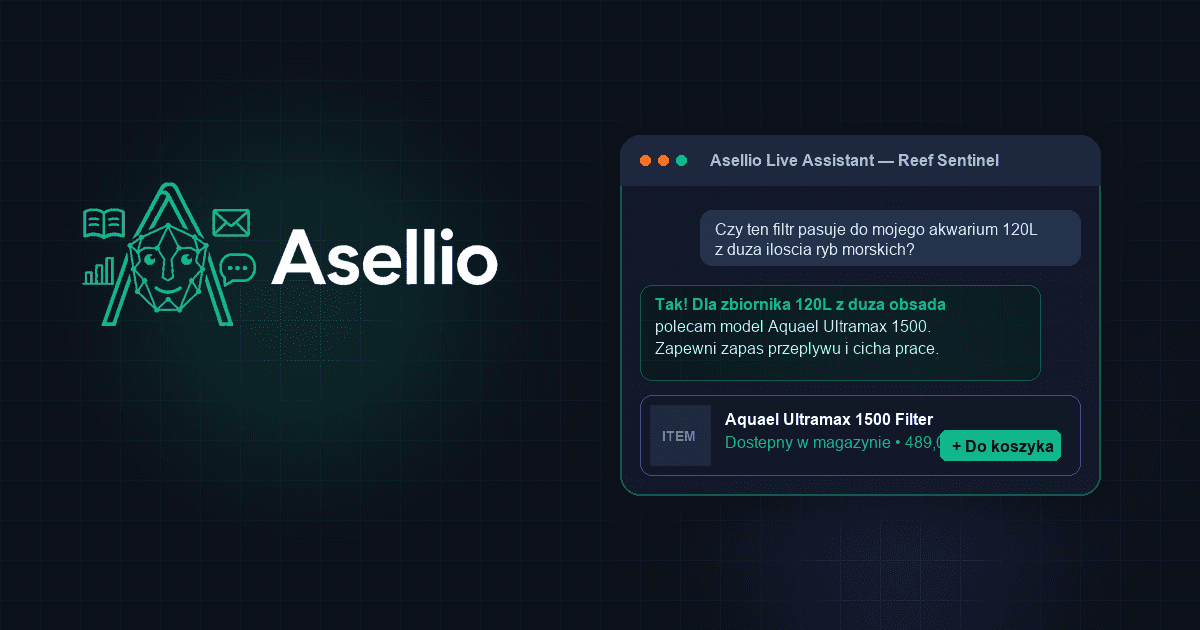
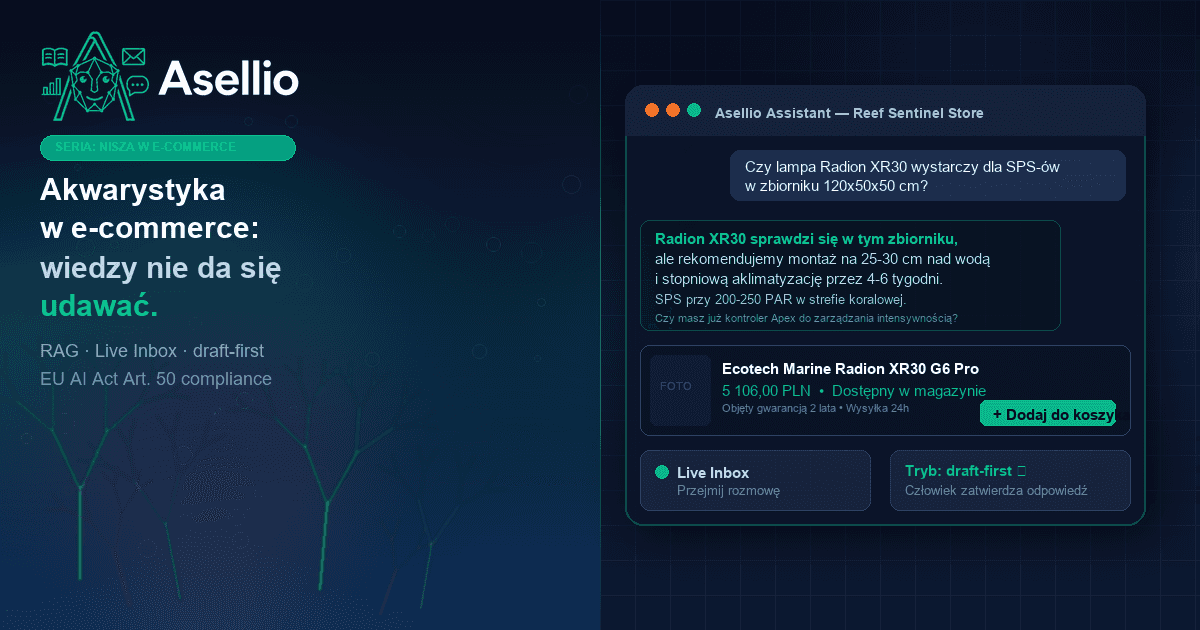
When a customer asks whether a given light is sufficient for SPS corals, Asellio should not simply read the wattage from the product listing. It should ask for context: tank dimensions, water column depth, planned bioload, and current lighting. When a customer raises questions about tank overcrowding or mixing chemical additives, the system should not force a product recommendation — it should be capable of saying "I need more information" or "I'm routing this to a team member."
That is why Live Inbox and the draft-first model are central to the architecture. AI prepares a response, but a human can approve, edit, or take over entirely. In a niche as sensitive as aquaristics, a human in the loop is not a bottleneck — it is a layer of accountability.
There is also a regulatory dimension: Article 50 of the EU AI Act, applicable from August 2, 2026, requires deployers of AI systems to inform users when they are interacting with an AI rather than a human — particularly relevant when the conversation concerns living creatures [18].
Closing Thoughts
Aquaristics e-commerce is not straightforward product retail. It is the sale of technical decisions in an environment where a mistake can cost more than the order's margin — and where the customer on the other end is often responsible for a living, fragile system.
That is exactly why I consider aquaristics one of the most demanding and most meaningful tests for Asellio. If the system can support an aquaristics store thoughtfully, cautiously, and contextually, it will handle most other niches as well.
If you run an aquaristics store and feel that your domain knowledge is your greatest competitive advantage — but also the hardest thing to scale — I would be glad to talk.
— Grzegorz Kamiński, CEO of Reef Sentinel Sp. z o.o., Creator of Asellio
This article was prepared with the assistance of AI tools for market data synthesis and thoroughly reviewed by the author (in compliance with Art. 50 AI Act transparency obligations).
P.S. If you build agentic workflows or e-commerce integrations, having the right development environment matters. Check out Cursor — an excellent AI-powered code editor for daily development work.
References
- Fortune Business Insights — Aquarium Market Size, Share & Trends: https://www.fortunebusinessinsights.com/aquarium-market-110692
- Grand View Research — Europe Ornamental Fish Market Size: https://www.grandviewresearch.com/industry-analysis/europe-ornamental-fish-market-report
- GlobalPETS — Sink or swim? Europe's aquatic pet market: https://globalpetindustry.com/article/sink-or-swim-europes-aquatic-pet-market/
- FEDIAF — Facts & Figures 2025: https://europeanpetfood.org/wp-content/uploads/2025/06/FEDIAF-Facts-Figures-2025.pdf
- World Bank WITS / Comtrade — Poland live ornamental fish imports 2024: https://wits.worldbank.org/trade/comtrade/en/country/POL/year/2024/tradeflow/Imports/partner/ALL/product/030110
- Animals / PMC — Marine Ornamental Fish Trade in the EU: https://pmc.ncbi.nlm.nih.gov/articles/PMC11201242/
- Terran Polska — Ecotech Radion XR30 G6 Blue LED: https://terranpolska.pl/ecotech-radion-xr30-g6-blue-led-light-oswietlenie-led-do-akwarium-morskiego
- Reefguard — Calcium Reactors: https://reefguard.pl/kategoria-produktu/sprzet/reaktory-wapnia/
- Bulk Reef Supply — Neptune Apex Controller Systems: https://www.bulkreefsupply.com/brands/neptune-systems/apex-controller-systems.html
- Reef2Reef — What is PAR and how much do we need?: https://www.reef2reef.com/threads/what-is-par-and-how-much-do-we-need.792552/
- Reef2Reef — Ideal SPS PAR: https://www.reef2reef.com/threads/ideal-sps-par.839395/
- Reef2Reef — Trends in R2R Active Membership: https://www.reef2reef.com/threads/trends-in-r2r-active-membership-an-unofficial-analysis.1119312/
- e-akwarystyka.pl — Filter selection for 300L tank: https://www.e-akwarystyka.pl/topic18119.html
- FishLore — Aqueon filters and tank size recommendations: https://www.fishlore.com/aquariumfishforum/threads/aqueon-filters-and-tank-size-recommendations.140666/
- Aquarium Co-Op — How to Safely Package and Ship Live Aquarium Fish: https://www.aquariumcoop.com/blogs/aquarium/how-to-ship-live-fish
- Garnelio — The dispatch of aquarium animals: https://www.garnelio.de/en/blog/aquarist-tips/the-dispatch-of-aquarium-animals
- Archive Market Research — Europe Ornamental Fish Market: https://www.archivemarketresearch.com/reports/europe-ornamental-fish-market-61
- European Commission — Transparency obligations under Article 50 of the AI Act: https://digital-strategy.ec.europa.eu/en/faqs/transparency-obligations-under-article-50-ai-act
Comments
Comments are powered by Cusdis. The widget only loads after you click.