Pet Industry E-Commerce Challenges — And Why Automation Alone Isn't Enough
Analysis of pet industry e-commerce challenges. Why generic chatbots fail and how to responsibly combine AI, RAG architecture, EU AI Act compliance, and GDPR with Asellio.
The pet industry is currently one of the fastest-growing e-commerce sectors, but it is also one that penalizes superficial approaches. Across Europe, according to FEDIAF data, approximately 299 million pets live in 139 million households. The European pet food market reached €29.3 billion with an annual growth rate of 9% [1][2].

In regional European markets, the scale is equally impressive. Industry reports highlight over 8 million dogs, 7.2 million cats, and substantial annual expenditures on pet food alone, accompanied by double-digit year-over-year market growth [3].
The trend toward online shopping continues to consolidate. E-commerce research shows that up to 78% of internet users shop online regularly [4][5], with recent quarterly engagement reaching 93% [6][7]. Within the pet niche specifically, up to 85% of pet owners report ordering products online, driven primarily by competitive pricing, extensive catalog variety, and convenient offer comparisons [8].
Having worked for years in marine aquaristics, breeding, and SaaS product development, I observe a distinct operational reality: selling pet supplies online differs fundamentally from selling books, electronics, or fast-moving consumer goods. In the pet sector, purchasing decisions directly impact the health, safety, and well-being of a living creature. This shifts every dimension of operations—from product catalog descriptions to customer support workflows and responsible AI deployment.
1. Customers Seek Consultation, Not Just Low Prices
A primary challenge for pet e-commerce stores stems from the knowledge gap faced by buyers. Pre-sale inquiries are rarely limited to price checks; they involve specific health and technical contexts: selecting diet formulas for sensitive digestive systems, post-surgical cat litter, aquarium filter throughput for specific tank volumes, lighting spectrums for aquatic plants, or supplement dosing and compatibility.
In brick-and-mortar retail, experienced store staff traditionally bridge this information gap [9]. In e-commerce, customers expect immediate guidance—without queueing or waiting until the next business morning for an email reply, often late in the evening when planning purchases.
This dynamic introduces operational risks. Slow responses lead to abandoned carts and lost sales to competitors. Generic, superficial answers erode customer trust. Conversely, crossing the line between product consulting and veterinary advice introduces legal and ethical liability. An automated assistance system must recognize its operational boundaries and clearly indicate: "Based on product specifications, I can compare ingredient profiles, but for medical symptoms or health diagnoses, please consult a licensed veterinarian."
2. Margin Pressure Makes Service Quality the Main Differentiator
Price comparison in digital retail is instantaneous. The majority of online pet shoppers cite competitive pricing and ease of comparison as key selection criteria [8]. Large marketplace platforms and major distributors dominate visibility and volume through massive ad spend [8].
Small and medium-sized specialized pet stores cannot win purely on margin compression. Instead, they build competitive advantage through response speed and expert consultation: providing precise clarifications on single-protein formulas, verifying filter media compatibility, or advising on water treatment protocols.
This is not basic ticket resolution. It is consultative selling executed in digital channels—across live chat, email, and contact forms.
3. Purchasing Uncertainty Drives Cart Abandonment
Uncertainty regarding product fit is a major driver of abandoned sales. Documented e-commerce metrics indicate an average cart abandonment rate exceeding 70% [10]. In pet e-commerce, abandonment rates can be even higher due to specific hesitations: harness sizing accuracy, age-appropriate dietary suitability, or replacement part compatibility for technical gear.
If a technical inquiry receives an answer hours later, the prospective buyer has already completed the transaction elsewhere. If an automated response provides inaccurate fitment advice, the business incurs returns, warranty overhead, and brand damage. The core issue is not a shortage of chatbot widgets, but the deployment of generic chatbots that lack context regarding store inventory, product compatibility, and responsible disclosure.
4. Multi-Channel Pressure on Compact Teams
Operations teams in specialized e-commerce rarely manage a single communication inbox. Questions arrive concurrently via site chat, email, web forms, marketplace messages, order status checks, and return requests. Studies show that over half of consumers actively use AI tools during their shopping journey, expecting instant answers to factual product questions [5].
Customer service expectations continue to rise globally. Instant visibility into order tracking and personalized product recommendations have become standard requirements [11][12][13]. In repeat-purchase niches—such as recurring food orders, filter media replacements, and health supplements—a single negative service experience often results in permanent customer churn.
5. Generic Models Lack Niche Intelligence
Deploying basic chat widgets with generic FAQ templates quickly reveals their technical limitations. Standard language models understand broad definitions but lack knowledge of a specific merchant's catalog, item availability, cross-compatibility, or shipping policies for delicate items.
This disconnect led to the architecture we built in Asellio. Rather than deploying an unconstrained conversational bot, we implement a specialized sales assistant grounded in the merchant's exact knowledge base: product specifications, shipping policies, FAQs, instruction manuals, and historic service tickets. Architecturally, this relies on Retrieval-Augmented Generation (RAG)—retrieving relevant, verified knowledge fragments from the merchant's data and generating responses grounded strictly in those facts.
Under this model, AI does not replace domain experts; it removes repetitive inquiry volume: checking stock levels, tracking shipments, comparing product variants, or confirming return windows. Complex edge cases, medical inquiries, and high-value customer feedback remain directly in the hands of experienced staff.
Legal and Ethical Compliance: EU AI Act and GDPR Integration
When engineering automation workflows in Asellio, three core principles govern design: grounding answers strictly in merchant knowledge, supporting multi-channel inbox workflows (chat, email, web forms), and enforcing strict regulatory compliance.
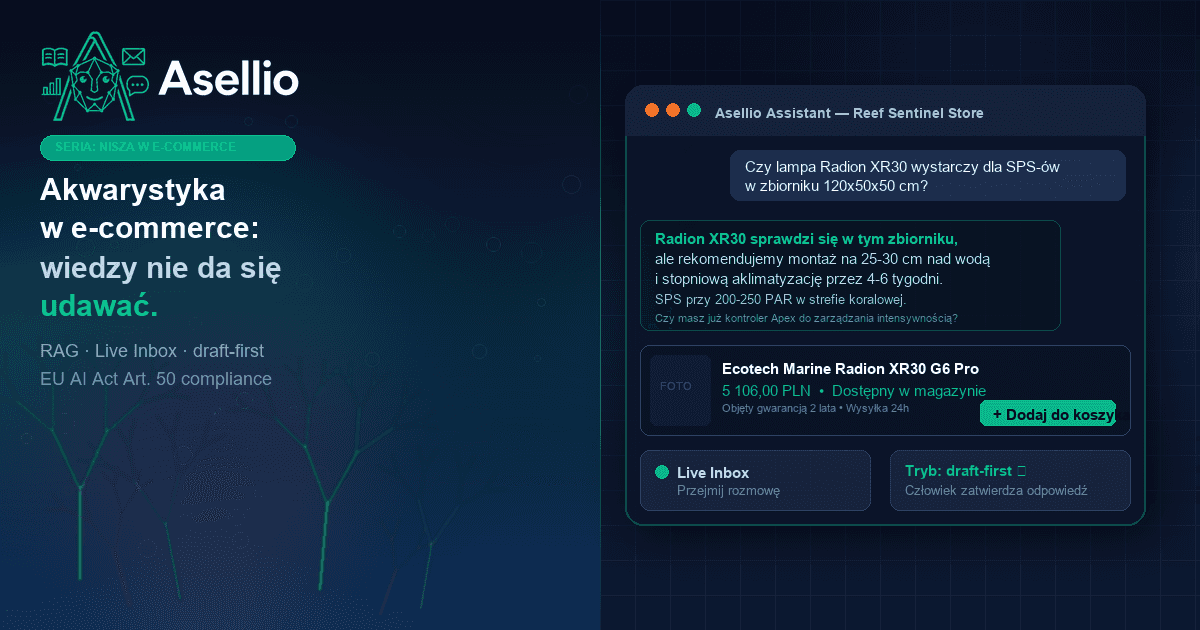
Asellio unifies multi-channel messaging into a Live Inbox while utilizing a draft-first workflow for AI Email Replies. Under draft-first mode, human agents review and approve generated responses before dispatch, allowing controlled auto-sending only for pre-approved, safe scenarios. Web contact forms are prioritized as high-intent signals, connected directly to order contexts from WooCommerce, Shopify, or BaseLinker.
This architecture aligns directly with European regulatory frameworks:
- EU Artificial Intelligence Act (AI Act): Under Article 50 (effective August 2, 2026), deployers of AI systems interacting directly with natural persons must inform users that they are interacting with an AI system [14][15].
- General Data Protection Regulation (GDPR): Personal data processing adheres to principles of lawfulness, fairness, transparency, data minimization, purpose limitation, and storage security [16][17].
Conclusion: Knowledge and Trust Drive Niche E-Commerce
Pet e-commerce will continue its expansion, but long-term profitability will belong to merchants who successfully translate traditional store expertise into digital channels: expert consultation, product accountability, and long-term customer trust.
AI automation delivers genuine ROI only when tailored to the specific constraints of the niche. Merchants must evaluate whether their automated systems are merely auto-responding to tickets or truly scaling the merchant's specialized domain expertise.
— Grzegorz Kamiński, CEO of Reef Sentinel Sp. z o.o., Creator of Asellio
This article was prepared with the assistance of AI tools for market data synthesis and thoroughly reviewed by the author (in compliance with Art. 50 AI Act transparency obligations).
P.S. If you are building agentic workflows, integrating knowledge bases, or engineering e-commerce software, check out Cursor, an excellent AI-powered code editor for daily development.
References
- FEDIAF, „FEDIAF Publishes 2025 Facts and Figures” — https://europeanpetfood.org/_/news/fediaf-publishes-2025-facts-and-figures/
- FEDIAF, „Facts & Figures 2025” PDF — https://europeanpetfood.org/wp-content/uploads/2025/06/FEDIAF-Facts-Figures-2025.pdf
- Brandly360, „Branża zoologiczna w Polsce – aktualna analiza rynku” — https://brandly360.com/pl/blog/branza-zoologiczna-w-polsce-aktualna-analiza-rynku/
- PAP Biznes, „Odsetek internautów kupujących online pozostaje stabilny na poziomie 78 proc.” — https://biznes.pap.pl/wiadomosci/firmy/odsetek-internautow-kupujacych-online-pozostaje-stabilny-na-poziomus-78-proc
- IAB Polska, „Raport Gemius »E-commerce w Polsce 2025« jest już dostępny” — https://www.iab.org.pl/aktualnosci/raport-e-commerce-w-polsce-2025-jest-juz-dostepny/
- e-Izba, „Polacy na e-zakupach w polskim e-commerce i nie tylko” — https://eizba.pl/polacy-na-e-zakupach-w-polskim-e-commerce-i-nie-tylko/
- e-Izba, „Omni-commerce. Kupuję wygodnie 2025” — https://eizba.pl/wp-content/uploads/2025/07/Omni-commerce-Kupuje-wygodnie-2025-skrot.pdf
- Zwierzęcy Marketing, „E-commerce w branży zoologicznej – cyfrowy pupil na zakupach” — https://zwierzecymarketing.pl/e-commerce-w-branzy-zoologicznej/
- Newseria Biznes, „Rynek zoologiczny przenosi się do e-commerce” — https://biznes.newseria.pl/biuro-prasowe/rynek-zoologiczny-przenosi,b1621815783
- Baymard Institute, „50 Cart Abandonment Rate Statistics 2026” — https://www.baymard.com/lists/cart-abandonment-rate
- Zendesk, „Zendesk 2025 CX Trends Report” — https://www.zendesk.com/newsroom/articles/2025-cx-trends-report/
- Salesforce, „State of the AI Connected Customer” — https://www.salesforce.com/resources/research-reports/state-of-the-connected-customer/
- Intercom, „Customer service trends as we know them are dead” — https://www.intercom.com/blog/customer-service-transformation-report-2025/
- European Commission, „Transparency obligations under Article 50 of the AI Act” — https://digital-strategy.ec.europa.eu/en/faqs/transparency-obligations-under-article-50-ai-act
- Artificial Intelligence Act, „Article 50: Transparency Obligations for Providers and Deployers of AI Systems” — https://artificialintelligenceact.eu/article/50/
- GDPR-info.eu, „Art. 5 GDPR – Principles relating to processing of personal data” — https://gdpr-info.eu/art-5-gdpr/
- European Commission, „Data protection explained” — https://commission.europa.eu/law/law-topic/data-protection/data-protection-explained_en
Comments
Comments are powered by Cusdis. The widget only loads after you click.