Why I Built Asellio: An AI Assistant That Understands Your Store, Not Just Language
The origin story of Asellio from an e-commerce practitioner and software developer perspective. Why generic chatbots fail in specialized niches and how RAG transforms sales consultation.
In the previous article of this series, I discussed the unique operational challenges facing pet industry e-commerce—specifically, that a customer looking for specialized diet formulas or specific aquarium filtration does not need generic conversation; they need precise, knowledgeable answers (“Pet Industry E-Commerce Challenges — And Why Automation Alone Isn't Enough”). This post expands directly on that foundation, explaining the origins of Asellio and why I chose to build it differently from standard retail chatbots.
This story did not begin with market research spreadsheets. Before developing SaaS products, I was—and remain—an active practitioner in marine aquaristics and breeding. Running Reef Sentinel, I spent hundreds of hours on industry forums, in retail stores, and chatting with vendors to determine whether a specific calcium reactor would integrate with my tank, whether a lighting setup delivered sufficient PAR output for hard corals, or whether a chemical supplement would destabilize water parameters.
As a full-stack software developer observing these interactions from an engineering perspective, I saw how frequently conventional conversational widgets failed when technical accuracy mattered most.
The Root Problem: Generic Chatbots Lack Niche Domain Intelligence
When testing popular chat widgets (such as Tidio or Intercom), a consistent pattern emerged. The system produced polite, fluent responses that were functionally empty. A bot could easily say, "Thank you for asking, I will check that for you," or pull a general definition from Wikipedia, but it possessed zero knowledge regarding equipment cross-compatibility, species-specific care requirements, or ingredient differences between two fertilizer variants in a merchant's inventory.
This is not a flaw in those platforms—they were designed as general-purpose communication layers to handle standard FAQs and linear routing scripts. However, they lack access to real merchant knowledge bases and actual product specs.
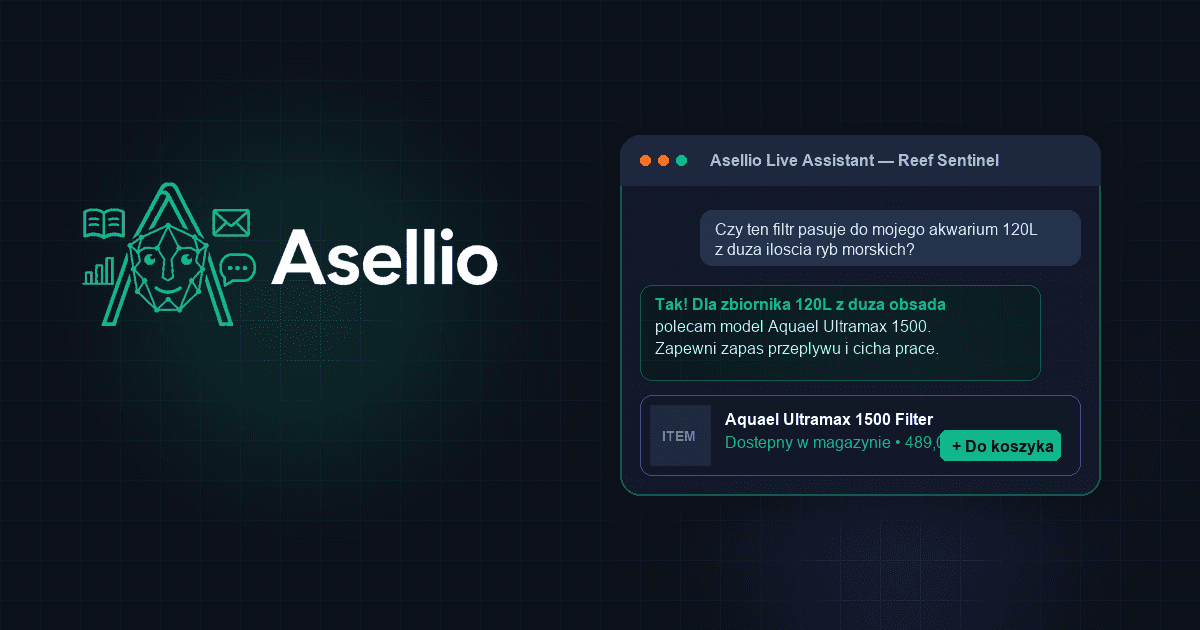
In specialized verticals like aquaristics, pet care, gardening, or specialized DIY, generic capability is insufficient. Customers do not ask "what is an aquarium filter"; they ask "does this specific filter handle a 120-liter tank with heavy fish stocking." A generic bot answers a question no one asked. In doing so, the store loses credibility, and the purchase intent ends in cart abandonment.
The Asellio Approach: An Assistant Trained on Your Store, Not the Whole Internet
The core concept of Asellio was to invert this architecture. Rather than building another general-purpose conversational model, I built a system that first ingests and learns a merchant's specific store data—its website content, documentation, FAQs, guides, and catalog—and uses that foundation to advise shoppers.
Architecturally, this relies on Retrieval-Augmented Generation (RAG). The assistant retrieves relevant, verified facts from the merchant's data and product catalog, then generates responses strictly grounded in those facts rather than guessing based on web training data.
In practice, a customer inquiring about lighting for a planted aquarium receives recommendations drawn exclusively from the merchant's active inventory. The assistant presents options as interactive visual product cards, allowing shoppers to evaluate specifications and add items directly to their cart. This represents the core difference between a bot that chats and an assistant that consults.
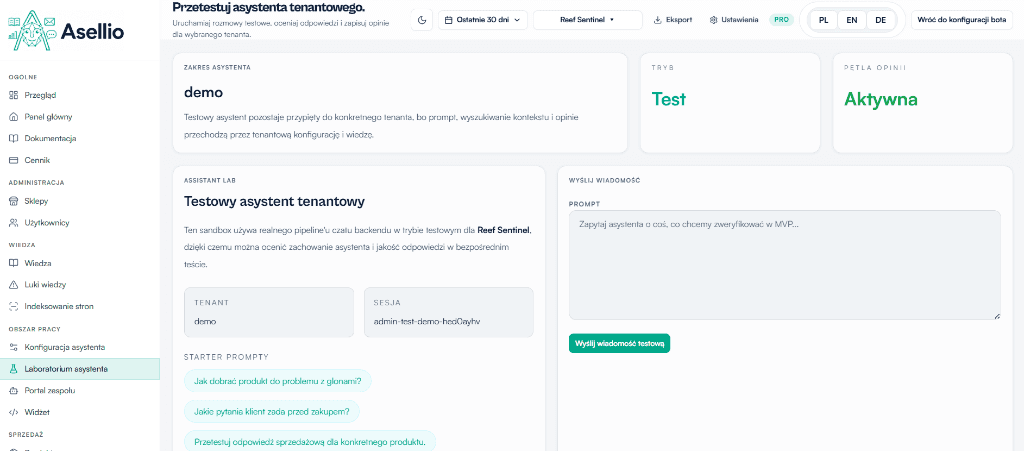
Asellio Assistant Lab dashboard — real-time prompt testing and store knowledge validation for a specific merchant tenant (Reef Sentinel).
Domain Specialization and Safety in High-Stakes Verticals
Another design priority was domain specialization. In pet care, Asellio recognizes distinct species categories—dogs, cats, rodents, reptiles, birds, amphibians—and tailors advisory context accordingly. A dietary query for a reptile requires entirely different knowledge parameters than food selection for a dog. Similarly, in aquaristics or horticulture, guidance varies significantly depending on whether the query involves aquatic flora, freshwater fish, or soil gardening.
This connects to a critical principle: safety in high-stakes scenarios. In verticals dealing with living creatures or plants, certain inquiries should never trigger a product recommendation. If a shopper reports that an animal ingested a toxic substance, the system must recognize the emergency, provide immediate safety guidance, and direct the user to emergency veterinary care—rather than attempting to recommend a product.
I designed Asellio to deliberately forego sales opportunities in favor of safety when critical thresholds are triggered. Responsible automation in sensitive niches requires this approach.
The Human Layer: AI Augments the Team, It Doesn't Replace It
Equally important is the human-in-the-loop design philosophy. Asellio is not intended to replace customer support personnel; it absorbs repetitive, high-volume queries so human staff can focus on complex or sensitive cases.
Any conversation requiring human judgment escalates seamlessly to a unified Live Inbox, allowing team members to take over at any point. Furthermore, for email automation, the system operates in a draft-first mode: generating draft responses for agent review and approval prior to sending.
In niches where inaccurate advice affects animal health or plant safety, human oversight remains essential for quality control.
Regulatory Compliance and Transparency by Design
This engineering philosophy extends directly to regulatory compliance. Asellio was developed to meet GDPR requirements and the disclosure mandates of Article 50 under the EU Artificial Intelligence Act (AI Act) for systems interacting directly with natural persons.
Transparency and data privacy are core structural requirements. E-commerce technology must earn trust before it can effectively drive sales conversions.
Vision: Specialized Capabilities for Specialized Merchants
The market offers numerous general-purpose chat tools that attempt to serve every industry, often failing to address the specific needs of specialized niches. The goal for Asellio is to deliver a platform that understands specialized domains—aquaristics, pet care, gardening, DIY—with the depth of an experienced retail consultant.
Asellio was built to solve the frustrations I experienced firsthand as a specialized retail customer. In upcoming posts, we will share technical walkthroughs and case studies demonstrating how merchants deploy Asellio across various retail sectors.
— Grzegorz Kamiński, CEO of Reef Sentinel Sp. z o.o., Creator of Asellio
This article was prepared with the assistance of AI tools for market data synthesis and thoroughly reviewed by the author (in compliance with Art. 50 AI Act transparency obligations).
P.S. If you are building agentic workflows, integrating knowledge bases, or engineering e-commerce software, check out Cursor, an excellent AI-powered code editor for daily development.
References
- FEDIAF, „FEDIAF Publishes 2025 Facts and Figures” — https://europeanpetfood.org/_/news/fediaf-publishes-2025-facts-and-figures/
- Brandly360, „Branża zoologiczna w Polsce – aktualna analiza rynku” — https://brandly360.com/pl/blog/branza-zoologiczna-w-polsce-aktualna-analiza-rynku/
- European Commission, „Transparency obligations under Article 50 of the AI Act” — https://digital-strategy.ec.europa.eu/en/faqs/transparency-obligations-under-article-50-ai-act
- GDPR-info.eu, „Art. 5 GDPR – Principles relating to processing of personal data” — https://gdpr-info.eu/art-5-gdpr/
Comments
Comments are powered by Cusdis. The widget only loads after you click.