Gardening E-Commerce Challenges and Asellio: Season and Soil Don't Fit a Generic Chatbot
Online gardening is not bags of soil and a pair of shears. Customers ask about hardiness zones, clay soil, and whether a plant will survive a courier. Why garden stores need knowledge you cannot dump into a generic chatbot.
The first piece in this series was about pet retail: expert questions, abandoned carts, and how a smaller store loses to a platform if it cannot advise (“Pet Industry E-Commerce Challenges and Asellio"). The second explained why I built Asellio in the first place (“Why I Built Asellio"). The third was aquaristics, and that one was easy to write — I actually live in that niche (“Aquaristics E-Commerce Challenges and Asellio").
This one is different. I do not garden for a living. I am writing as someone who has spent years watching specialist e-commerce and building a tool to scale a store's knowledge — not as a practitioner of this trade. That is exactly why I needed this article. If Asellio only works in my own niche, it is a hobby project.
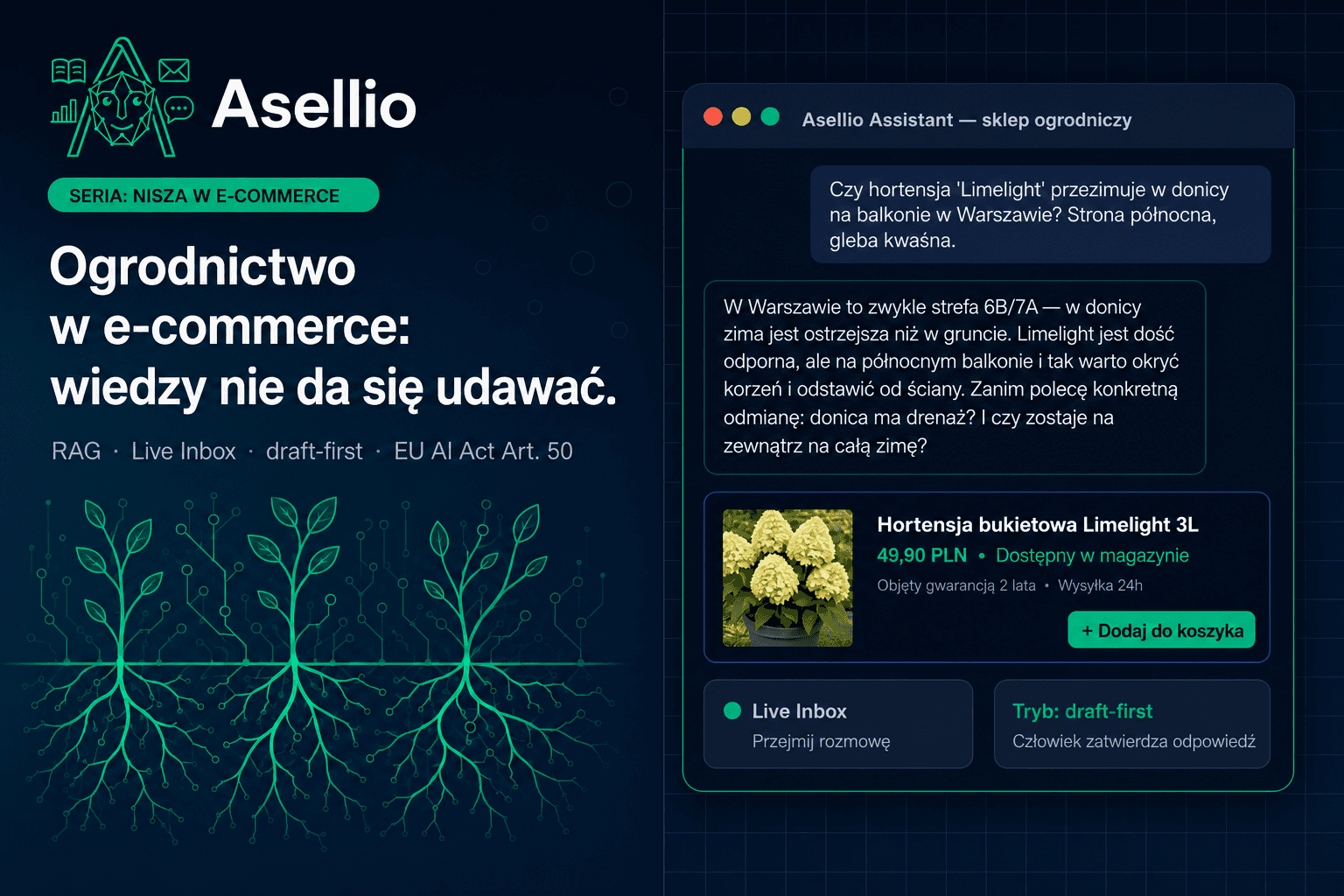
A garden-store customer rarely shows up for “a bag of soil.” They show up with a question: will this hydrangea survive winter on a north-facing balcony, will clay drown the roots, can two products be mixed, and what now that the parcel sat in a depot over a hot weekend.
The market is growing. Not evenly
The global online plant nursery market was worth $4.46 billion in 2025 and is projected to reach $6.49 billion by 2030 [1]. Broader home & garden B2C e-commerce is expected, according to Technavio, to add $49.62 billion between 2024 and 2029 [2]. In Europe, online DIY / Home / Garden jumped from €56 billion in 2023 to €66 billion in 2024, with the online share moving from 15.2% to 17% [3]. In Poland, ECDB puts the Garden e-commerce segment at $769.3 million in 2025 [4].
For a specialist shop that is not just good news. Demand pulls in the big platforms. What is left is the thing a marketplace will not sell on a Sunday night: advice that does not end with “check the label.”
Season is not a campaign. Season is the company
In gardening, the calendar is not a Mailchimp decoration. It is the rhythm of stock, deliveries, people, and the inbox.
The HTA Garden Retail Monitor for 2022–2024 draws a blunt chart: most categories lift sharply between February and March, peak in May, then fall month after month until year-end [5]. Seeds do 20% of annual sales in April. Bedding plants do 27% in May [5].
Support follows the same curve. March, April, May: sowing, balconies, fertiliser, mowers, irrigation. An answer two days late is often no longer a sale. A wrong answer is a return — or a customer who asks the forum next time, not you.
“Will this work?” has a specific meaning here
In pet retail, the question is about food. In aquaristics, about a light and water chemistry. In gardening, it is winter, shade, soil, and plant-protection products.
The RHS hardiness scale H1a–H7 is based on the lowest temperature a plant is likely to survive — and the RHS immediately adds that this is only a guide. Microclimate, containers, exposure, and growing conditions can overturn it [6]. In Poland the classic map is zones 5B, 6A, 6B, 7A and 7B; newer work even adds 8A [7]. A customer in Suwałki and a customer in Wrocław ask the same question. They need different answers.
Plant-protection products make the room even tighter. The label is an official document approved by Poland's Ministry of Agriculture: dose, application, pre-harvest interval, re-entry period, safety rules [8]. Mixing pesticides and adjuvants can produce physical and chemical interactions — which is why a jar test comes before you mix the whole tank [9].
A generic chatbot sounds confident in these conversations. It does not know your zone, the label on that specific product, or the fact that the shop does not advise on chemicals at all. Confidence without knowledge is worse here than silence.
A plant in a box is not a kettle in a box
Buying plants online is convenient until the parcel spends a weekend in a depot. Shopify is blunt: two to three days is the usual window; four days or more raises the risk of drying out. Water too heavily before shipping and you get mould or rotting roots in transit [10].
Then the emails start. Dropped leaves. Spilled soil. “It looked different in the photo.” “How do I save this now.” Costa Farms put it simply: when someone's plant dies, it is harder to come back and buy another, because that hurt lingers [11].
A shop that can say “we will not ship this cultivar right now, it is too hot” is selling trust. Not just stock.
Knowledge walks over to the forum. Price walks over to the marketplace
If the shop does not answer, the customer will still find someone who does. In Poland that means Forum ZielonyOgrodek.pl and Ogrodowisko: species, feeding, pruning, aftercare [12][13]. This is not side traffic. It is the decision moment the store just gave away.
From the other side: Castorama, Leroy Merlin, OBI. Semcore's report on Polish garden retail looked at Castorama.pl, Leroymerlin.pl, Ogrodosfera.pl, Sadowniczy.pl and Swiatkwiatow.pl, among others [14]. Castorama launched a marketplace in January 2025, Leroy Merlin on 7 April 2025, OBI planned a similar move for May 2026 [15].
A small shop will not win by pretending to be a smaller Castorama. It wins if it is the place that knows which cultivar makes sense, when not to ship it, and when to say: “don't mix those.”
How Asellio can support a garden store
I am not building “a bot for gardens.” I am building an assistant on a specific shop's knowledge. RAG — Retrieval-Augmented Generation — means answers come from product copy, guides, shipping tables, terms, FAQs, manufacturer instructions, and ticket history. In gardening that is concrete: do not guess the hardiness zone. Ask about location, exposure, soil, area, and what the customer wants to mix.
In peak season Asellio can take availability, dispatch dates, cultivar differences, and after-delivery care off the team's plate. For plant-protection products, disease questions, and live-goods claims, it stays draft-first with Live Inbox. AI prepares the reply. A human approves, edits, or takes over.
This is not a sticker for the regulation. Article 50 of the AI Act covers chatbots and AI agents, and the transparency duties apply from 2 August 2026 [16]. The customer should know they are talking to AI. The shop should know when AI has to step back.
Closing thoughts
Garden e-commerce will keep growing. The biggest players will not win it alone. The shops that win will be the ones that move online the reason people still walk into a good garden centre: precise, responsible advice.
I do not run a garden day to day. I know the problem from other niches: the knowledge sits in a few people's heads, and you cannot scale it by hand when the inbox splits open in May.
If you run a garden store and feel that your edge only works when you personally answer the messages — that is exactly the problem I am trying to solve. I would be glad to talk.
— Grzegorz Kamiński, CEO of Reef Sentinel Sp. z o.o., Creator of Asellio
This article was prepared with the assistance of AI tools for market data synthesis and thoroughly reviewed by the author (in compliance with Art. 50 AI Act transparency obligations).
P.S. If you build agentic workflows or e-commerce integrations, having the right development environment matters. Check out Cursor — an excellent AI-powered code editor for daily development work.
References
- The Business Research Company — Online Plant Nursery Market Size, Share, Growth Report 2026-2030: https://www.thebusinessresearchcompany.com/report/online-plant-nursery-global-market-report
- Technavio — Home And Garden Products B2C E-Commerce Market Growth Analysis: https://www.technavio.com/report/home-and-garden-products-b2c-e-commerce-market-industry-analysis
- Cross-Border Commerce Europe — Top 50 DIY, Home & Garden Retail Europe 2025: https://www.cbcommerce.eu/blog/2025/03/15/top-50-diy-home-garden-retail-europe-2025-the-50-leading-online-retailers-in-the-diy-home-garden-sector/
- ECDB — Garden eCommerce Market in Poland: https://ecommercedb.com/markets/pl/garden
- HTA — Seasonality of different category sales in Garden Centres, October 2025: https://hta.org.uk/media/trkn3lpk/state-of-the-market-report-seasonality-of-different-category-sales-in-garden-centres-october-2025.pdf
- RHS — RHS hardiness rating: https://www.rhs.org.uk/advice/rhs-hardiness-rating
- Poradnik Ogrodniczy — Plant hardiness zones: https://poradnikogrodniczy.pl/strefy-mrozoodpornosci-roslin.php
- PSOR — Plant protection product label: https://psor.pl/etykieta-srodka-ochrony-roslin-instrukcja-dotyczaca-skutecznosci-i-bezpieczenstwa-produktu/
- Nebraska Extension — Testing Pesticide Mixtures for Compatibility: https://extensionpubs.unl.edu/publication/g2350/2023/html/view
- Shopify — How To Ship Plants: Tips for Mailing Live Plants (2025): https://www.shopify.com/blog/how-to-ship-plants
- Garden Center Magazine — The rise of AI chatbots: https://www.gardencentermag.com/article/artificial-intelligence-ai-chatbots-bloomin-costa-farms-southwood-garden-center/
- Forum ZielonyOgrodek.pl: https://forum.zielonyogrodek.pl/
- Ogrodowisko — Gardening forum: https://www.ogrodowisko.pl/forum
- Semcore — SXO and e-commerce report for the Polish gardening industry: https://semcore.pl/semcore-lab/raport-sxo-e-commerce-dla-branzy-ogrodniczej/
- Tabletowo — OBI opens a marketplace following Leroy Merlin and Castorama: https://www.tabletowo.pl/obi-otworzy-marketplace-jak-leroy-merlin-i-castorama/
- European Commission — Transparency obligations under Article 50 of the AI Act: https://digital-strategy.ec.europa.eu/en/faqs/transparency-obligations-under-article-50-ai-act
Comments
Comments are powered by Cusdis. The widget only loads after you click.