Data-Driven Customer Service: Building AI Models from Chats and Tickets
How to leverage NLP, ML, and predictive analytics to train AI agents that autonomously resolve customer queries 24/7 with full personalization.
Introduction: From Reactive Support to Intelligent Predictive Systems
Data from chats, purchase histories, and support tickets today is not just logs for archiving – it is the foundation for AI models that achieve real autonomy in customer service. This represents a transition from scripted chatbots reacting to keywords to contextually aware agents utilizing NLP and ML to comprehend intent, emotions, and the history of each interaction.
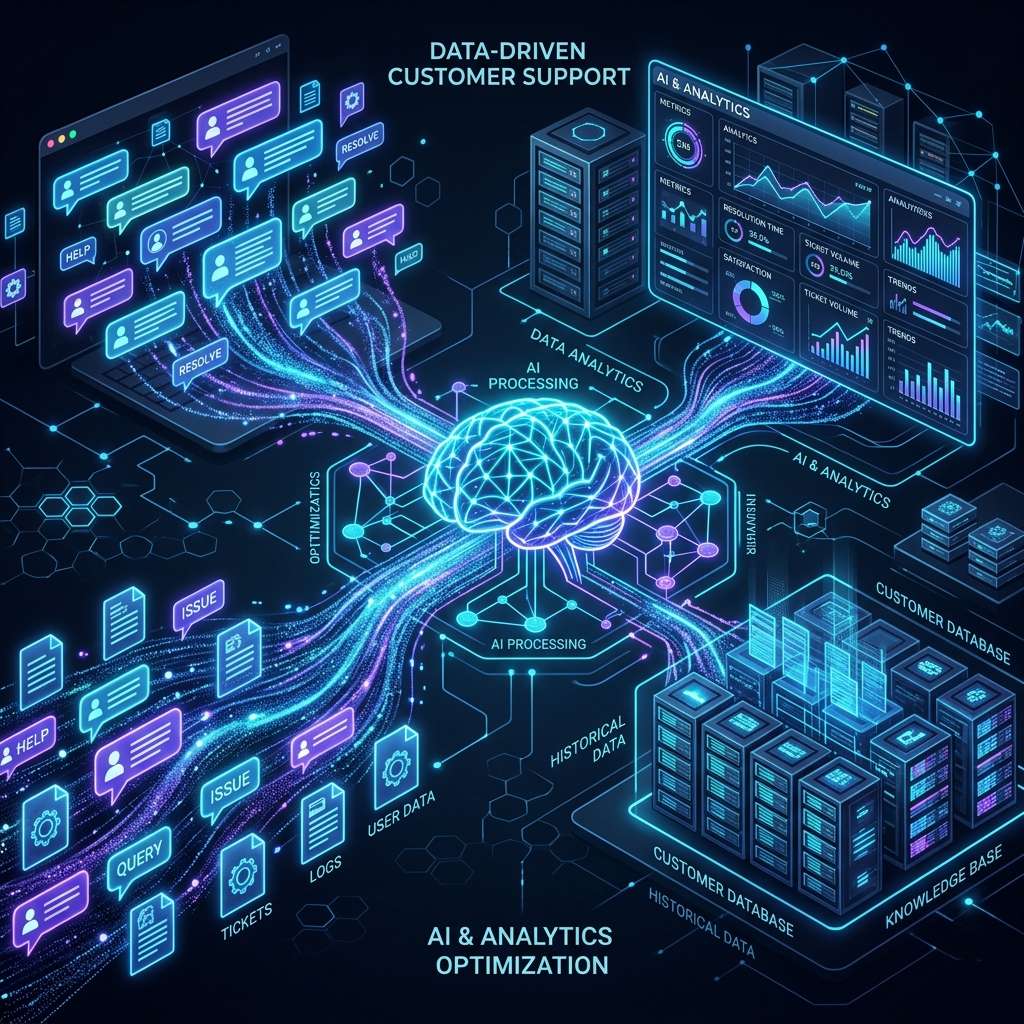
The architecture of such a system is based on a hybrid approach: generative AI (GPT-like models) combined with Retrieval-Augmented Generation (RAG), where the model does not generate responses from thin air but reaches into a verified knowledge base built from actual company data. This significantly reduces hallucinations and helps keep answers consistent with company policy – although it doesn't eliminate them completely.
The Technical Pipeline:
First, ingestion and preprocessing normalize chat logs (cleaning and handling missing values) and segment them into query-response and problem-solution chunks. Purchase histories are converted into feature vectors for behavior prediction. Next, embedding generation converts text into dense vectors using Word2Vec, GloVe, or transformer models like BERT to capture semantics. These embeddings are stored in vector databases (such as Pinecone or Milvus) optimized for similarity search to retrieve context for the AI agent in real-time.
Models are trained on multiple tracks: NLP on logs for intent detection, and ML on customer history to predict churn or upsell opportunities. Sentiment analysis works in real-time, adapting response tone to customer emotions. Predictive analytics goes a step further, detecting patterns and solving problems before the customer reaches out.
Guardrails and governance are mandatory baseline requirements. Systems operate within trusted boundaries of compliance, brand voice, and security. Without these controls, systems risk generating hallucinations or causing data leaks.
Success Metrics:
CSAT (Customer Satisfaction) increases through personalization since the AI has access to full customer history and purchase context. AHT (Average Handle Time) decreases because the system automatically categorizes and routes complex tickets to the appropriate human agent while resolving simple ones autonomously. The deflection rate is a key KPI indicating the percentage of queries handled without escalation, reflecting operational cost reduction.
Companies report measurable performance gains: faster resolution times, lower operational costs, and higher retention rates through tailored experiences. AI scales without increasing headcount, handling high-volume, repetitive requests, while human agents focus on edge cases requiring empathy and creativity.
Real-world Use Cases:
- Ticket triage: AI classifies and assigns tickets in seconds, reducing wait time.
- Agent assistance: real-time suggestions for human agents who remain in the loop but resolve cases significantly faster.
- Purchase-based personalization: recommending refills or relevant accessories based on historical purchase data.
A core rule is that data quality is the foundation. Unified Customer Data Platforms (CDP) are implemented to unify, clean, and enrich data before feeding it to models. Attempting to train models on unstructured or siloed logs yields unstable results.
Technical Architecture: From Ingestion to Inference in RAG Pipelines
Data Ingestion: From Raw Logs to Structured Chunks
The foundation of every RAG pipeline is the normalization of input data. Chat logs require text cleaning, handling missing values, and segmentation into query-response pairs – training units that preserve conversation context. Purchase data must be transformed into feature vectors describing customer behaviors: purchase frequency, average basket value, and product categories.
In practice, this requires an ETL pipeline that:
- Parses different log formats (JSON from APIs, plain text from legacy systems)
- Removes PII in compliance with GDPR before training
- Creates timestamped chunks with metadata (sentiment score, intent label, customer segment)
The choice of chunk size is a key trade-off. Chunks that are too small (single sentences) lose context, while chunks that are too large (entire conversations) dilute semantic search precision. The sweet spot is 2-4 exchange pairs with 20-30% overlap between chunks.
Embedding Generation: From Word2Vec to Transformers
Word2Vec and GloVe represent legacy approaches; production RAG systems are dominated by transformer-based embeddings (BERT, RoBERTa, sentence-transformers). They capture semantic context rather than simple co-occurrence statistics.
For example, a query like "I want to return a product" is semantically distinct from "product returned to warehouse". While simple vector methods see similarity through the shared word "product", transformers distinguish the intent (customer complaint vs logistics update), enabling high-precision classification.
Model choice represents a trade-off:
- Multilingual-E5 or mT5 for multi-language support
- Sentence-BERT for speed[5]
- Domain-specific fine-tuning on proprietary chats (usually a noticeable accuracy gain – measure it on your own data)
Standard BERT-base embeddings use 768 dimensions. They can be reduced to fewer dimensions (e.g. with PCA, or by using models trained to support shorter embeddings) and stored in quantized form, which cuts database storage – but check the impact on retrieval quality on your own data.
Vector Databases: Pinecone, Milvus, and Similarity Search Optimization
Real-time retrieval requires infrastructure designed for similarity search. Pinecone and Milvus are managed solutions with built-in HNSW (Hierarchical Navigable Small World) indexing – an algorithm that reduces search complexity from O(n) to O(log n).
In practice:
- Pinecone: serverless, pay-per-query, suitable for rapid prototyping and scaling without DevOps overhead.
- Milvus: self-hosted, offering more control and lower operational costs at scale (>10M vectors).
- Qdrant / Weaviate: alternatives supporting native hybrid search (vector + keyword).
Database tuning involves:
- Selecting index types (HNSW vs IVF_FLAT) to balance latency and recall.
- Utilizing scalar or product quantization (PQ, SQ) to reduce memory footprints by up to 75%.
- Designing sharding strategies for horizontal scaling.
- Implementing a cache layer (Redis) for frequent top-K queries.
With HNSW indexing, similarity search scales roughly logarithmically instead of linearly with the number of vectors[4], so a well-tuned vector database can keep retrieval fast even at tens of millions of vectors. Measure latency and recall@10 on your own data before choosing settings.
Model Training: Intent Detection and Predictive Analytics
Intent detection on chat logs is a multi-class classification task (e.g., refund_request, product_inquiry, technical_support, billing_issue). A BERT classifier is trained on historical data with human-labeled intents, Accuracy depends heavily on label quality, the number of intents, and how well they're separated, so measure it on a held-out set of real tickets.
Predictive models work on structured data:
- Churn prediction: gradient boosting algorithms (XGBoost, LightGBM) trained on ticket features (number of escalations, resolution time, sentiment trend).
- Upsell scoring: collaborative filtering and propensity models trained on purchase history.
- Next-best-action: reinforcement learning for sequential decisions in conversation.
The core metric is the precision-recall balance. A false positive in upsell scoring results in spam, while a false negative in churn prediction results in a lost customer. Typically, models are optimized for the F2 score to prioritize recall.
Sentiment Analysis and Guardrails: Real-Time Compliance
Lightweight real-time sentiment analysis models (such as DistilBERT fine-tuned on customer service data) are fast enough for live conversations, enabling the agent to adapt response tone to customer emotions or trigger immediate escalation to human agents.
Production guardrails are mandatory:
- Content filtering: blocking toxic or inappropriate responses.
- Factual grounding: ensuring every response has a source in the verified knowledge base (RAG citations).
- Compliance checks: automated PII masking and GDPR consent verification.
- Hallucination detection: confidence thresholding paired with human-in-the-loop validation for uncertain cases.
Implementation follows a layered approach:
- Pre-generation guardrails (input validation, intent routing)
- Generation constraints (temperature tuning, prompt engineering)
- Post-generation filters (toxicity scoring, fact-checking)
These safety systems form a governance framework with audit logs, A/B testing on safety metrics, and continuous monitoring, reducing incorrect escalations in production.
Preprocessing and Feature Engineering: Preparing Data from Three Sources
Before training models, data must be cleaned and structured. Preprocessing quality determines final model accuracy.
Cleaning Chat Logs
Historical conversations contain valuable context but are often unstructured. Text normalization removes emojis, corrects typos, and standardizes abbreviations. Tokenization and lemmatization reduce words to their base forms, preparing the text for embedding generation.
Logs are segmented into query-response pairs to form training units. Each chunk must preserve context without introducing noise.
Structuring Purchase Data
Purchase history is the source of behavior prediction. Feature vectors are created based on RFM (Recency, Frequency, Monetary) metrics, supplemented by product affinity matrices to identify recurring purchase sequences.
Normalizing and enriching data with temporal features (seasonality, trends) enables predicting churn and personalizing recommendations in real-time.
Analyzing Support Tickets
Support tickets require extraction of three layers: problem category, priority, and resolution patterns.
This data trains models for ticket triage – automatic routing based on content and predicted complexity. Sentiment extraction from descriptions helps prioritize, ensuring frustrated customers are escalated quickly.
Customer Data Platform: Unification Before Training
A CDP is required to unify chat, purchase, and ticket logs into a single customer profile with consistent IDs, synchronized timestamps, and a unified schema.
Enrichment attaches demographic data, behavioral signals, and historical context. Data quality metrics are required before training: accuracy, completeness, and consistency.
The lower the completeness and consistency of your data, the more unstable the predictions and the higher the risk of wrong answers. A unified customer data platform (CDP) or a well-integrated service desk is a common foundation for this work[1]. Without solid preprocessing, the best model in the world will yield poor results.
Production Implementations: Case Studies and Measurable Results
Ticket Triage: From Chaos to Precision
Automatic ticket categorization is the first point where AI starts delivering ROI. The system analyzes ticket content, assigns categories, and routes cases to the right team without human intervention, reducing AHT and eliminating support bottlenecks.
The NLP model processes incoming tickets, extracts intent and sentiment, matches them with historical patterns, and decides whether the query is a simple FAQ (handled autonomously) or requires escalation to L2 support. This approach increases first-contact resolution rates and allows scaling support without proportional headcount growth.
Agent Assistance: AI as Copilot
Real-time suggestions for agents are a game-changer in complex interactions. While the agent talks with the customer, the AI analyzes context, searches the knowledge base, and suggests answers, help articles, or troubleshooting procedures in the background.
Human agents retain final oversight but save time on information retrieval, reducing cognitive load and accelerating resolution. In one Agent Assist case study cited by Master of Code, response time was 65% faster and tickets were closed twice as fast[2].
Purchase-Based Personalization: Context Is Everything
Access to real-time purchase data changes interaction quality. The AI agent sees the entire customer journey, enabling contextual recommendations and proactive problem solving.
For example, if a customer contacts support regarding product issues, the system immediately retrieves their purchase history, previous support cases, and customer tier to suggest appropriate remedies (e.g., replacements or vouchers) without manual CRM lookups.
Operational Metrics: Numbers Don't Lie
Organizations implementing data-driven AI in customer service report concrete improvements. Examples collected by Master of Code include a 27% reduction in average handle time after deploying an agent-assist tool and 30% lower operating costs in another case study; the same compilation cites a Gartner forecast that conversational AI will reduce contact center labor costs by $80 billion in 2026[2].
How much volume AI can deflect depends on how standard your queries are – for simple, repetitive questions the share can be high, which lets teams scale support efficiently.
Proactive Support: Getting Ahead of Problems
AI analyzes patterns in tickets, identifies emerging issues, and triggers proactive communication (e.g., notifying users of known application bugs and workarounds) before tickets escalate, reducing overall support volumes.
Research Trends and Expert Consensus: Human-AI Collaboration
Data quality is the foundation; model performance depends directly on the dataset. Implementing a unified Customer Data Platform (CDP) to clean and enrich data is a prerequisite.
AI implementation requires continuous experimentation. Different NLP algorithms are tested on specific use cases to compare transformer architectures against general API models for domain-specific vocabulary. Collecting agent and customer feedback helps refine models iteratively.
AI serves as a collaborator rather than a replacement. Automating routine requests (e.g., password resets or shipping updates) allows human agents to focus on complex, high-empathy edge cases, improving CSAT and reducing Average Handle Time.
Transitioning from rigid decision trees to dynamic NLP allows real-time sentiment analysis and context retrieval. For queries regarding order status, the model retrieves shipping metadata and responds with specific details rather than generic templates.
Security frameworks require models to operate within strict guardrails: preventing data leaks, maintaining brand voice, and escalating edge cases. In practice, setting confidence thresholds (e.g., forwarding queries to human agents if confidence falls below 85%) prevents incorrect automation.
Implementation Challenges and Proven Solutions
Deploying AI in customer service requires robust risk and infrastructure management. Experience shows that a significant portion of AI projects in support fail due to operational complexity rather than model limitations.
Security and governance are ground zero. Support tickets contain PII, credit card details, and confidential data, requiring multi-layered encryption at rest and in transit. Role-based access control (RBAC) must be enforced across models, feature stores, and APIs. Under GDPR and CCPA, automated data retention policies should move raw logs to cold storage or delete them after 90 days.
Hallucinations are the biggest risk. To prevent incorrect policy descriptions, models should be fine-tuned on corporate knowledge bases and bound by rule-based validation layers. Generative outputs must be validated against verified sources, with human-in-the-loop validation required for high-stakes actions, such as transactions exceeding >$500.
Integration with legacy systems is always challenging. Connecting legacy CRMs or ticketing systems without modern APIs requires middleware to translate protocols and normalize schemas. An event-driven architecture using message queues (e.g., Kafka or RabbitMQ) acts as a buffer, preventing timeouts by decoupling legacy systems from real-time AI processing.
Model drift degrades accuracy as customer queries and product features evolve. Continuous monitoring of confidence scores and fallback rates is required. Retraining pipelines should be automated and tested via A/B deployment on limited traffic before full rollout.
ROI metrics must be defined before development, targeting deflection rates, AHT reduction, and cost per interaction. Conducting a knowledge base audit is critical, as outdated documents cause hallucinations. A dedicated content team should update references in sprints.
Practical Checklist: From Proof-of-Concept to Production
Step 1: Data Audit - Foundations, Not Decorations
Prior to model selection, a thorough data audit is required, as historical records are often siloed across disparate legacy systems.
Audit checklist:
- Completeness: evaluate missing fields in tickets over the last 12 months.
- Quality: identify unresolved chats or uncategorized tickets.
- Accessibility: ensure data can be extracted efficiently for training.
Step 2: Tech Stack - Choose Tools, Not Religion
Technology selection should align with team expertise. A practical setup for mid-sized operations combines managed vector databases (Weaviate or Pinecone) with standard embeddings (OpenAI) and API-based LLMs, monitored via dedicated tools (Langsmith or Helicone) to track latency and token consumption from day one.
Step 3: Pilot with Laser Focus
Pilots should focus on a single, measurable use case, such as ticket triage. A typical setup trains a classifier on 10k historical tickets to categorize and prioritize requests. The baseline performance is compared against manual routing times, with the initial phase focused on assisting human agents rather than full automation.
Step 4: Iterative Refinement - Where Magic Happens
Early pilot phases reveal edge cases. A structured refinement cycle collects incorrect predictions, adjusts few-shot prompts, and A/B tests updates on minor traffic. Performance improvements are driven by prompt engineering and retrieval optimization rather than base model retraining.
Step 5: Production Deployment - Where Proof-of-Concepts Die
Production rollout requires operational infrastructure:
- CI/CD for models: testing prompt changes against validation sets.
- Monitoring & alerting: tracking latency (p95 <2s), error rates (<1%), and token costs.
- Human escalation: routing cases to agents if model confidence falls below a set threshold (e.g., <0.7).
- Compliance filters: scanning responses for PII leaks and brand voice alignment.
Success Metrics - Measure What Counts
Example targets – calibrate them to your own baseline and ticket mix:
Tier 1 - Business impact:
- Cost per ticket: targeting 40-60% reduction.
- Deflection rate: set a realistic year-one target based on how many of your tickets are truly repetitive.
Tier 2 - Quality:
- CSAT: maintaining scores equal to or higher than human baselines.
- First-contact resolution: targeting >70% for AI.
Tier 3 - Operational:
- AHT (Average Handle Time): aiming for a 10-15% reduction.
This article was prepared with the assistance of AI tools for market data synthesis and thoroughly reviewed by the author (in compliance with Art. 50 AI Act transparency obligations).
P.S. If you're building agentic workflows or managing e-commerce API layers, using a modern editor can significantly speed up your development. You can check out Cursor, which is an excellent AI-powered code editor for these tasks.
Bibliography
- 13 AI Customer Service Best Practices for 2026 – Kustomer
- AI in Customer Service Statistics [2026] – Master of Code
- CX Trends 2026 – Zendesk
- Efficient and robust approximate nearest neighbor search using Hierarchical Navigable Small World graphs – Malkov & Yashunin (arXiv)
- Sentence-BERT: Sentence Embeddings using Siamese BERT-Networks – Reimers & Gurevych (arXiv)
Comments
Comments are powered by Cusdis. The widget only loads after you click.